
Editors’ Highlights are summaries of recent papers by AGU’s journal editors.
Source: Journal of Geophysical Research: Solid Earth
Saltwater intrusion poses a growing threat to freshwater supplies in coastal regions, yet detecting its early movement remains difficult. In a new field study from a United Kingdom beach sand aquifer, Rowan et al. [2026] demonstrate that ocean tides leave a measurable electrical signature in the subsurface—one that may help track saline intrusion before it reaches water supply wells.
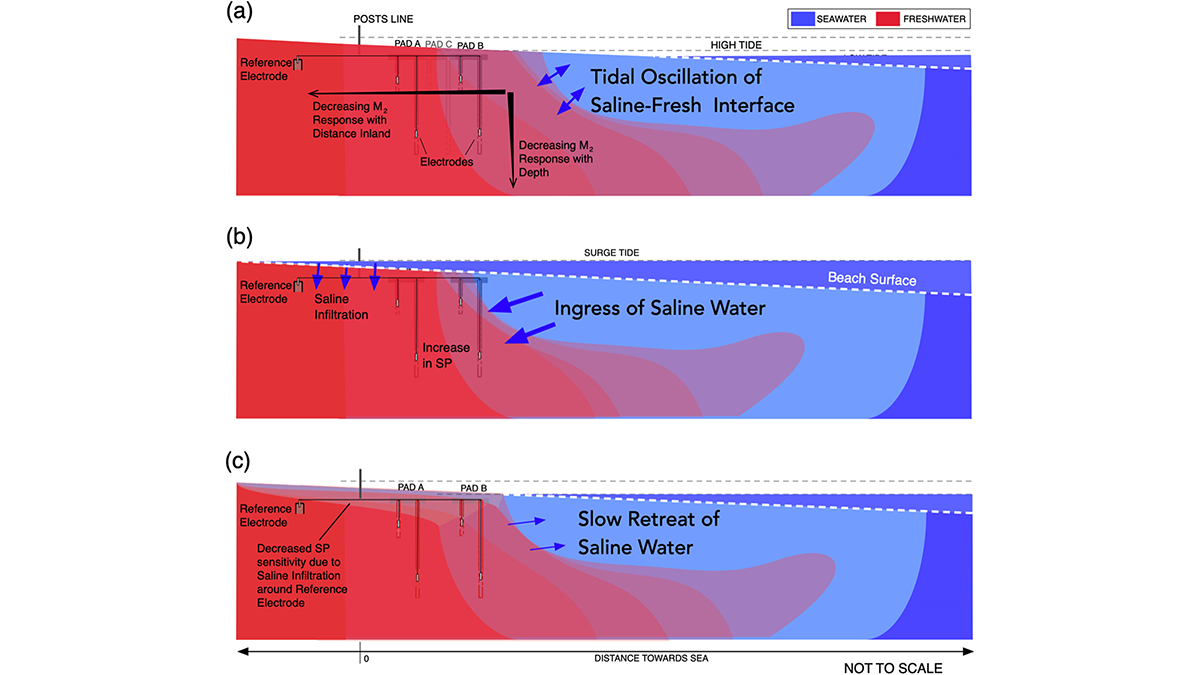
Over three months, the team monitored self-potential (SP), groundwater levels, temperature, and electrical conductivity in 12 boreholes at varying depths and distances from the shoreline. Spectral analysis revealed a clear semi-diurnal lunar tidal (M₂) signal in SP data, with amplitudes of about 1 millivolt. The tidal signal systematically decreased with depth and distance inland, and its magnitude could be predicted from electrode position (R² = 0.96). Notably, while tidal components were present in groundwater levels, they were absent in temperature and fluid conductivity, suggesting that the SP signal was generated remotely by movement of the saline interface.
Storm surges also produced larger SP shifts, reinforcing the sensitivity of the method. The results support self-potential monitoring as a low-impact, cost-effective tool for remotely tracking saline plume dynamics in vulnerable coastal aquifers.
Citation: Rowan, T. S. L., Butler, A. P., McDonnell, M. C., Águila, J. F., Flynn, R., Hamill, G. A., et al. (2026). Observations of tidal induced responses in self-potential data in a UK beach sand aquifer: Implications for monitoring seawater intrusion. Journal of Geophysical Research: Solid Earth, 131, e2025JB033414. https://doi.org/10.1029/2025JB033414
—Maxim Lebedev, Associate Editor, Douglas R. Schmitt, Editor JGR: Solid Earth