
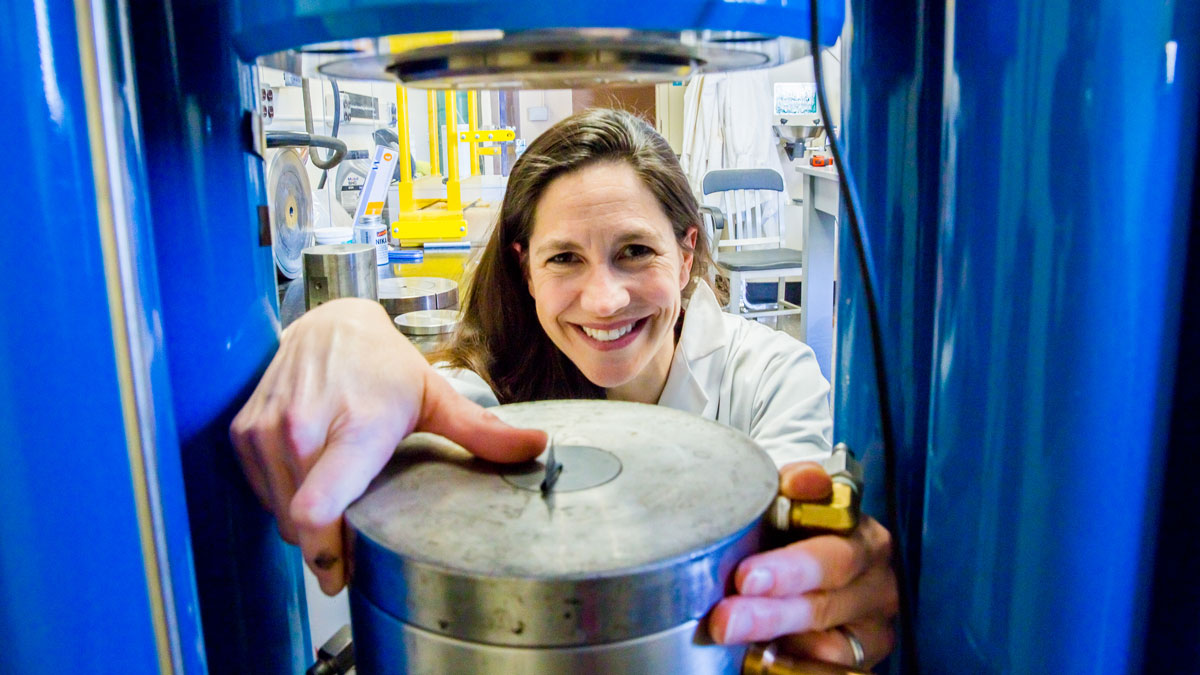

Elizabeth Cottrell grew up collecting rocks and flowers. Her curiosity and love for nature led to her role today as research geologist, chair of the Department of Mineral Sciences, and curator of the National Rock Collection at the Smithsonian Institution’s National Museum of Natural History. One of the world’s largest collections of its kind, it features hundreds of thousands of specimens available for use and study by scientists.
“I think people don’t realize the national collections are so strategic for the United States. You could study what’s in the national collection for the rest of your career and never run out of research questions or interesting things to study,” Cottrell said.
Before becoming the steward of one of the world’s largest collections of rocks and ores, as well as one of the Smithsonian’s public faces of geologic news and information, Cottrell majored in chemistry at Brown University. Because Brown has an open curriculum system in which students design their own degree plan instead of taking required core classes, Cottrell explored a variety of scientific avenues. A class called “Mars, Moon, and the Earth” piqued her interest in geology.
“I talked to the undergraduate adviser in the geology department and said, ‘Hey, I’m a chemistry major. Is there research that someone who knows chemistry can do in geology?’”
“Seek out mentors. Seek out people who can help you navigate all the different systems to reach your goals. People want to help, I think. People want to be mentors.”
Cottrell was paired with her Earth sciences mentor, Mac Rutherford. His mentorship helped her on a trajectory to graduate school at Columbia University and to becoming a Fulbright Scholar at L’Institut de Physique du Globe de Paris.
According to Cottrell, nothing is more important for a student than finding mentors. “Seek out people who can help you navigate all the different systems to reach your goals,” she said. “People want to help, I think. People want to be mentors.”
After a year of living and working in Paris, Cottrell was fluent in French, and she maintains the international and geological ties forged during her Fulbright even 20 years later.
What is one book, movie, or piece of media about your field you would recommend to young scientists?
Cottrell recommends the Hugo Award–winning science fiction novel The Fifth Season by N. K. Jemisin. In Jemisin’s world, the inhabitants are viscerally linked to geological processes.
“For so many geologists, I think the Fulbright is a very powerful program,” Cottrell said. “Fulbrights are a thing of place, and geology is a thing of place. There’s a big overlap, because you’re studying the rock language of that place.”
Today, Cottrell is still spending her time outside of work immersed in the natural world, exploring different landscapes with her family. “I’m really interested in ecology and forests, so I just like to spend time outside,” she said. “If I keep camping and backpacking, if I can be completely cut off, all the better.”
—Rebecca Owen (@beccapox.bsky.social), Science Writer
This profile is part of a special series in our August 2026 issue on science careers.