

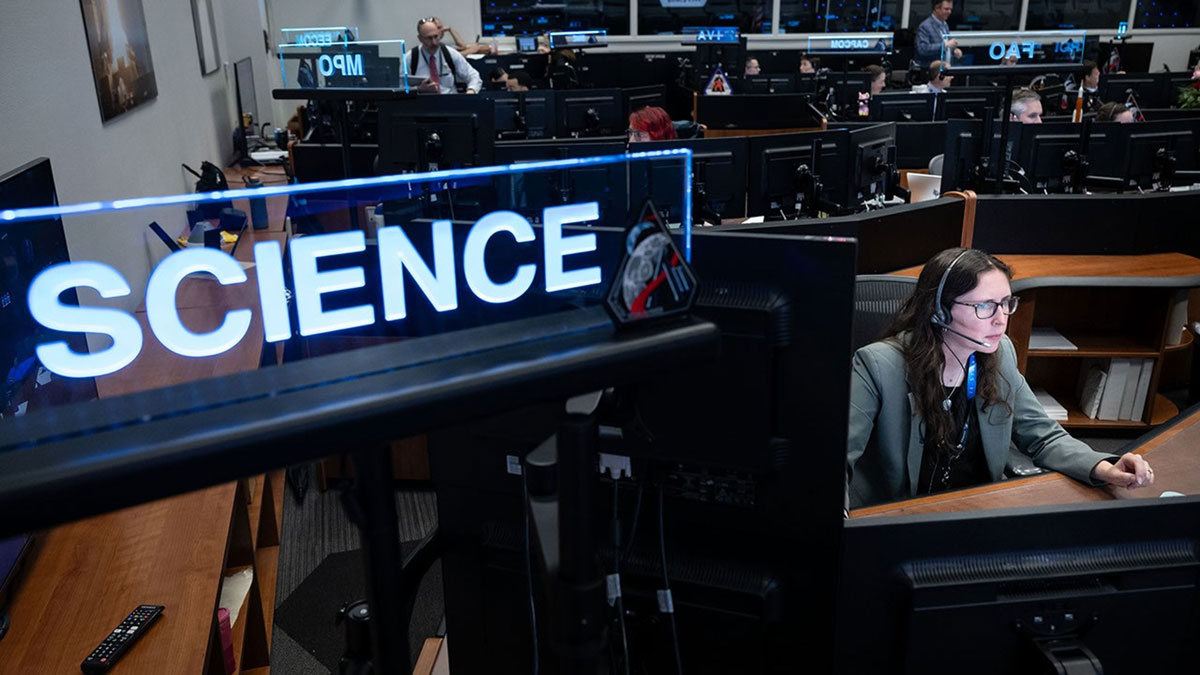

In April, a crew of four astronauts flew around the Moon and back, describing what they saw to avid earthbound listeners in terms both poetic and scientific. A dedicated voice sitting at the newly minted Science desk in NASA Johnson Space Center’s Mission Control Center acknowledged the astronauts’ reports and shared in their Moon joy.
The voice, that of Kelsey Young, soon became familiar to the millions of people who tuned in to watch the 10-day Artemis II live stream. Her replies of “copy, Moon joy” and “Amaze, amaze, amaze” quickly went viral.
“I wake up every day and I’m like, ‘Heck yes, I get to go to work today,’” said Young, a planetary geologist and science flight operations lead for the Artemis campaign. “I love what I do.” She is one of the few people outside of Capsule Communications (CAPCOM) to speak with astronauts during a mission and has helped train those astronauts in lunar geology at lunar analogue field sites in Canada and Iceland.
“They’re not the crew executing the science team’s objective,” Young said. “They’re part of the science team. They are field scientists actually doing, in this case, orbital observations.”
Young’s love of science, and of fieldwork in particular, started in high school with a project tracking salamanders in local parks. She studied geology at the University of Notre Dame in South Bend, Ind., and earned a doctorate in geology at Arizona State University in Tempe.
She said grad school wasn’t all smooth sailing for her. She pushed through a research project she didn’t enjoy and struggled with STEM (science, technology, engineering, and mathematics) classes until she found the science niche she loved out in the field. She encouraged others who may be struggling to stay the course.
“If you have that goal in mind that feels that right, it helps you through the things that you are struggling with,” Young said.
What is one book, movie, or piece of media about your field you would recommend to young scientists?
Young loves some of the new hits about human spaceflight like Project Hail Mary and The Martian. She doesn’t mind scientific inaccuracies, and her advice to young scientists is to learn to suspend your disbelief so you can fully enjoy science-adjacent stories.
Her fieldwork-based graduate project exploring the thermochronology of impact craters gave her the experience needed to later train astronauts in lunar science, while another project brought her to Johnson Space Center and introduced her to the joy of flight operations. Later, that joy brought her back to NASA, where she helped develop the brand-new Science console at mission control and became the first to operate it.
“Integrating field science—geology, lunar science—into this new generation of human spaceflight operations is something that I will carry with me for the rest of my life and career,” Young said.
—Kimberly M. S. Cartier (@astrokimcartier.bsky.social), Staff Writer
This profile is part of a special series in our August 2026 issue on science careers.