Research & Developments is a blog for brief updates that provide context for the flurry of news regarding law and policy changes that impact science and scientists today.
A recent investigative report found that spending for NASA’s research and analysis programs has remained relatively flat for 15 years, ignoring recommendations from community-led decadal surveys and directives by Congress. Given inflation, spending for these programs has actually decreased 30% in value from Fiscal Year (FY) 2011 to FY2025.
“The consequences are devastating,” wrote Mark Sykes in the blog that accompanied his investigation. “NASA is losing the intellectual content needed to identify and answer the breadth of significant scientific questions it is faced with today and it is losing the community of scientists (young and old) our nation needs to pursue these questions and maintain leadership in the world.”
Following the Money
Research and analysis (R&A) programs fund openly competed proposals that generate basic research and data analysis. This basic science underpins most of the agency’s mission and research portfolios, from high-profile, high-budget space telescopes to interplanetary spacecraft to lunar science.
In the two most recent decadal surveys for planetary science, published in 2011 and 2022, the scientific community recommended that NASA increase its budget for planetary science R&A to better support its expanded research portfolio, and that those increases should slightly outpace inflation.
What’s more, Congress also directed that NASA grow its R&A grant programs. As recently as the 2022 CHIPS and Science Act, it set a goal that R&A “reaches a level of not less than 10 percent of the total annual funding of relevant divisions of [NASA’s] Science Mission Directorate by fiscal year 2025.” That is, planetary R&A should strive to reach 10% of the Planetary Science Division (PSD) budget.
While neither decadal surveys nor goals set by Congress are legally binding, ignoring both is decidedly against the norm.
Sykes, a planetary scientist at the Planetary Science Institute in Tucson, Ariz., obtained data on NASA’s R&A funding through the Freedom of Information Act (FOIA) and publicly available documents. R&A is not listed as a single line item in NASA’s budget or the President’s Budget Request to Congress, but rather spread throughout individual programs and missions. Sykes’s investigation tallied separate R&A contributions across PSD programs for 15 years to reveal the total level of funding.
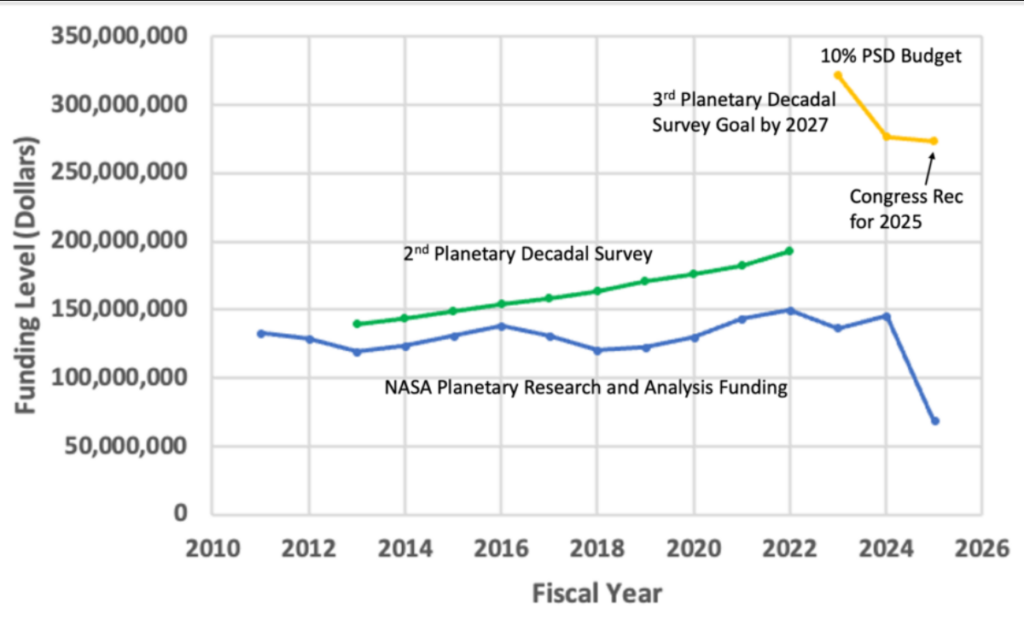
The data show that in the first year covered by the 2011 planetary science decadal survey recommendations (which was 2013), planetary R&A spending ($119 million) was already lower than the recommended funding level ($140 million). The discrepancy between recommended and actual spending only grew over the years covered by the 2011 survey.
The 2022 planetary science decadal survey, as well as Congress, then recommended that planetary R&A spending reach 10% of the total PSD budget. In 2023, planetary R&A spent only 2.5% the PSD budget, a discrepancy of about $185 million.
Shortchanging Basic Science
The only significant change in planetary R&A spending since 2011 was in 2025. NASA budgeted $144 million for planetary R&A in FY2025, still a relatively flat amount. But halfway through that fiscal year, it had spent just 47% of that ($68 million).
“For years, money budgeted has been very close to money expensed,” Sykes told Eos via email. “I noticed that FY2025 budget numbers did not appear to [be] in the President’s Budget Requests for FY2026 and FY2027, which made me wonder what might be going on.”
NASA has 2 years to spend appropriated funds, but historically has spent those funds by the end of the fiscal year.
Related
• An Investigative Report on the Funding of NASA Planetary Research and Analysis Programs, FY2011-FY2025
• An Update for FY2025
• Trump’s Attacks on Science: The State of the Science 1 Year On
• Get Involved: AGU Science Policy Action Center
“It would be pretty notable for NASA to incur costs amounting to 50% of its R&A budgets in the last three months!” Sykes said. “I would say that the accrued costs for FY2025 reflects a de facto change in the budget by the Administration.”
He added that this may be one of the many examples of the second Trump administration choosing not to spend Congressionally allocated funds for programs that don’t align with their politics.
Despite anticipating the shortfall, Sykes said, “it was still a shock to actually see it.”
This investigation spans 15 years, 8 NASA administrators, and four presidential administrations with varying levels of support for NASA and for science. FY2025 spending aside, the systemic underfunding of research and analysis cannot be laid at the feet of any individual or group of appropriators.
However, “When coupled with huge cuts to science proposed by the Administration, the discouragement of foreign students from all nations and international collaborations, and the deep reductions in experienced NASA personnel that has already occurred over the past year and a half, the U.S. may not recover,” Sykes wrote.
—Kimberly M. S. Cartier (@astrokimcartier.bsky.social), Staff Writer
These updates are made possible through information from the scientific community. Do you have a story about how changes in law or policy are affecting scientists or research? Send us a tip at [email protected].