
Part 4 of “The State of the Science 1 Year On,” a report from Eos and AGU
The State of the Science 1 Year On

• Executive Summary
• Climate Change and Energy
• Health and Safety
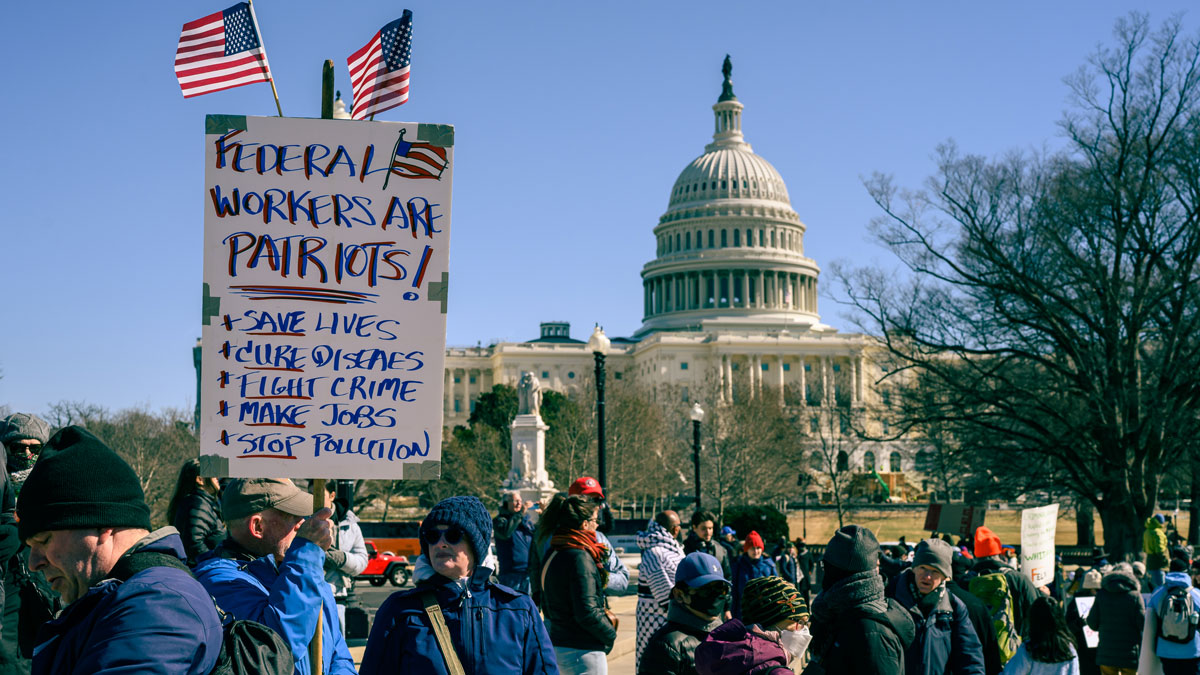
• The Federal Workforce
• Academia and Research
• Environment
• Concluding Remarks
• Joint Report
• Joint Report PDF
• Tracking Science Policy Decisions and Approaches
Overview
Before Inauguration Day, President Donald Trump openly stated his desire to drastically reduce the size of the federal workforce and cut teams, programs, and even cabinet-level departments deemed “wasteful” of federal resources or misaligned with his political agenda.
He has followed through with those intentions in waves of fast-moving policy and has employed a variety of tactics to push federal employees, including scientists, out of their jobs. A year into his second term, the federal workforce faces significant uncertainty about who may be the next target for cuts and how far those cuts could go.
Before Inauguration and Overarching Goals
There were 2,313,216 people employed across the federal government in September 2024. As of January 2026, there were 2,084,618, a 9.9% reduction. Table 1 shows a breakdown of employee numbers at select federal science agencies before Trump’s second inauguration, the number of people employed at those agencies as of 1 October 2025, and the change in number of employees. These numbers were compiled before the 8 January data release from the Office of Personnel Management.
In addition to reducing the federal workforce, the Trump administration has made strategic decisions when appointing cabinet-level and other agency leaders.
Elon Musk, for example, is CEO of NASA’s largest contractor, SpaceX. The day of Trump’s inauguration, Musk was appointed to lead the newly created Department of Government Efficiency (DOGE) and serve as a special adviser to the president. Interior Secretary Doug Burgum, a former North Dakota governor and longtime proponent of oil and gas drilling, now leads the National Energy Council that oversees drilling permits on public land. Education Secretary Linda McMahon, a former professional wrestling executive, was appointed with the mission of shuttering the department she leads.
EPA Administrator and former New York legislator Lee Zeldin often voted against environmental legislation during his time in Congress and now oversees efforts to roll back environmental and climate regulations. Meteorologist Neil Jacobs, who supported Trump during the 2019 “Sharpiegate” incident, was appointed head of NOAA. Jared Isaacman, NASA Administrator, is a private astronaut and billionaire with deep ties to Musk.
First 100 Days
Trump’s second first 100 days in office (20 January–30 April) brought unprecedented, rapid, and legally dubious changes to the federal workforce. Russell Vought, director of the Office of Management and Budget, admitted that “we want the [government] bureaucrats to be traumatically affected … We want to put them in trauma” so that they voluntarily leave their jobs.
Several of Trump’s Day 1 executive actions sought to reshape the federal workforce, including (but not limited to) eliminating climate change and environmental justice research; programs related to diversity, equity, and inclusion; and the Department of Education. He implemented a hiring freeze across the federal government and required all federal employees to return to in-person work. These and other executive actions related to the federal science workforce are listed in Table 2.
On 28 January, the Office of Personnel Management (OPM) sent federal workers an email titled “A Fork in the Road,” which offered them the option of deferred resignation on 30 September. This limited-time offer, which some agencies revived in April, led roughly 154,000 people (7% of the federal workforce) to leave voluntarily.
In February, DOGE required all federal employees to send weekly emails explaining five things they did in their jobs and justifying their continued employment. “Failure to respond will be taken as a resignation,” Musk posted on his social media platform, X. Some agencies directed employees to comply with the order while others told them to ignore it. OPM later said that responding to the emails was voluntary, and the White House ended the initiative in April.
The administration barred federal scientists from attending a meeting of the Intergovernmental Panel on Climate Change (IPCC) and canceled the upcoming National Climate Assessment (NCA), ceding leadership on fighting climate change to other countries. This cancellation led AGU and the American Meteorological Society to put together a special collection of research to maintain momentum to support the NCA. AGU also partnered with several universities to nominate U.S. scientists to contribute to the next IPCC report.
Mass layoffs and reductions in force (RIFs) began soon after Trump took office. Initially, RIFs targeted probationary employees, but the scope quickly expanded to include experienced personnel. Hundreds were fired from NOAA in February (a 5% reduction), including two flight directors of the Hurricane Hunter program and National Weather Service (NWS) scientists who produced forecasts, tracked flood risks, and maintained radar systems. NASA used RIFs to shutter its offices of strategy, chief scientist, and diversity. The EPA closed its environmental justice offices and worked to fire more than 1,000 scientists in its research arm. DOGE and the General Services Administration targeted the Mine Safety and Health Administration for cuts.
The Department of Health and Human Services fired scientists working on preventing the spread of bird flu and other airborne viruses. The Department of Energy fired people overseeing the safety of America’s nuclear stockpile. The Transportation Department fired dozens of air traffic controllers, a decision that impacted military, commercial, and space travel.
The Education Department closed its office of civil rights enforcement and several diversity and justice-related programs.
After several lawsuits and public backlash, a judge’s order reversed some of these mass layoffs and ordered the government to make clear that employees were not fired for cause. AGU was a coplaintiff in this lawsuit. Some mission-critical employees were offered back their positions, though not all took the offer. Some who came back were later laid off anyway and some probationary employees returned to work late in the year, describing the experience as “a complete roller coaster.”
Layoffs Throughout the Year
In May, the president released The President’s Budget Request (PBR), which proposed major funding cuts to science programs across the federal government alongside workforce reductions. A draft of this budget request was released in April and was followed by Executive Order No. 14210, which directed federal agencies to engage in “large-scale” RIFs and reorganizations.
At least nine lawsuits have been filed opposing the executive order, including one from a coalition of nonprofits, including AGU, as well as unions, U.S. cities, and counties asserting that those RIFs are illegal without a congressionally approved budget.
At the time of publication, these PBR-guided RIFs have not gone into effect or been adopted into a federal budget for fiscal year 2026 (FY26). Congress seems poised to reject this budget request.
Regardless, layoffs and RIFs continued through the spring and summer. The Departments of Defense, Treasury, and Agriculture saw the largest workforce reductions, although the EPA fired hundreds of employees in late April and the Department of the Interior lost 9,700 employees. NASA lost 4,890 people, including more than 2,000 senior-level staff. Meanwhile, 400 Centers for Disease Control and Prevention staff who were laid off in April were brought back.
May’s temporary restraining order “was no match for this Court’s demonstrated enthusiasm for greenlighting this President’s legally dubious actions.”
In May, a federal judge in San Francisco temporarily halted some of these layoffs. That temporary restraining order was then extended, but the Supreme Court allowed the mass firings to proceed in July. In the lone dissent, Justice Ketanji Brown Jackson said that May’s temporary restraining order “was no match for this Court’s demonstrated enthusiasm for greenlighting this President’s legally dubious actions in an emergency posture.”
In December, the Department of Veterans Affairs (VA) abruptly cut around 35,000 jobs, many related to healthcare, after having already lost around 30,000 employees throughout the year.
On 2 January 2026, FEMA laid off 65 people on the Cadre of On-Call Response and Recovery workforce. Leaked emails revealed a draft plan to terminate more than 10,000 more positions in 2026, reducing staff numbers by half.
Rule Changes and Pushback
In March, thousands of people participated in Stand Up for Science rallies at more than 100 locations across the United States and in Europe.
In late May, Trump signed an executive order “Restoring Gold Standard Science” to federal science agencies. Scientists immediately voiced concern that the directive would open the door to political interference in federal science and lead scientists to self-censor to avoid being fired.
“Don’t be fooled, this ‘gold standard’ is about politics, not science.”
“Don’t be fooled, this ‘gold standard’ is about politics, not science,” AGU President Brandon Jones wrote in response. “It co-opts the very language and practices we all have abided by, twisting it to support an agenda that will undermine advances across a range of critical areas, from climate science and new sources of clean energy to natural disaster preparedness and air and water quality.”
Though most departments and agencies have focused on downsizing, some are hiring, albeit with new standards. Many applying for federal jobs in 2025, including prospective NWS meteorologists, faced questions about their loyalty and support for the Trump administration and its policies.
In June, more than 300 officials from the National Institutes of Health (NIH) condemned the administration’s actions against federal science in the Bethesda Declaration. Hundreds of EPA employees signed their own Declaration of Dissent, followed by employees at the National Science Foundation (NSF) in the Alexandria Declaration and employees at NASA in the Voyager Declaration. In August, nearly 200 current and former Federal Emergency Management Agency (FEMA) staffers signed the Katrina Declaration objecting to the obstruction of FEMA’s mission.
Some who signed these letters experienced retaliation. The EPA fired at least five dissenters and suspended more without pay. FEMA has placed on leave all employees who put their name on the Katrina Declaration. It later fired one signatory and declined to reinstate others. NIH placed the scientist who organized the Bethesda Declaration on leave, as well as several senior officials who blew the whistle on the undermining of vaccine research. Some have sued the administration for wrongful termination.
In September, whistleblowers at NASA claimed that OMB officials were directing NASA to implement the budget and program cuts outlined in the PBR. Despite the whistleblower report and increased scrutiny, subsequent reporting showed that NASA was closing several buildings and labs at the Goddard Space Flight Center in Greenbelt, Md.
In December, a bipartisan group of lawmakers struck down an executive order that stripped federal workers of collective bargaining rights.
The 43-Day Government Shutdown
Congress failed to pass a spending bill for FY26 or a continuing resolution to temporarily extend FY25 funding, so the U.S. government shut down on 1 October. It was the start of a 43-day shutdown, the longest in U.S. history.
Ahead of the shutdown, Trump and congressional Republicans threatened that many federal workers would be laid off rather than furloughed and would not guarantee that furloughed employees would receive backpay despite it being mandated by law. Trump directed federal agencies to prepare for mass firings and RIFs during the shutdown and directed that those RIF plans align with PBR priorities.
Some agencies began implementing RIFs during the shutdown. The CDC laid off 1,300 employees, only to bring hundreds back the next day. Around 4,000 RIF notices had been issued by day 10 of the shutdown.
Labor groups sued the Trump administration to halt these layoffs. (AGU moved to connect its existing suit protecting federal workers to the new shutdown-related lawsuit.) On day 15 of the shutdown, a judge temporarily blocked the administration from conducting mass layoffs during the shutdown. On day 28, that order was extended to indefinitely block further RIFs during the shutdown and halt any RIF orders that had already been issued. The judge is continuing to evaluate the merit of the RIFs on an agency-by-agency basis.
For more than a month, many federal scientists were required to work without pay.
During the shutdown, many federal scientists were required to work without pay. Hurricane Hunters flew over Hurricane Melissa. NOAA and NWS meteorologists continued to provide forecasts. Air traffic controllers and aviation meteorologists worked ceaselessly. NASA mission control staff continued to monitor active spacecraft and the International Space Station. National parks remained open.
An October executive order extended the near-total hiring freeze implemented on day 1 and also ordered that hiring be “consistent with the national interest, agency needs, and the priorities of my administration.”
The shutdown ended on 12 November. The continuing resolution (CR) that reopened the government reversed many of the shutdown layoffs and reiterated that furloughed employees were entitled to backpay. The CR also prevents further RIFs before it expires on 30 January.
Looking Forward
Any renewed push to reshape the federal workforce will bring more change, more uncertainty, and potentially more trauma to an already beleaguered federal workforce.
The first year of Trump’s second term in office has been one of upheaval for federal workers, including federal scientists, who serve the public across the country. Although mass layoffs, reorganizations, RIFs, and voluntary departures have shrunk the federal workforce by 9.9% (228,598 people), that number falls short of the apparent goal of reducing the federal workforce by 75% (1.7 million people) by 2028.
Some of the administration’s objectives have been achieved. Offices related to climate, environmental justice, civil rights, and diversity, equity, and inclusion have been shuttered. New policies have increased political oversight of federal hiring, firing, and research spending. The Department of Education and EPA have experienced drastic employment cuts, reorganizations, and a reduction of regulatory jurisdiction. Other objectives have yet to be realized, including the privatization of NWS and NASA and the outright closure of the Department of Education. It’s unclear whether RIFs will resume when the CR expires and whether the administration will once again order agencies to prepare for layoffs should another shutdown occur. Agencies may be required to make more staffing or research cuts depending on the details of a congressionally approved FY26 budget. Civilian federal employees received a 1% pay increase on 1 January, lower than the inflation rate, which will financially strain workers. Any renewed push to reshape the federal workforce will bring more change, more uncertainty, and potentially more trauma to already beleaguered federal employees.
Table 1. Number of People Employed by the Federal Government
| AGENCY OR DEPARTMENT | EMPLOYEES, SEPTEMBER 2024a [1] | EMPLOYEES, 1 OCTOBER 2025 | TOTAL CHANGEb | PERCENT CHANGE |
| Total | 2,313,216 | 2,101,535 | −211,681 [2] | −9.2 |
| Department of Education | 4,209 | 1,700 [3] | −2,509 | −59.6 |
| Department of Health and Human Services (HHS) | 92,620 | 79,717 [4] | −12,903 | −13.9 |
| Centers for Disease Control and Prevention (CDC) | 12,820 | 13,635 [4] | 815 | 6.4 |
| Environmental Protection Agency (EPA) | 16,839 | 15,166 [5] | −1,673 | −9.9 |
| Federal Emergency Management Agency (FEMA)c | 24,348 [6] 24,348 [6] | 24,925 (GAO) [6] 23,350 (DHS) [7] | 577 −998 | 2.4 −4.1 |
| National Aeronautics Space Administration (NASA) | 18,150 | 18,218 [8] | 68 | 0.4 |
| National Oceanic and Atmospheric Administration (NOAA) | 12,434 | 10,466 [9] | −1,968 | −15.8 |
| National Park Service (NPS) | 21,866 | 14,500 [10] | −7,366 | −33.7 |
| National Science Foundation (NSF) | 1,717 | 1,402 [11] | −315 | −18.3 |
| U.S. Forest Service (USFS) | 39,285 | 32,390 [12] | −6,895 | −17.6 |
| U.S. Geological Survey (USGS) | 8,417 | 6,776 [13] | −1,641 | −19.5 |
aUnless otherwise indicated, all employment numbers in this column are derived from source [1].
b This calculation of the total change in employment does not account for people hired between September 2024 and 20 January 2025 or fired after 1 October 2025 and is an underestimate. More details can be found in the text, and the most recent federal employment numbers can be found at https://data.opm.gov/
c The Government Accountability Office (GAO) and Department of Homeland Security (DHS) cite different 1 June employment numbers for FEMA. Both have been included here for completeness.
Sources
[1] U.S. Office of Personnel Management, FedScope September 2024 data release, www.fedscope.opm.gov/.
[2] Partnership for Public Service, Federal Harms Tracker, accessed 24 November 2025, ourpublicservice.org/federal-harms-tracker/cost-to-your-government/.
[3] L. McMahon, U.S. Department of Education contingency plan for lapse in fiscal year (FY) 2026 appropriations, 28 Sept. 2025, www.ed.gov/media/document/us-department-of-education-contingency-plan-lapse-fiscal-year-fy-2026-appropriations-508-112431.pdf.
[4] U.S. Department of Health and Human Services, FY 2026 HHS contingency staffing plan for operations in the absence of enacted annual appropriations, 25 Sept. 2025, www.hhs.gov/about/budget/fy-2026-hhs-contingency-staffing-plan/index.html.
[5] EPA, U.S. Environmental Protection Agency contingency plan for shutdown, 29 Sept. 2025, www.epa.gov/system/files/documents/2025-09/epa-contingency-plan-9_29_25.pdf
[6] USAFacts, What does the Federal Emergency Management Agency (FEMA) do?, usafacts.org/explainers/what-does-the-us-government-do/subagency/federal-emergency-management-agency/.
[7] U.S. Department of Homeland Security, Procedures relating to a lapse in appropriations, p. 52, 29 Sept. 2025, www.dhs.gov/sites/default/files/2025-09/2025_0930_dhs_procedures_related_to_a_lapse_in_appropriations.pdf
[8] S. Shinn, NASA Continuity of Appropriations Plan, 29 Sept. 2025, www.nasa.gov/wp-content/uploads/2025/09/nasa-continuity-of-appropriations-plan-final-9-29-2025.pdf?emrc=cd4554.
[9] Department of Commerce, Plan for orderly shutdown due to lapse of congressional appropriations, p. 48, 29 Sept. 2025, www.commerce.gov/sites/default/files/2025-09/DOC-Lapse-Plan-2025
.pdf.
[10] National Park Service, Contingency plan, Sept. 2025, www.doi.gov/sites/default/files/documents/2025-09/doi-nps-lapse-plan2025930508.pdf.
[11] National Science Foundation, The National Science Foundation plan for operations during a lapse in appropriations, 22 Sept. 2025, nsf-gov-resources.nsf.gov/files/nsf-shutdown-sept-2025.pdf?VersionId=4AvlTQz81zX0dyjyvCYU1zq19XeLhEdq.
[12] U.S. Department of Agriculture, Lapse of funding plan, p. 19, 30 Sept. 2025, www.agri-pulse.com/ext/resources/2025/09/30/fy2026-usda-lapse-plan.pdf.
[13] U.S. Department of the Interior, U.S. Geological Survey contingency plan, Sept. 2025, www.doi.gov/sites/default/files/documents/2025-09/doi-usgs-contingency-plan2025930508.pdf.
Table 2. Partial List of Executive Actions Impacting the Federal Science Workforce
| DATE | NUMBER | NAME | IMPACT |
| 20 Jan. 2025 | 14,148 | Initial Rescissions Of Harmful Executive Orders And Actions | Rescinds many previous executive orders, including several that sought to create new jobs to combat the climate crisis, prevent sex- and gender-based workforce discrimination, and promote diversity in the federal workforce |
| 20 Jan. 2025 | 14,151 | Ending Radical and Wasteful Government DEI Programs and Preferencing | Ends “Equity Action Plans” instituted across federal agencies, terminates offices related to diversity, equity, and inclusion and environmental justice and related positions |
| 20 Jan. 2025 | 14,158 | Establishing and Implementing the President’s “Department of Government Efficiency” | Established DOGE, which implemented mass layoffs, deferred resignations, and early retirement programs meant to shrink the federal workforce |
| 20 Jan. 2025 | 14170 | Reforming the Federal Hiring Process and Restoring Merit to Government Service | Instructs agencies to create federal hiring plans in accordance with administration priorities |
| 20 Jan. 2025 | 14,171 | Restoring Accountability to Policy -Influencing Positions Within the Federal Workforce | Reclassifies Schedule F employees (those employed in policymaking positions) to make them easier to fire |
| 20 Jan. 2025 | Memorandum | Hiring Freeze | No position vacant on 20 January may be filled, and no new positions may be created; exceptions: armed forces, immigration, national security, and public safety |
| 20 Jan. 2025 | Memorandum | Return to In-Person Work | Instructs agencies to terminate remote work arrangements and orders federal workers to return to in-person work |
| 21 Jan. 2025 | 14,173 | Ending Illegal Discrimination and Restoring Merit-Based Opportunity | Rescinds several previous executive orders that promoted diversity and inclusion in the federal workforce and for federal contractors |
| 23 Jan. 2025 | 14,177 | President’s Council of Advisors on Science and Technology | Established a committee to advise the president on matters of science |
| 24 Jan. 2025 | 14,180 | Council to Assess the Federal Emergency Management Agency | Established a committee to evaluate how to reform FEMA |
| 11 Feb. 2025 | 14,210 | Implementing the President’s “Department of Government Efficiency” Workforce Optimization Initiative | Directs federal science agencies to prepare for widespread reductions in force and reorganizations |
| 24 Apr. 2025 | 14,284 | Strengthening Probationary Periods in the Federal Service | Adjusts definition of probational period for new federal employees, aids in probationary period RIFs |
| 23 May 2025 | 14,303 | Restoring Gold Standard Science | Changes federal science standards in a way that reduces transparency and increases political oversight; requires agencies to submit plans on how they will comply with new standards |
| 7 Aug. 2025 | 14,332 | Improving Oversight of Federal Grantmaking | Formalizes a system of political appointees reviewing and approving research grants |
| 15 Oct. 2025 | 14,356 | Ensuring Continued Accountability in Federal Hiring | Extends the federal hiring freeze implemented on 20 January, with limited exceptions; also requires that hiring practices align with administration priorities |
Curated Links
Key resources for this report and people interested in this topic:
Adams, K., et al. (2025), The Bethesda Declaration: A call for NIH and HHS leadership to deliver on promises of academic freedom and scientific excellence, www.standupforscience.net/bethesda-declaration.
American Federation of Government Employees (2025), Summary of AFGE lawsuits against Trump & how litigation works, www.afge.org/article/summary-of-afge-lawsuits-against-trump–how-litigation-works-2/.
Anonymous (2025), Declaration of Dissent, www.standupforscience.net/epa-declaration.
Cartier, K. M. S. (2025), Crowds stand up for science across the United States, Eos, 106, https://doi.org/10.1029/2025EO250096.
Forester, J., et al. (2025), Katrina Declaration and Petition to Congress, www.standupforscience.net/fema-katrina-declaration.
Gardner, E. (2025), Judge stops shutdown-related RIFs indefinitely, Eos, 28 Oct., eos.org/research-and-developments/judge-stops-shutdown-related-rifs-indefinitely.
Hinman-Sweeney, E., et al. (2025), The Voyager Declaration, www.standupforscience.net/nasa-voyager-declaration.
Jones, B. (2025), AGU condemns threatened mass firings of U.S. federal workforce during shutdown, From the Prow, 6 Oct., fromtheprow.agu.org/agu-condemns-threatened-mass-firings-of-u-s-federal-workforce-during-shutdown/.
Jones, B. (2025), AGU statement on the U.S. government shutdown, From the Prow, 1 Oct., fromtheprow.agu.org/agu-statement-on-the-u-s-government-shutdown/.
Jones, B. (2025), All that’s gold does not glitter, From the Prow, 20 Aug., fromtheprow.agu.org/all-thats-gold-does-not-glitter/.
Jones, B. (2025), Don’t just reopen government. Recommit to science, 13 Nov., From the Prow, fromtheprow.agu.org/dont-just-reopen-government-recommit-to-science/.
Office of Management and Budget (2025), Fiscal year 2026 discretionary budget request, 2 May, www.whitehouse.gov/wp-content/uploads/2025/05/Fiscal-Year-2026-Discretionary-Budget-Request.pdf.
Soriano, J., et al. (2025), Appeal to defend civil service protections and the mission of the National Science Foundation, American Federation of Federal Employees, 21 July, democrats-science.house.gov/imo/media/doc/AFGE_Local_3403_NSF_Letter_to_RM_Lofgren_REDACTED_Redacted.pdf.
Tollefson, J., A. Witze, and D. Garisto (2025), The US government shutdown is over: What’s next for scientists, Nature, 13 Nov., www.nature.com/articles/d41586-025-03706-0.
van Deelen, G., and K. M. S. Cartier (2025), Science agencies shuttered in government shutdown, Eos, 1 Oct., eos.org/research-and-developments/science-agencies-shuttered-in-government-shutdown.
—Eos (@eos.org)