Source: Journal of Geophysical Research: Biogeosciences
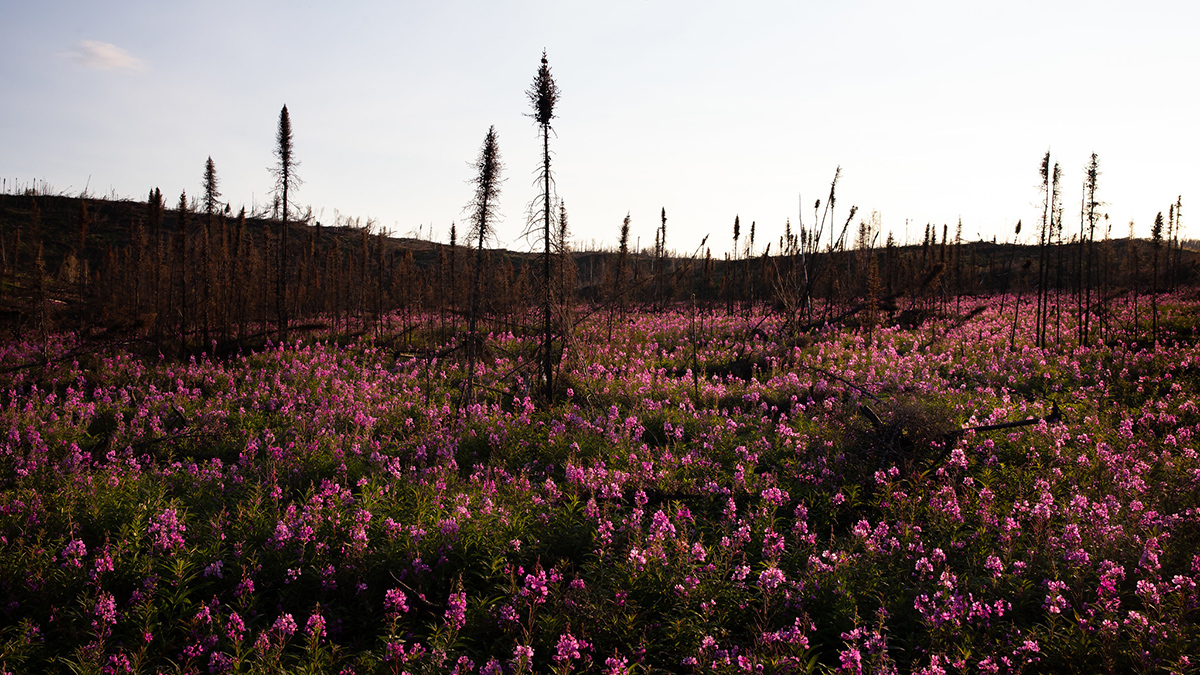
In Alaska’s boreal forests, a negative feedback loop between wildfires and vegetation plays an important role in governing the size and likelihood of fires. Wildfires clear out mature forests, allowing them to be replaced by less flammable young forests that temporarily suppress fires. This relationship helps balance fire activity, but to what extent is unclear. Scientists are also uncertain how this relationship will change as the climate warms.
Gaglioti et al. use remotely sensed data on Alaskan wildfires between 1984 and 2020 to look at fires that encounter previously burned areas. They use a logistic regression model to assess the degree to which young fuels resist wildfire and whether warmer, drier conditions can affect this resistance.
The authors found that younger vegetation in recently burned areas has historically exerted a strong negative influence on fire activity. Reburning rates in younger forests were 1–3 orders of magnitude lower than rates in older forests, with the burned-area perimeter often acting as a barrier to later encroaching fires. A simple model of landscape burning estimates that without this negative feedback loop, Alaska would have seen 5 times more wildfires during the past 40 years, the authors say.
Extreme fire weather had a significant dampening effect on this relationship, especially in younger forests, the authors found. This is in line with previous research and suggests that a changing climate could weaken the suppressive role of younger vegetation. Nevertheless, future climate change, which the researchers modeled by taking historically extreme fire years as normal, does not completely negate the suppressive effect of past burning.
Comparing their results with similar studies in the western contiguous United States, the authors found the limiting effect of past fires on new fire activity to be twice as strong in Alaska, where less flammable deciduous trees grow back more quickly and the replacement of ladder fuel (fuel that carries fire from the forest floor to tree crowns) takes longer. Their results could be useful to fire managers, who often use past burn areas as natural firebreaks. Using their model, managers could assess how likely a given burned area is to suppress new fire activity based on its age and current fire weather. (Journal of Geophysical Research: Biogeosciences, https://doi.org/10.1029/2025JG009543, 2026)
—Nathaniel Scharping (@nathanielscharp), Science Writer