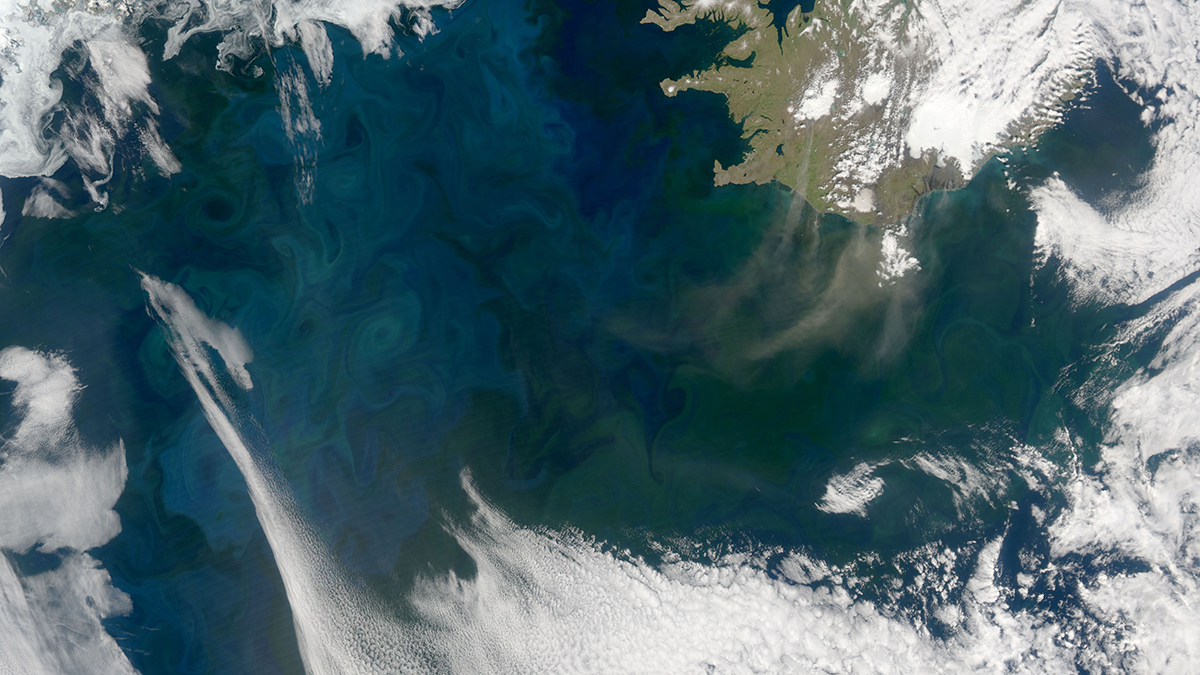
Source: Journal of Geophysical Research: Biogeosciences
In the ocean, a haze made from tiny bits of dead plants, animals, and microbes hangs in the upper reaches of the water. Each particle is just a fraction of a micrometer across, but together the carbon within these particles weighs around 700 billion tons—about as much as all the carbon in the atmosphere.
Dissolved organic carbon (DOC), as these little bits are called, is a food source that sustains marine bacteria and a carbon store with huge implications for climate change. Yet scientists don’t understand what dictates the distribution of DOC throughout the ocean.
Owusu et al. set out to explain the distribution of DOC with a focus on the North Atlantic subtropical gyre, where the concentration of DOC is particularly high. Some scientists have hypothesized that certain hard-to-break-down forms of DOC are sucked into subtropical gyres by strong currents, then remain trapped there long-term. But this team had a different suspicion: The type and number of bacteria present in the gyre dictate how much DOC accumulates.
To test their theory, the researchers used a consumer-resource model to study how bacteria compete for DOC when they have access to varying levels of nitrogen, which can limit bacterial growth. When the researchers varied bacterial prevalence, DOC concentration followed quite naturally, they found. However, the rate at which dead organisms produced DOC did not fully explain the prevalence of DOC. The results are consistent with a recent study in which researchers sampled water from the gyre and found there weren’t enough bacteria around to take advantage of all the DOC they could be munching on.
The findings represent a switch from the long-dominant theory that the biochemical properties of DOC determine how easily it breaks down. The study suggests that the microbial makeup of ocean water is actually the prime deciding factor in how much dissolved organic matter it contains. (Journal of Geophysical Research: Biogeosciences, https://doi.org/10.1029/2025JG009257, 2026)
—Saima May Sidik (@saimamay.bsky.social), Science Writer