Source: Geophysical Research Letters
Humanity’s ongoing disruption of atmospheric carbon dioxide (CO2) concentrations, temperatures, and global nutrient cycles is starving the oceans of oxygen. Although we can measure ongoing changes to ocean circulation and marine life, we still don’t know how far the oxygen loss and the damage to ocean ecosystems could go. One way to foresee the oceans’ future is to look back at how our seas and their inhabitants responded to higher CO2 levels and warmer climates in the past.
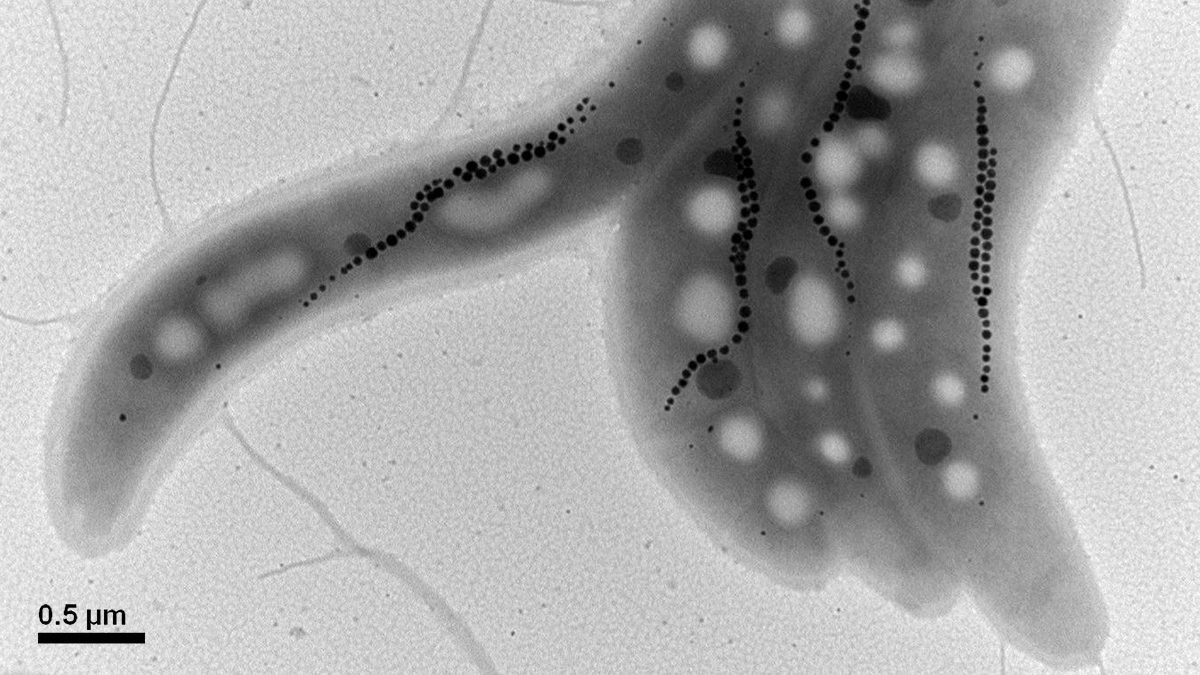
Marine microorganisms record signs of bygone conditions in the tiny fossils they leave behind, but most fossils offer clues about relative changes in ocean oxygen over time, rather than recording absolute oxygen concentration. To resolve this, Huang et al. examined more than 200 modern ocean sediment samples from ocean basins worldwide to link “magnetofossils”—nanoscopic magnetic minerals left behind by bacteria—to present-day oxygen levels in the water. The work provided a new equation scientists can use to calculate the absolute oxygen levels in long-ago seas.
Magnetofossil-forming bacteria live within the top few centimeters of the seafloor, where they grow crystals of minerals like magnetite to detect and respond to Earth’s magnetic field. Using a transmission electron microscope, the researchers painstakingly documented the shapes of more than 4,500 magnetic mineral grains, each scarcely wider than one thousandth of a human hair. Samples from parts of the ocean with lower oxygen levels had a greater number of skinny, bullet-shaped magnetite crystals, whereas waters with more oxygen favored the growth of tiny magnetite cubes. The change in shape can be seen visually, but also through differences in the crystals’ magnetic properties.
The pattern of increasing cube formation as oxygen levels rise holds across different temperatures, salt concentrations, and organic carbon levels in the seawater, making magnetofossils a widely applicable tool for charting past ocean oxygen to date, the authors say. By picking out the bacterial magnetite in older seafloor samples, researchers can now use this paper’s results as a yardstick for how much oxygen reached the deep ocean under the hotter climates of Earth’s past, they suggest. (Geophysical Research Letters, https://doi.org/10.1029/2026GL124170, 2026)
—Sasha Warren (@sashawarren.bsky.social), Science Writer