• About
  • Special Reports
  • Topics
    • Climate
    • Earth Science
    • Oceans
    • Space & Planets
    • Health & Ecosystems
    • Culture & Policy
    • Education & Careers
    • Opinions
  • Projects
    • Postcards From the Field
    • ENGAGE
    • Editors’ Highlights
    • Editors’ Vox
    • Eos en Español
    • Eos 简体中文版
    • Print Archive: 2015–2025
  • Policy Tracker
  • Blogs
    • Research & Developments
    • The Landslide Blog
  • Newsletter
  • Submit to Eos
  • AGU.org
  • Career Center
  • Join AGU
  • Give to AGU
  • About
  • Special Reports
  • Topics
    • Climate
    • Earth Science
    • Oceans
    • Space & Planets
    • Health & Ecosystems
    • Culture & Policy
    • Education & Careers
    • Opinions
  • Projects
    • Postcards From the Field
    • ENGAGE
    • Editors’ Highlights
    • Editors’ Vox
    • Eos en Español
    • Eos 简体中文版
    • Print Archive: 2015–2025
  • Policy Tracker
  • Blogs
    • Research & Developments
    • The Landslide Blog
  • Newsletter
  • Submit to Eos
Skip to content
  • AGU.org
  • Career Center
  • Join AGU
  • Give to AGU
Eos

Eos

Science News by AGU

Support Eos
Sign Up for Newsletter
  • About
  • Special Reports
  • Topics
    • Climate
    • Earth Science
    • Oceans
    • Space & Planets
    • Health & Ecosystems
    • Culture & Policy
    • Education & Careers
    • Opinions
  • Projects
    • Postcards From the Field
    • ENGAGE
    • Editors’ Highlights
    • Editors’ Vox
    • Eos en Español
    • Eos 简体中文版
    • Print Archive: 2015–2025
  • Policy Tracker
  • Blogs
    • Research & Developments
    • The Landslide Blog
  • Newsletter
  • Submit to Eos

AGU Books

Chemostratigraphy is a comparatively new method for the characterization and interpretation of rock records over different periods of geologic time
Posted inEditors' Vox

Unravelling the Past Using Elements and Isotopes

by A. N. Sial, C. Gaucher, M. Ramkumar and V. P. Ferreira 12 February 201922 August 2023

A new book explores chemostratigraphy, a fascinating and relatively young branch of geoscience, presenting the latest developments and applications.
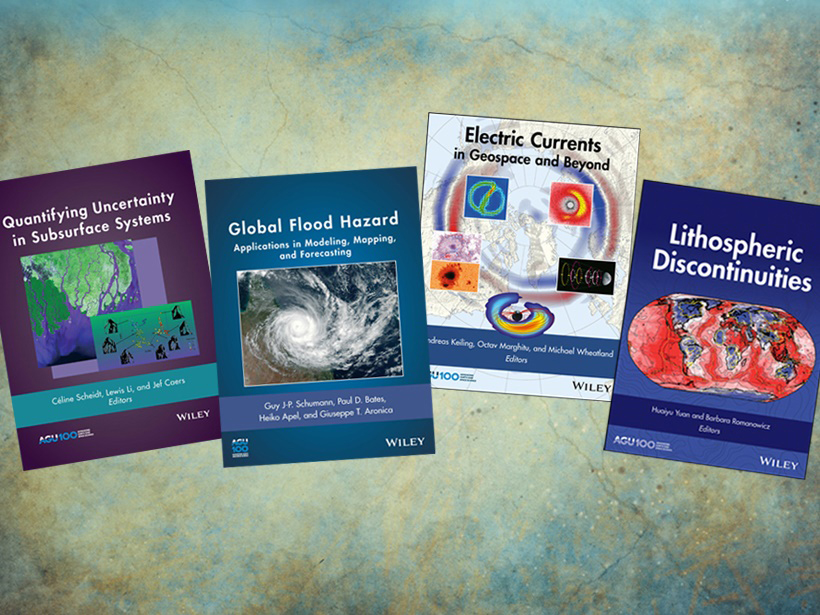
Four of 12 new volumes published in 2018 by AGU and Wiley
Posted inAGU News

AGU Books Program Continues to Thrive

by Jenny Lunn 30 November 20187 April 2023

The past year has been a successful one for AGU’s books program, with a dozen new volumes on a range of topics in the Earth and space sciences and a new Web platform.

Posted inEditors' Vox

Earthquake Precursors, Processes, and Predictions

by D. Ouzounov 31 August 20185 October 2022

A new book presents various studies that may establish a link between earthquakes and different types of precursor signals from the Earth, atmosphere, and space.

Global Flood Hazard: Applications in Modeling, Mapping and Forecasting
Posted inEditors' Vox

The Challenges of Global Flood Hazard Mapping and Prediction

by G. J.-P. Schumann 9 July 201827 February 2023

A new book presents the latest tools in remote sensing technologies and modeling approaches for addressing challenges and meeting future needs in global flood hazard mapping and prediction.

Ethics wordle
Posted inEditors' Vox

Ethics Crucial for the Future of the Geosciences

by L. Gundersen 8 November 201727 March 2023

A new AGU Special Publication provides a policy and practice overview of where we are and where we need to be regarding scientific integrity and ethics in the geosciences.
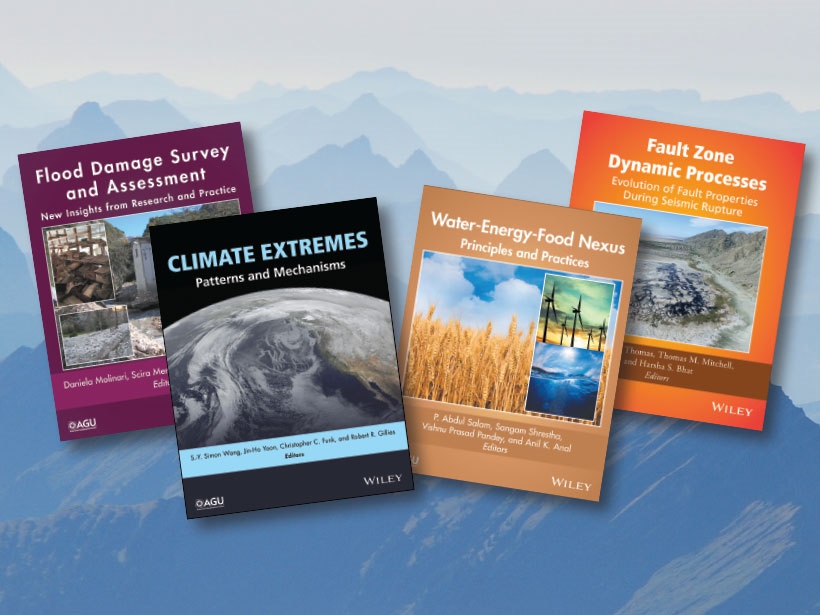
Four new books published third quarter 2017.
Posted inAGU News

AGU Books Program Continues to Grow

by Jenny Lunn 17 August 201719 April 2023

With a dozen new titles published in the past year and interviews with editors as a new feature, the AGU books program is expanding during a time of change in scholarly publishing.

Posted inEditors' Vox

The Value of Disaster Damage Data

by D. Molinari, S. Menoni and F. Ballio 21 July 20172 February 2022

The editors of a new book describe the benefits of systematic collection, storage, analysis, and sharing of damage data after flood events.
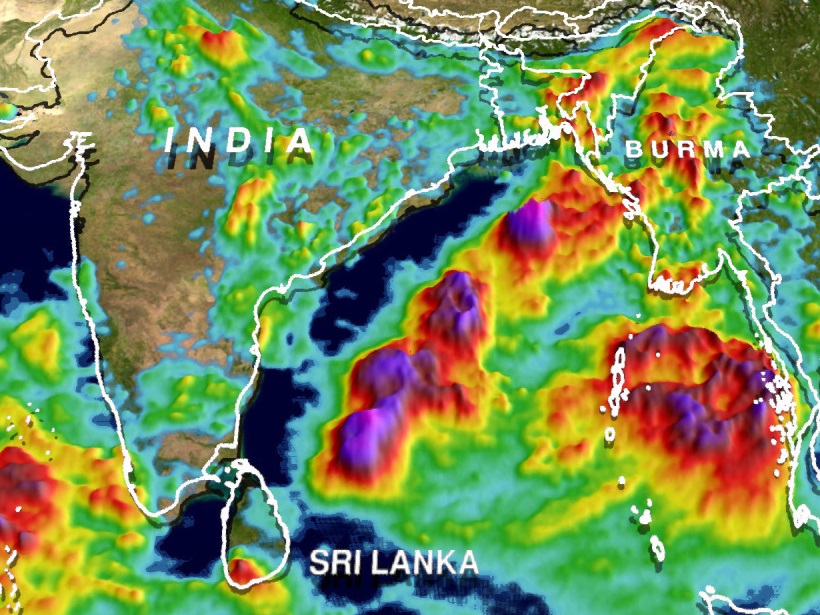
Total rainfall accumulation over South Asia from May 24 to June 1, 2017 using estimates from NASA's Integrated Multi-satellitE Retrievals for GPM (IMERG) data.
Posted inEditors' Vox

How Does Changing Climate Bring More Extreme Events?

by S.-Y. S. Wang, J.-H. Yoon, C. C. Funk and R. R. Gillies 13 July 201725 February 2022

The editors of a new book describe how and why weather and climate phenomena are intensifying with climate change.
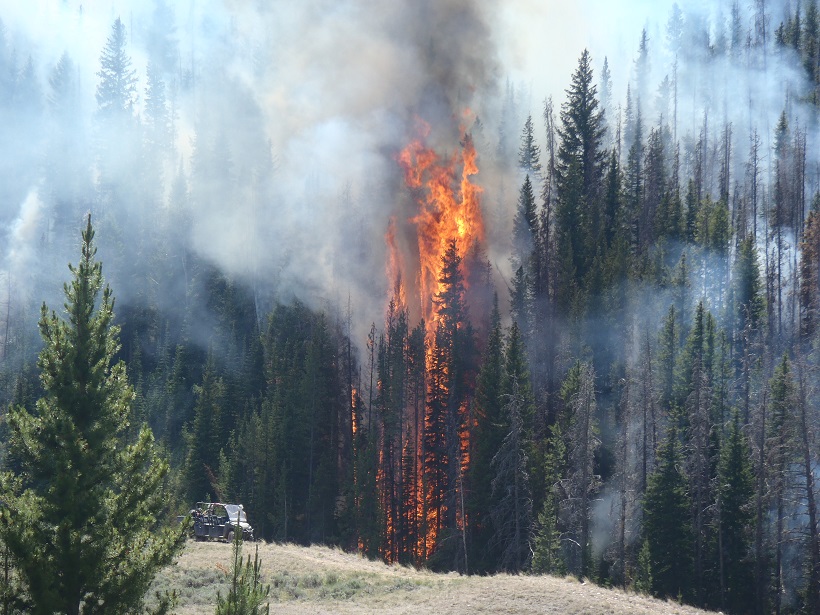
Posted inEditors' Vox

Reducing Uncertainty in Hazard Prediction

by K. Riley, M. Thompson, P. Webley and K. Hyde 28 April 201720 May 2022

The editors of a new book describe how to characterize uncertainty in natural hazards, the incorporation of uncertainty into modeling, its contribution to better decision-making, and research needs.

Recent covers of some of the 20 journals that AGU currently publishes.
Posted inAGU News

Providing Greater Context for Earth and Space Science Research

by Jenny Lunn and Brooks Hanson 12 April 201730 August 2022

A new "highlights" page, plain-language summaries, and other recent initiatives further enhance the material in journals and books published by the American Geophysical Union.

Posts pagination

Newer posts 1 … 3 4 5 6 Older posts
Over a dark blue-green square appear the words Special Report: The State of the Science 1 Year On.

Features from AGU Publications

Research Spotlights

As Wildfires Increase in the West, So Does Suppression Spending

10 June 202610 June 2026
Editors' Highlights

Multi-Scale Fault Roughness Encapsulated in a Friction Law

11 June 202611 June 2026
Editors' Vox

Small-Scale Indian Ocean Dynamics Underpin Marine Ecology and Climate

4 June 20263 June 2026
Eos logo at left; AGU logo at right

About Eos
ENGAGE
Awards
Contact

Advertise
Submit
Career Center
Sitemap

© 2026 American Geophysical Union. All rights reserved Powered by Newspack