• About
  • Sections
  • Topics
    • Climate
    • Earth Science
    • Oceans
    • Space & Planets
    • Health & Ecosystems
    • Culture & Policy
    • Education & Careers
    • Opinions
  • Projects
    • ENGAGE
    • Editors’ Highlights
    • Editors’ Vox
    • Eos en Español
    • Eos 简体中文版
    • Print Archive
  • Science Policy Tracker
  • Blogs
    • Research & Developments
    • The Landslide Blog
  • Newsletter
  • Submit to Eos
  • AGU.org
  • Career Center
  • Join AGU
  • Give to AGU
  • About
  • Sections
  • Topics
    • Climate
    • Earth Science
    • Oceans
    • Space & Planets
    • Health & Ecosystems
    • Culture & Policy
    • Education & Careers
    • Opinions
  • Projects
    • ENGAGE
    • Editors’ Highlights
    • Editors’ Vox
    • Eos en Español
    • Eos 简体中文版
    • Print Archive
  • Science Policy Tracker
  • Blogs
    • Research & Developments
    • The Landslide Blog
  • Newsletter
  • Submit to Eos
Skip to content
  • AGU.org
  • Career Center
  • Join AGU
  • Give to AGU
Eos

Eos

Science News by AGU

Support Eos
Sign Up for Newsletter
  • About
  • Sections
  • Topics
    • Climate
    • Earth Science
    • Oceans
    • Space & Planets
    • Health & Ecosystems
    • Culture & Policy
    • Education & Careers
    • Opinions
  • Projects
    • ENGAGE
    • Editors’ Highlights
    • Editors’ Vox
    • Eos en Español
    • Eos 简体中文版
    • Print Archive
  • Science Policy Tracker
  • Blogs
    • Research & Developments
    • The Landslide Blog
  • Newsletter
  • Submit to Eos

everything atmospheric

Nuns pose with a snowman at the Vatican in Rome on 26 February 2018.
Posted inResearch Spotlights

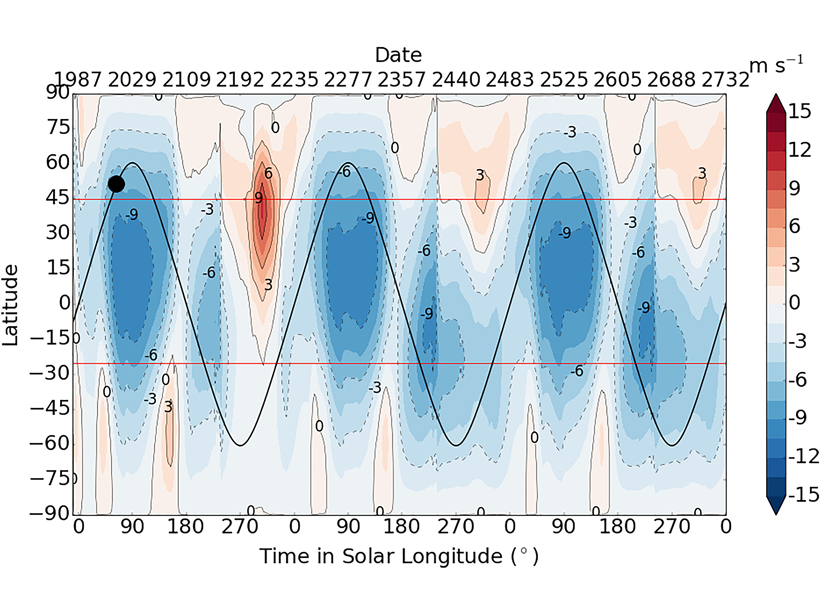
Using Multiple Models to Improve Seasonal Forecasting

by Terri Cook 15 April 201929 March 2022

The first study to examine the ability of a suite of general circulation models to predict sudden warmings in Earth’s stratosphere highlights the potential for improving Northern Hemisphere forecasts.

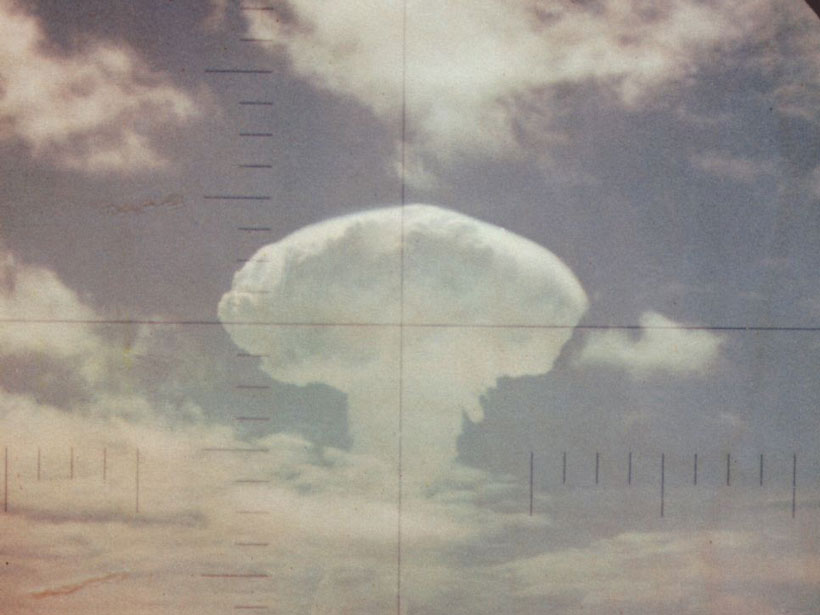
A 1970 nuclear test at Mururoa atoll, French Polynesia
Posted inEditors' Vox

Measuring Explosive Events on Earth from the Ionosphere

by C. Y. Huang, J. F. Helmboldt, J. Park, T. R. Pedersen and R. J. Willeman 12 April 201919 October 2021

Natural and manmade explosive events occurring on or below the Earth’s surface can be measured remotely in different ways and different places from the ionosphere.

A satellite view of the Río de la Plata’s plume
Posted inResearch Spotlights

Unraveling the Origins of a Record-Setting Marine Heat Wave

by Terri Cook 8 April 201916 December 2021

The extreme heat wave in the southwestern Atlantic in 2017 was likely caused by upper atmosphere circulation patterns triggered by the Madden-Julian Oscillation tropical weather cycle.

Space shuttle Endeavour in 2010 with a multihued view of Earth’s atmosphere layers
Posted inResearch Spotlights

The Thermosphere Responds to a Weaker Than Normal Solar Cycle

Aaron Sidder, freelance science writer by Aaron Sidder 5 April 201927 March 2023

Infrared emissions from nitric oxide and carbon dioxide in Earth’s upper atmosphere, which are closely tied to incoming solar radiation, are drastically lower than in the previous solar cycle.

A view of poor air quality in Delhi, India.
Posted inResearch Spotlights

Aerosol Particle Size May Contribute to Varying Health Responses

Aaron Sidder, freelance science writer by Aaron Sidder 4 April 201923 March 2023

Particulate matter in the atmosphere derives from industrial and environmental sources. The size of the particle determines how it deposits in the body and leads to different health challenges.

Laboratory experiment used to simulate the shock wave made by an asteroid impact on Mars
Posted inResearch Spotlights

Rover and Lasers Unlock Clues to Early Martian Atmosphere

Aaron Sidder, freelance science writer by Aaron Sidder 3 April 201924 April 2024

Sediments from the Curiosity rover and experiments using tanks of gas and laser beams helped reveal how water continued to flow on Mars after the planet lost its atmospheric carbon dioxide.

Noctilucent clouds near Moscow, Russia, photographed from the SONC balloon at a height of about 8 km on 5 July 2018.
Posted inScience Updates

Looking at “Night-Shining” Clouds from the Stratosphere

by P. Dalin, N. Pertsev, V. Perminov, D. Efremov and V. Romejko 2 April 20193 February 2022

One research group studied noctilucent clouds at large distances from a different point of view, using cameras aboard a meteorological balloon that sailed into the stratosphere.

A view of the observatory at Mount Abu
Posted inResearch Spotlights

What Drives Temperature Inversions in the Mesosphere?

by E. Underwood 27 March 201916 March 2023

A study of nightglow over India reveals that gravity waves are less important than previously thought.

Twilight in the Tapajós National Forest, seen from an observation tower
Posted inResearch Spotlights

A Simplified Model of Water Vapor Exchange in the Amazon

Aaron Sidder, freelance science writer by Aaron Sidder 27 March 20195 September 2023

Evapotranspiration is the exchange of water vapor between land and the atmosphere, and it is hard to measure and model. A new study shows promise for its estimation over large, vegetated landscapes.

The Southern Ocean is known for high waves and elevated levels of sea spray aerosols.
Posted inScience Updates

Connecting the Southern Ocean with Clouds

by S. Landwehr, J. Schmale and D. W. H. Walton 25 March 201917 August 2022

ACE-DATA/Antarctic Sea-Atmosphere Interactions Data (ASAID) Workshop; 5–6 November 2018, Lausanne, Switzerland

Posts pagination

Newer posts 1 … 56 57 58 59 60 … 86 Older posts
A view of a Washington, D.C., skyline from the Potomac River at night. The Lincoln Memorial (at left) and the Washington Monument (at right) are lit against a purple sky. Over the water of the Potomac appear the text “#AGU24 coverage from Eos.”

Features from AGU Publications

Research Spotlights

Understanding Cloud Droplets Could Improve Climate Modeling

10 November 202510 November 2025
Editors' Highlights

Marine Heatwaves Reshape Precipitation Patterns

6 November 20256 November 2025
Editors' Vox

Publishing Participatory Science: The Community Science Exchange

20 October 202517 October 2025
Eos logo at left; AGU logo at right

About Eos
ENGAGE
Awards
Contact

Advertise
Submit
Career Center
Sitemap

© 2025 American Geophysical Union. All rights reserved Powered by Newspack