• About
  • Sections
  • Topics
    • Climate
    • Earth Science
    • Oceans
    • Space & Planets
    • Health & Ecosystems
    • Culture & Policy
    • Education & Careers
    • Opinions
  • Projects
    • Postcards From the Field
    • ENGAGE
    • Editors’ Highlights
    • Editors’ Vox
    • Eos en Español
    • Eos 简体中文版
    • Print Archive: 2015–2025
  • Science Policy Tracker
  • Blogs
    • Research & Developments
    • The Landslide Blog
  • Newsletter
  • Submit to Eos
  • AGU.org
  • Career Center
  • Join AGU
  • Give to AGU
  • About
  • Sections
  • Topics
    • Climate
    • Earth Science
    • Oceans
    • Space & Planets
    • Health & Ecosystems
    • Culture & Policy
    • Education & Careers
    • Opinions
  • Projects
    • Postcards From the Field
    • ENGAGE
    • Editors’ Highlights
    • Editors’ Vox
    • Eos en Español
    • Eos 简体中文版
    • Print Archive: 2015–2025
  • Science Policy Tracker
  • Blogs
    • Research & Developments
    • The Landslide Blog
  • Newsletter
  • Submit to Eos
Skip to content
  • AGU.org
  • Career Center
  • Join AGU
  • Give to AGU
Eos

Eos

Science News by AGU

Support Eos
Sign Up for Newsletter
  • About
  • Sections
  • Topics
    • Climate
    • Earth Science
    • Oceans
    • Space & Planets
    • Health & Ecosystems
    • Culture & Policy
    • Education & Careers
    • Opinions
  • Projects
    • Postcards From the Field
    • ENGAGE
    • Editors’ Highlights
    • Editors’ Vox
    • Eos en Español
    • Eos 简体中文版
    • Print Archive: 2015–2025
  • Science Policy Tracker
  • Blogs
    • Research & Developments
    • The Landslide Blog
  • Newsletter
  • Submit to Eos

Hazards & Disasters

Posted inScience Updates

Toward Another Lava Lake in the Virunga Volcanic Field?

by B. Smets, N. d’Oreye and F. Kervyn 21 October 20144 October 2021

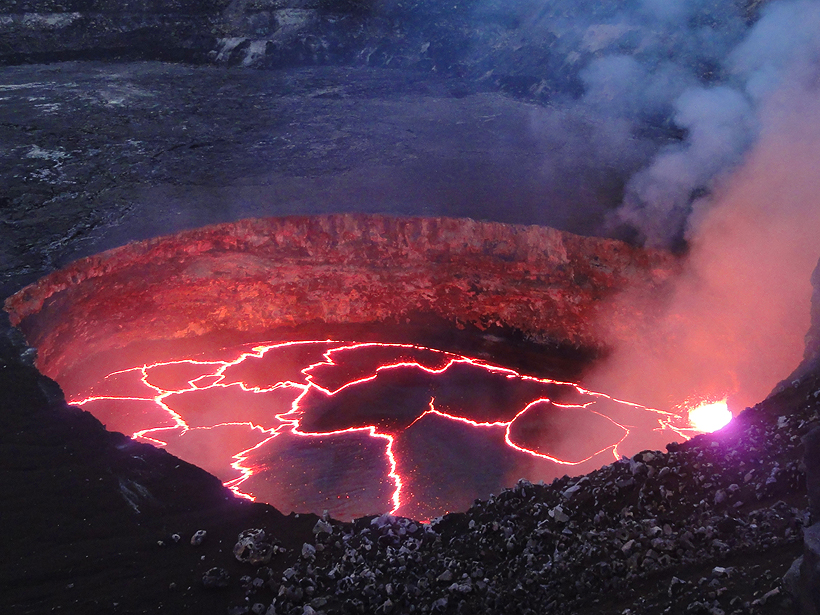
Earlier this year, a red glow became visible atop Nyamulagira, a volcano in the East African Rift. Helicopter flights soon confirmed lava fountains inside a pit crater on the volcano's central caldera.

Posted inNews

Field Dispatch: Up Close and Personal With a Volcanic Eruption

JoAnna Wendel, freelance science writer and illustrator by JoAnna Wendel 30 September 20142 May 2022

What’s it like to do field work mere miles away from an erupting volcano?

Posted inScience Updates

A Rapid Response Study of the Hercules Gas Well Blowout

by S. B. Joye, J. P. Montoya, S. A. Murawski, T. M. Özgökmen, T. L. Wade, R. Montuoro, B. J. Roberts, D. J. Hollander, W. H. Jeffrey and J. P. Chanton 23 September 201417 March 2023

Following the 23 July 2013 blowout of a gas production in the Gulf of Mexico owned by Hercules Offshore, scientists established a rapid response study to investigate the environmental effects.

Posted inResearch Spotlights

A Model to Predict When a Cholera Outbreak Might Hit the Congo

by C. Schultz 16 September 20149 September 2024

Researchers determined the environmental conditions most likely to trigger a cholera epidemic in a region in eastern Congo.

Posted inResearch Spotlights

Large Volcanic Eruptions Cause Drought in Eastern China

by C. Schultz 16 September 201418 November 2022

In a study with implications for geoengineering, large Northern Hemispheric volcanic eruptions are found to cause strong droughts in much of eastern China.

Posted inScience Updates

Detecting Near-Field Tsunamis off the Coast of British Columbia

by T. L. Insua and K. Moran 16 September 201428 October 2022

A Near-Field Tsunami Initiative for the Coast of British Columbia;
Port Alberni, British Columbia, 27–28 March 2014

Posted inFeatures

Crop Residue Burning: A Threat to South Asian Air Quality

by R. P. Singh and D. G. Kaskaoutis 16 September 201420 October 2021

Smoke from the residues, burned during October and November to ready fields for next year’s planting, emanate from Punjab, a region spanning northwestern India and eastern Pakistan.

Posted inScience Updates

Next-Generation Severe Weather Forecasting and Communication

by L. P. Rothfusz, C. Karstens and D. Hilderband 9 September 20143 August 2025

A new concept called Forecasting a Continuum of Environmental Threats (FACETs) aims to enhance weather forecasting with high-resolution probabilistic hazard information.

Posted inResearch Spotlights

How Should Flood Risk Assessments Be Done in a Changing Climate?

by C. Schultz 2 September 201420 May 2022

The common assumption that flood behavior is not changing over time causes water managers to undervalue flood protection benefits. A better method of risk assessment is proposed.

Posted inNews

Decades-Old Sediment Cores Complicate Cascadia Earthquake History

JoAnna Wendel, freelance science writer and illustrator by JoAnna Wendel 2 September 201414 March 2024

Scientists have long known that the Pacific Northwest is vulnerable to massive earthquakes, but newly unearthed data raises questions about the strength and frequency of these quakes.

Posts pagination

Newer posts 1 … 169 170 171 172 Older posts
A view of a bridge, with the New Orleans skyline visible in the distance between the bridge and the water. A purple tint, a teal curved line representing a river, and the text “#AGU25 coverage from Eos” overlie the photo.

Features from AGU Publications

Research Spotlights

Denitrification Looks Different in Rivers Versus Streams

16 January 202616 January 2026
Editors' Highlights

ALMA’s New View of the Solar System

16 January 202616 January 2026
Editors' Vox

Bridging the Gap: Transforming Reliable Climate Data into Climate Policy

16 January 202616 January 2026
Eos logo at left; AGU logo at right

About Eos
ENGAGE
Awards
Contact

Advertise
Submit
Career Center
Sitemap

© 2026 American Geophysical Union. All rights reserved Powered by Newspack