• About
  • Special Reports
  • Topics
    • Climate
    • Earth Science
    • Oceans
    • Space & Planets
    • Health & Ecosystems
    • Culture & Policy
    • Education & Careers
    • Opinions
  • Projects
    • Postcards From the Field
    • ENGAGE
    • Editors’ Highlights
    • Editors’ Vox
    • Eos en Español
    • Eos 简体中文版
    • Print Archive: 2015–2025
  • Policy Tracker
  • Blogs
    • Research & Developments
    • The Landslide Blog
  • Newsletter
  • Submit to Eos
  • AGU.org
  • Career Center
  • Join AGU
  • Give to AGU
  • About
  • Special Reports
  • Topics
    • Climate
    • Earth Science
    • Oceans
    • Space & Planets
    • Health & Ecosystems
    • Culture & Policy
    • Education & Careers
    • Opinions
  • Projects
    • Postcards From the Field
    • ENGAGE
    • Editors’ Highlights
    • Editors’ Vox
    • Eos en Español
    • Eos 简体中文版
    • Print Archive: 2015–2025
  • Policy Tracker
  • Blogs
    • Research & Developments
    • The Landslide Blog
  • Newsletter
  • Submit to Eos
Skip to content
  • AGU.org
  • Career Center
  • Join AGU
  • Give to AGU
Eos

Eos

Science News by AGU

Support Eos
Sign Up for Newsletter
  • About
  • Special Reports
  • Topics
    • Climate
    • Earth Science
    • Oceans
    • Space & Planets
    • Health & Ecosystems
    • Culture & Policy
    • Education & Careers
    • Opinions
  • Projects
    • Postcards From the Field
    • ENGAGE
    • Editors’ Highlights
    • Editors’ Vox
    • Eos en Español
    • Eos 简体中文版
    • Print Archive: 2015–2025
  • Policy Tracker
  • Blogs
    • Research & Developments
    • The Landslide Blog
  • Newsletter
  • Submit to Eos

Hazards & Disasters

Posted inNews

Obama Links Climate Change to National and Global Security

by Randy Showstack 21 May 20152 February 2022

Obama tells new Coast Guard officers that climate change poses a serious security threat to coastal areas and a challenge to the U.S. military.

Posted inResearch Spotlights

Regional Nuclear War Could Cause a Global Famine

Kate Wheeling, freelance science writer by Kate Wheeling 15 May 20157 July 2025

A detonation of less than 0.03% of the current global nuclear arsenal could cause fires that clog the air with soot. This soot could block solar radiation, leading to worldwide crop shortages.

Posted inNews

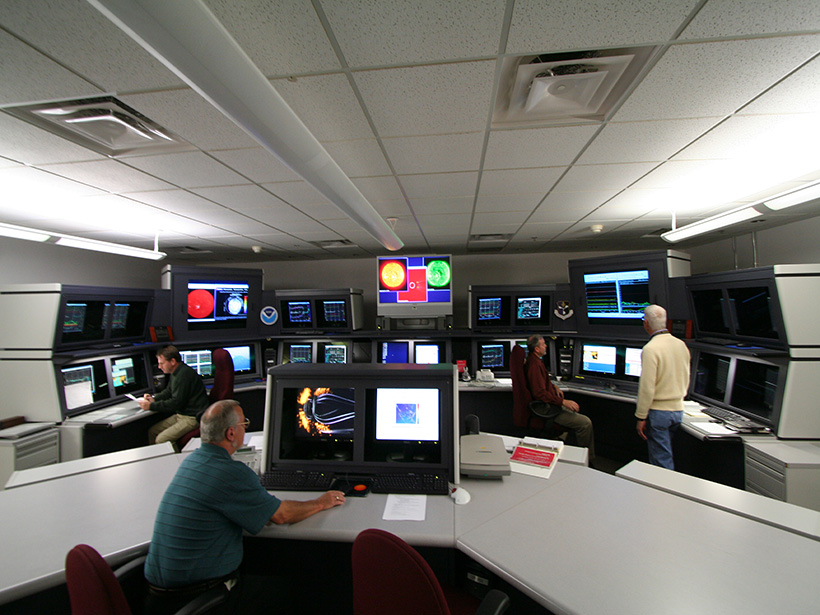
Protecting Earth from Solar Storms

JoAnna Wendel, freelance science writer and illustrator by JoAnna Wendel 13 May 201513 October 2021

A task force on space weather recently released a national strategy to reduce damage resulting from solar storms. The plan is now open for public comment.

Posted inNews

Scientist's Field Season Ends with Nepal Quake

Nanci Bompey, assistant director of AGU’s media relations department by N. Bompey 12 May 20158 December 2022

A graduate student studying tectonics found himself caught in a disaster at the end of fieldwork in the Himalayas.

Posted inResearch Spotlights

What Causes Extreme Hail, Tornadoes, and Floods in South America?

by S. Palus 11 May 20152 August 2022

A study of extreme weather in South America shows seasonal and spatial patterns, which, if better understood, could help save lives and minimize damage to property.

Posted inNews

Reducing Earthquake Risk in Nepal

by Randy Showstack 7 May 201510 May 2022

What specific approaches work well to protect people from earthquake hazards in Nepal? Hazard mitigation expert Brian Tucker shares his insight.

Posted inNews

What Can We Learn About Disaster Preparedness from Nepal's Quake?

by Randy Showstack 5 May 201510 May 2022

In an interview with Eos, hazard mitigation expert Brian Tucker gives his views on disaster preparedness in the wake of the recent earthquake in Nepal.

Posted inResearch Spotlights

Could Amazonian Deforestation Increase Cloudiness and Rain?

by S. Palus 4 May 201529 April 2022

In trading trees for pastures, patchwork differences in vegetation heights increase cloudiness in downwind regions.

Posted inResearch Spotlights

Surface Folds Hint at Magnitude of Slip Along Thrust Faults

by J. Rosen 1 May 201525 August 2022

The shape of deformed sediments at the surface may allow researchers to estimate the cumulative slip along thrust faults such as the Chelungpu fault in Taiwan.

Posted inResearch Spotlights

Ozone Hole to Remain Large During Cold Years

by E. Betz 28 April 20153 June 2024

Despite the Montreal Protocol's success, it will take years of observations to be sure that regulations are allowing the ozone hole to recover.

Posts pagination

Newer posts 1 … 170 171 172 173 174 … 178 Older posts
Over a dark blue-green square appear the words Special Report: The State of the Science 1 Year On.

Features from AGU Publications

Research Spotlights

As Wildfires Increase in the West, So Does Suppression Spending

10 June 202610 June 2026
Editors' Highlights

Multi-Scale Fault Roughness Encapsulated in a Friction Law

11 June 202611 June 2026
Editors' Vox

Small-Scale Indian Ocean Dynamics Underpin Marine Ecology and Climate

4 June 20263 June 2026
Eos logo at left; AGU logo at right

About Eos
ENGAGE
Awards
Contact

Advertise
Submit
Career Center
Sitemap

© 2026 American Geophysical Union. All rights reserved Powered by Newspack