• About
  • Sections
  • Topics
    • Climate
    • Earth Science
    • Oceans
    • Space & Planets
    • Health & Ecosystems
    • Culture & Policy
    • Education & Careers
    • Opinions
  • Projects
    • ENGAGE
    • Editors’ Highlights
    • Editors’ Vox
    • Eos en Español
    • Eos 简体中文版
    • Print Archive
  • Science Policy Tracker
  • Blogs
    • Research & Developments
    • The Landslide Blog
  • Newsletter
  • Submit to Eos
  • AGU.org
  • Career Center
  • Join AGU
  • Give to AGU
  • About
  • Sections
  • Topics
    • Climate
    • Earth Science
    • Oceans
    • Space & Planets
    • Health & Ecosystems
    • Culture & Policy
    • Education & Careers
    • Opinions
  • Projects
    • ENGAGE
    • Editors’ Highlights
    • Editors’ Vox
    • Eos en Español
    • Eos 简体中文版
    • Print Archive
  • Science Policy Tracker
  • Blogs
    • Research & Developments
    • The Landslide Blog
  • Newsletter
  • Submit to Eos
Skip to content
  • AGU.org
  • Career Center
  • Join AGU
  • Give to AGU
Eos

Eos

Science News by AGU

Support Eos
Sign Up for Newsletter
  • About
  • Sections
  • Topics
    • Climate
    • Earth Science
    • Oceans
    • Space & Planets
    • Health & Ecosystems
    • Culture & Policy
    • Education & Careers
    • Opinions
  • Projects
    • ENGAGE
    • Editors’ Highlights
    • Editors’ Vox
    • Eos en Español
    • Eos 简体中文版
    • Print Archive
  • Science Policy Tracker
  • Blogs
    • Research & Developments
    • The Landslide Blog
  • Newsletter
  • Submit to Eos

Pacific Ocean

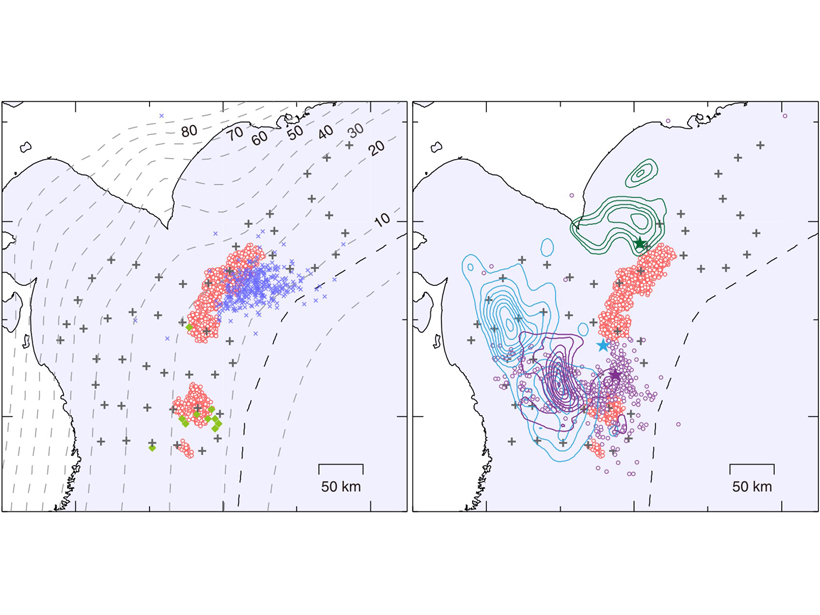
Figure showing earthquake tremor locations
Posted inEditors' Highlights

Shallow Low Frequency Tremors in Japan Trench

by G. P. Hayes 14 June 20196 December 2021

A new seafloor seismic network detected low-frequency tremor on the subduction zone interface offshore northern Japan, indicating regions of slow slip in close proximity to shallow megathrust events.

Figure showing first transect of radiocarbon in DOC with depth below the ocean surface in the Pacific Ocean, as a function of latitude
Posted inEditors' Highlights

Pacific Carbon Ages During Long Journey Along Ocean Floor

by Rose Cory 4 June 201927 September 2022

The radiocarbon signal of DOC with depth across the Pacific Ocean basin effectively supports a number of important theories that have been suggested over the years.

A map showing vertical motions in southwest Japan 7 years after the 1946 Nankai earthquake
Posted inResearch Spotlights

Déjà Vu: Understanding Subduction Zones’ Cycle of Seismicity

by Terri Cook 3 June 201918 January 2022

A unique geodetic data set from Japan’s Nankai subduction zone offers an unparalleled opportunity to study surface deformation spanning almost an entire seismic cycle.

Satellite image of a collapsed storm over atolls
Posted inResearch Spotlights

Pacific Carbon Uptake Accelerating Faster Than Expected

by E. Underwood 29 May 201911 August 2022

A new study suggests that shifting ocean currents drive faster carbon dioxide uptake.

A research vessel traverses Sydney Harbor with the Sydney Opera House in the background.
Posted inScience Updates

Australia–New Zealand Plan for Future Scientific Ocean Drilling

by M. F. Coffin, J. Parr and L. Armand 29 May 201914 March 2023

Australian–New Zealand IODP Consortium Ocean Planet Workshop; Canberra, Australia, 14–16 April 2019

An almond orchard with trees in bloom
Posted inNews

California Heat Waves Triggered by Pacific Thunderstorms

Mary Caperton Morton, Science Writer by Mary Caperton Morton 29 April 201930 March 2023

New link may offer 5-week lead time on predicting extreme heat in California’s fruit belt.

The 17 October 2015 landslide at Tyndall Glacier Alaska
Posted inResearch Spotlights

Study of Alaskan Landslide Could Improve Tsunami Modeling

by E. Underwood 26 April 201911 February 2022

A rare submarine landslide provides researchers with a reference point for modeling the biggest tsunamis.

Deep drilling in the Atacama Desert in 2017
Posted inNews

Atacama’s Past Rainfall Followed Pacific Sea Temperature

Kimberly M. S. Cartier, News Writing and Production Intern for Eos.org by Kimberly M. S. Cartier 23 April 20194 April 2023

This is the first paleoclimate record of precipitation near Atacama’s hyperarid core and suggests that its moisture source is different from that of the Andes.

Citizen Scientist Inspects gray Northern Fulmar carcass
Posted inOpinions

Science in This Century Needs People

by Julia Parrish 22 April 201918 April 2023

An ecologist built an army of beach surveyors over 20 years and now has the world’s largest data set of marine bird mortality informing climate change and disaster studies.

Posted inEditors' Highlights

Distinguishing Pacific and Atlantic Contributions to the Arctic

by J. Sprintall 18 April 201912 January 2022

A semi-conservative tracer combining nitrate and dissolved oxygen is more accurate than traditional tracers in distinguishing between Atlantic and Pacific water mass contributions to the Arctic.

Posts pagination

Newer posts 1 … 11 12 13 14 15 … 22 Older posts
A view of a bridge, with the New Orleans skyline visible in the distance between the bridge and the water. A purple tint, a teal curved line representing a river, and the text “#AGU25 coverage from Eos” overlie the photo.

Features from AGU Publications

Research Spotlights

An Ecosystem Never Forgets

19 December 202519 December 2025
Editors' Highlights

Frictional Properties of the Nankai Accretionary Prism

11 December 20259 December 2025
Editors' Vox

Hydrothermal Circulation and Its Impact on the Earth System

3 December 20253 December 2025
Eos logo at left; AGU logo at right

About Eos
ENGAGE
Awards
Contact

Advertise
Submit
Career Center
Sitemap

© 2025 American Geophysical Union. All rights reserved Powered by Newspack