• About
  • Special Reports
  • Topics
    • Climate
    • Earth Science
    • Oceans
    • Space & Planets
    • Health & Ecosystems
    • Culture & Policy
    • Education & Careers
    • Opinions
  • Projects
    • Postcards From the Field
    • ENGAGE
    • Editors’ Highlights
    • Editors’ Vox
    • Eos en Español
    • Eos 简体中文版
    • Print Archive: 2015–2025
  • Policy Tracker
  • Blogs
    • Research & Developments
    • The Landslide Blog
  • Newsletter
  • Submit to Eos
  • AGU.org
  • Career Center
  • Join AGU
  • Give to AGU
  • About
  • Special Reports
  • Topics
    • Climate
    • Earth Science
    • Oceans
    • Space & Planets
    • Health & Ecosystems
    • Culture & Policy
    • Education & Careers
    • Opinions
  • Projects
    • Postcards From the Field
    • ENGAGE
    • Editors’ Highlights
    • Editors’ Vox
    • Eos en Español
    • Eos 简体中文版
    • Print Archive: 2015–2025
  • Policy Tracker
  • Blogs
    • Research & Developments
    • The Landslide Blog
  • Newsletter
  • Submit to Eos
Skip to content
  • AGU.org
  • Career Center
  • Join AGU
  • Give to AGU
Eos

Eos

Science News by AGU

Support Eos
Sign Up for Newsletter
  • About
  • Special Reports
  • Topics
    • Climate
    • Earth Science
    • Oceans
    • Space & Planets
    • Health & Ecosystems
    • Culture & Policy
    • Education & Careers
    • Opinions
  • Projects
    • Postcards From the Field
    • ENGAGE
    • Editors’ Highlights
    • Editors’ Vox
    • Eos en Español
    • Eos 简体中文版
    • Print Archive: 2015–2025
  • Policy Tracker
  • Blogs
    • Research & Developments
    • The Landslide Blog
  • Newsletter
  • Submit to Eos

Space & Planets

An artist’s impression of planet formation: Close to the star, dust particles grow into planetesimals and Earth-like planets. Farther away, gas accretes on planetary cores to create Jupiter-like giants.
Posted inNews

Krypton Isotopes Provide New Clues to Planets’ Pasts

by Carolyn Wilke 4 May 202217 March 2023

To trace how crucial ingredients for life arrived at Earth, scientists track noble gases. Now, improved methods are drawing new clues from krypton, the most cryptic of noble gases.

On the left: a view of Pluto, as imaged by the New Horizons spacecraft. On the right: a close-up of an undulating region believed to have been formed by volcanoes that erupted icy material.
Posted inNews

Pluto’s Surface Was Recently Sculpted by Icy Volcanism

Katherine Kornei, Science Writer by Katherine Kornei 2 May 202217 February 2023

Geologically young regions of Pluto’s southern hemisphere were likely resurfaced by cryovolcanism, data from the New Horizons spacecraft reveal.

Figures showing global distributions of calculated height-integrated Pedersen conductance and Hall conductance.
Posted inEditors' Highlights

Meteoric Ions Influence Conductance in the Jovian Ionosphere

by Viviane Pierrard 29 April 20227 September 2022

Meteoric ions dominate the Jovian lower ionosphere due to their long lifetimes. Due to the large densities of the meteoric ions, conductance is enhanced independently of local time.

The dark blue orb of Neptune is viewed by Voyager 2 at an upward angle from the south pole. A dark navy storm spot, the Great Dark Spot, is just to the right of the center of the planet, and white high-altitude clouds are scattered around the planet.
Posted inNews

Diagnosing Neptune’s Chilly Summer

Kimberly M. S. Cartier, News Writing and Production Intern for Eos.org by Kimberly M. S. Cartier 28 April 202228 April 2022

A pandemic project analyzing a trove of infrared images revealed an unexplained phenomenon taking place in Neptune’s atmosphere.
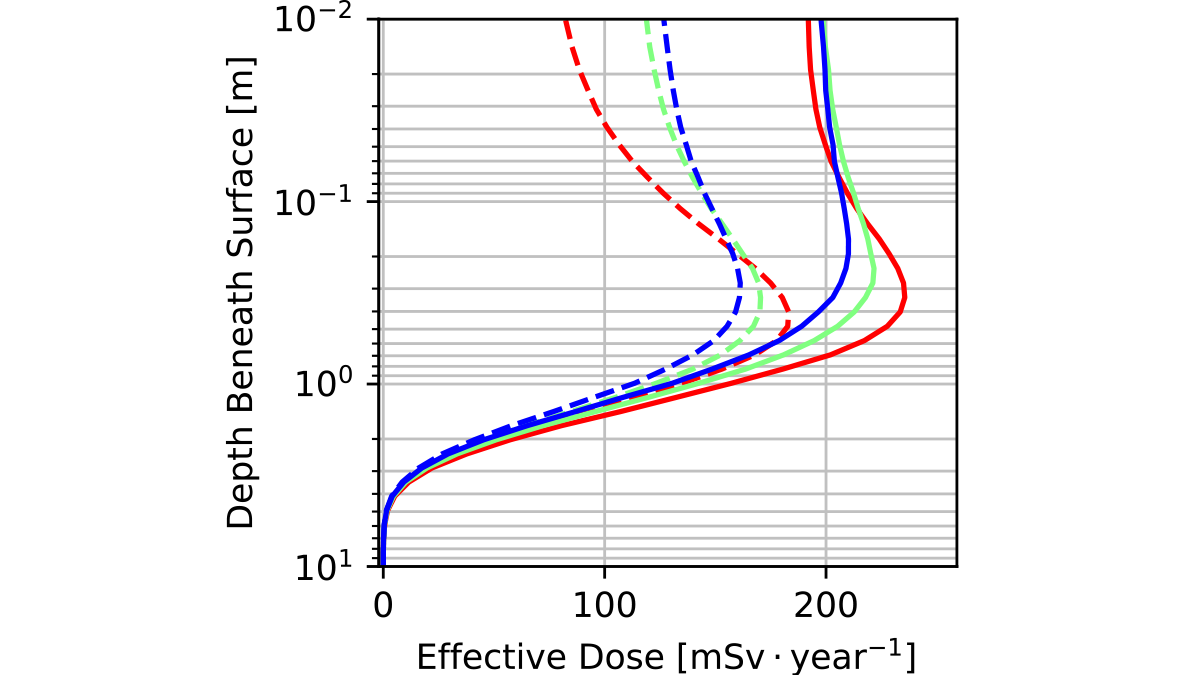
Simulation results showing the effective dose in mSv/year as a function of depth beneath the Martian surface.
Posted inEditors' Highlights

Life on Mars? Estimating Radiation Risks for Martian Astronauts

by Andrew Poppe 19 April 202221 December 2022

New research suggests that to minimize radiation risk for human exploration of Mars, astronauts will need to dig deep for safety.
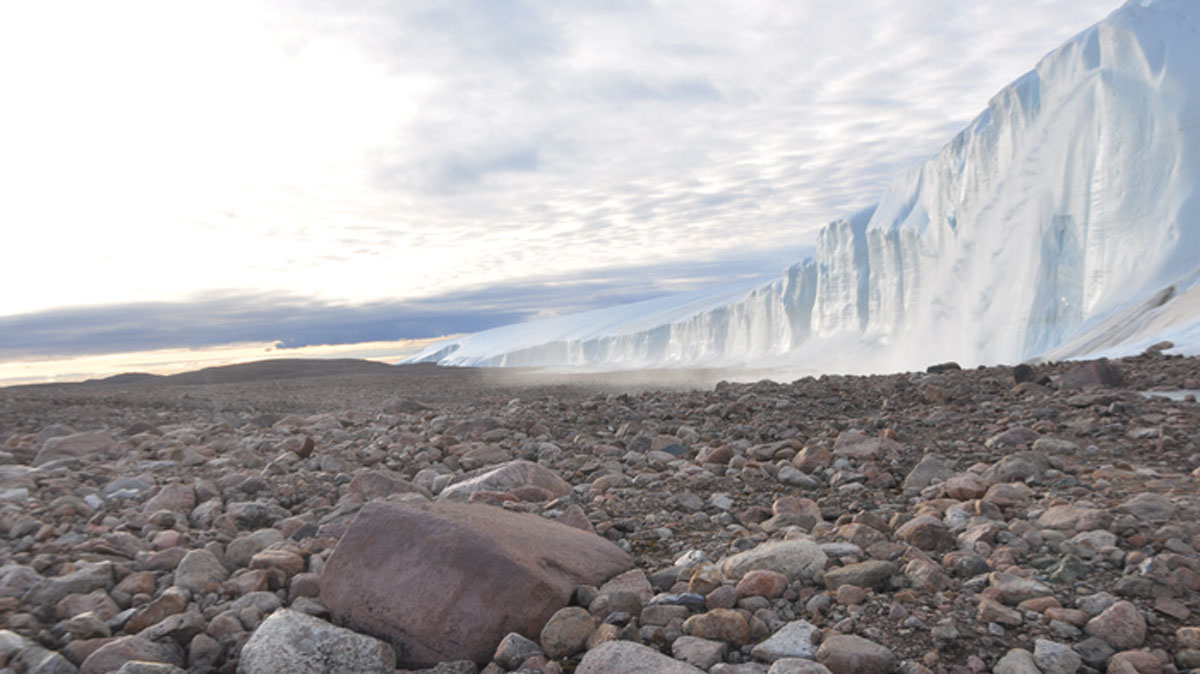
A wall of ice looms over an expanse of rocks.
Posted inNews

Impact Structure Hidden Under Arctic Ice Dates to the Paleocene

Katherine Kornei, Science Writer by Katherine Kornei 13 April 202213 September 2025

Greenland’s Hiawatha impact structure, more than 30 kilometers in diameter, is much older than previously thought, new results suggest.

Image of AB Aurigae’s protoplanetary disk shows wispy spirals and a bright blobby protoplanet. A scale shows that the protoplanet’s orbit is about 3 times wider than Neptune’s orbit around the Sun.
Posted inNews

Giant Planet’s Formation Caught in Action

by Jure Japelj 11 April 202225 April 2022

Astronomers took a direct image of a massive protoplanet embedded in a protoplanetary disk. The system provides strong evidence for an as-yet-unconfirmed theory of planet formation.
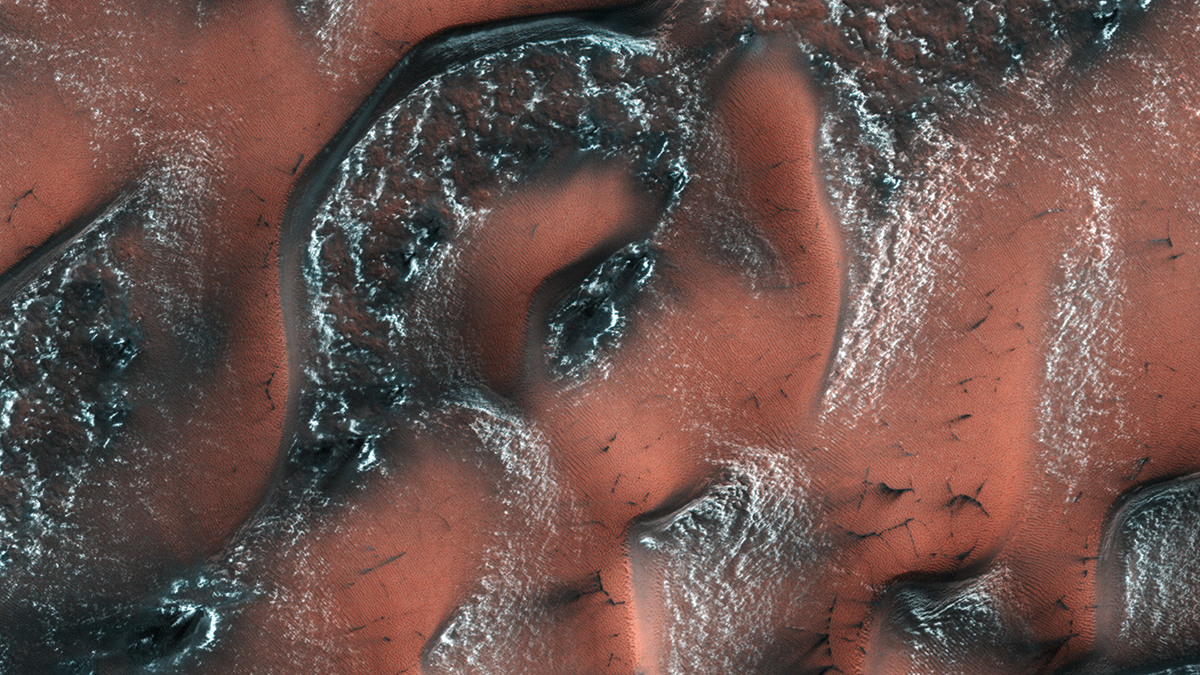
An aerial image of the windswept surface of Mars. The ground is rusty red with blacker sediment curling across the image in the form of dunes. A dusting of white snow accentuates the ridges of large and small scale dunes.
Posted inNews

Mars’s Dust Cycle Controls Its Polar Vortex and Snowfall

Kimberly M. S. Cartier, News Writing and Production Intern for Eos.org by Kimberly M. S. Cartier 1 April 20221 April 2022

On Earth, the water cycle is a dominant climate force. On Mars, it’s the dust.
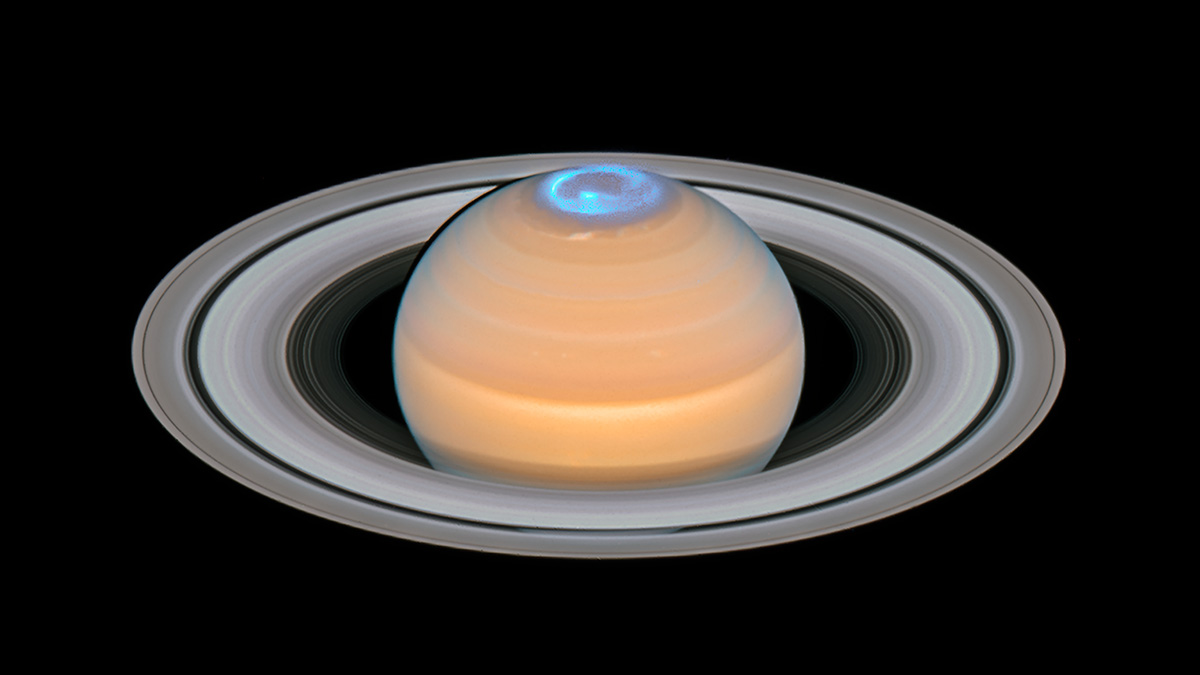
A blue ring of auroral emission glows above Saturn’s north pole.
Posted inNews

Saturn’s Powerful Winds Explain Changes in the Length of Its Day

Katherine Kornei, Science Writer by Katherine Kornei 17 March 20228 August 2022

Atmospheric winds moving at more than 7,000 kilometers per hour distort Saturn’s magnetic field, revealing why spacecraft have measured changes in the length of a day on the ringed world.

The three CubeSats from the MDASat constellation sit in a clean room at Cape Peninsula University of Technology, Cape Town, South Africa.
Posted inNews

Satellites Help Cement South Africa’s Space Industry

by Munyaradzi Makoni 16 March 20222 July 2025

A trio of CubeSats allows South Africa to showcase its growing space industry as well as monitor its coastal zones.

Posts pagination

Newer posts 1 … 43 44 45 46 47 … 126 Older posts
Over a dark blue-green square appear the words Special Report: The State of the Science 1 Year On.

Features from AGU Publications

Research Spotlights

Extensive Sand Dune Loss Threatens California Coast

26 June 202625 June 2026
Editors' Highlights

Where Methane is Emitted Matters for Global Burden

18 June 202616 June 2026
Editors' Vox

Small-Scale Indian Ocean Dynamics Underpin Marine Ecology and Climate

4 June 20263 June 2026
Eos logo at left; AGU logo at right

About Eos
ENGAGE
Awards
Contact

Advertise
Submit
Career Center
Sitemap

© 2026 American Geophysical Union. All rights reserved Powered by Newspack