• About
  • Special Reports
  • Topics
    • Climate
    • Earth Science
    • Oceans
    • Space & Planets
    • Health & Ecosystems
    • Culture & Policy
    • Education & Careers
    • Opinions
  • Projects
    • Postcards From the Field
    • ENGAGE
    • Editors’ Highlights
    • Editors’ Vox
    • Eos en Español
    • Eos 简体中文版
    • Print Archive: 2015–2025
  • Policy Tracker
  • Blogs
    • Research & Developments
    • The Landslide Blog
  • Newsletter
  • Submit to Eos
  • AGU.org
  • Career Center
  • Join AGU
  • Give to AGU
  • About
  • Special Reports
  • Topics
    • Climate
    • Earth Science
    • Oceans
    • Space & Planets
    • Health & Ecosystems
    • Culture & Policy
    • Education & Careers
    • Opinions
  • Projects
    • Postcards From the Field
    • ENGAGE
    • Editors’ Highlights
    • Editors’ Vox
    • Eos en Español
    • Eos 简体中文版
    • Print Archive: 2015–2025
  • Policy Tracker
  • Blogs
    • Research & Developments
    • The Landslide Blog
  • Newsletter
  • Submit to Eos
Skip to content
  • AGU.org
  • Career Center
  • Join AGU
  • Give to AGU
Eos

Eos

Science News by AGU

Support Eos
Sign Up for Newsletter
  • About
  • Special Reports
  • Topics
    • Climate
    • Earth Science
    • Oceans
    • Space & Planets
    • Health & Ecosystems
    • Culture & Policy
    • Education & Careers
    • Opinions
  • Projects
    • Postcards From the Field
    • ENGAGE
    • Editors’ Highlights
    • Editors’ Vox
    • Eos en Español
    • Eos 简体中文版
    • Print Archive: 2015–2025
  • Policy Tracker
  • Blogs
    • Research & Developments
    • The Landslide Blog
  • Newsletter
  • Submit to Eos

temperature

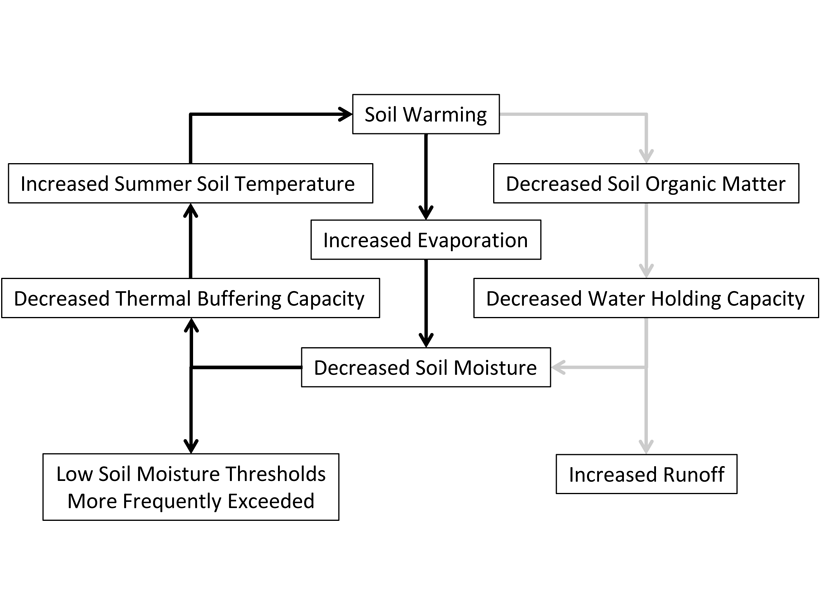
Schematic showing hypothesized feedbacks of soil warming, the ability of soil to buffer warming, and the amount of water soil can hold
Posted inEditors' Highlights

Soil Remains Warmer and Drier After Long-term Warming Stops

by W. M. Hammond 23 July 202022 March 2023

Pausing a long-term soil warming experiment revealed that previously warmed plots remained both warmer and drier compared to plots which had not experienced previous soil warming.

Two diamonds in the shape of a diamond anvil cell
Posted inAGU News

A Dive into the Deep Earth

Heather Goss, AGU Publisher by Heather Goss 24 June 202030 November 2022

In July, Eos looks at the incredible capabilities scientists have developed to recreate the enormous pressures and temperatures that exist far below the planet’s surface.

A green laser beam streams between two parts of a cylindrical instrument.
Posted inFeatures

Earth’s Core Is in the Hot Seat

Jenessa Duncombe, Staff Writer by Jenessa Duncombe 24 June 202019 August 2022

How old is Earth’s inner core? High-pressure and high-temperature experiments suggest that our planet’s inner furnace may be much younger than expected.

A canopy view of Morgan-Monroe State Forest in southern Indiana
Posted inResearch Spotlights

Hardwood Forest Soils Are Sinks for Plant-Produced Volatiles

by David Shultz 7 May 202031 October 2022

New research identifies temperature, moisture, and soil fungi as important factors in influencing how biogenic volatile organic compounds cycle between plants and the atmosphere.

Maps showing observed (left) and simulated (right) subsurface ocean heat content changes in the Southern Ocean
Posted inEditors' Highlights

Explaining Cold and Fresh Southern Polar Ocean Surface Waters

by P. Rizzoli 6 May 202017 August 2022

Global climate models do not reproduce observed trends of the Southern polar ocean surface, but an increase in wind-transported sea ice that melts and inhibits mixing may account for the disparity.

Map of South Asia showing population exposure to accumulated relative intensity in the decade around 2050 under a high emissions climate change scenario relative to the decade around 2000.
Posted inEditors' Highlights

Health Concerns from Combined Heat and Pollution in South Asia

by D. Wuebbles 24 April 202014 April 2023

Little research has studied the impacts of combined climate conditions. Together, heat events and poor air quality in South Asia amplify the imminent health challenge.

Placid view of Lake Windermere, Cumbria, and low rolling hills
Posted inNews

New Classification System for Lakes Forecasts a Warming Trend

Tim Hornyak, Science Writer by Tim Hornyak 2 April 20206 March 2023

Researchers devised a system of nine thermal categories for lakes and estimate that 79% of northern frigid lakes could become warmer types.

A clean two-lane road leads into a sunny winter day in Tromsø, Norway.
Posted inNews

Cleaner Air Takes Some of the Bite out of European Winters

Tim Hornyak, Science Writer by Tim Hornyak 26 February 202028 February 2023

Scientists find that reduced aerosol emissions correspond to fewer extremely cold days.

Rock leaves a trail on a cracked, dry lake bed.
Posted inNews

Does This Fossil Reveal a Jurassic Tropical Freeze?

by H. Leifert 19 February 202027 January 2023

On view for over a century, a fossil slab may display evidence of tropical freezing during the Jurassic, but scientists never noticed it—until one finally did. Some colleagues are not convinced.

A ski chairlift sits motionless above bare ground.
Posted inNews

Here’s What Your Favorite Ski Resort May Look Like in 2085

Jenessa Duncombe, Staff Writer by Jenessa Duncombe 9 January 202028 October 2022

Ski seasons at many of North America’s western resorts might melt away by 2085 because of warming temperatures.

Posts pagination

Newer posts 1 … 15 16 17 18 19 … 27 Older posts
Over a dark blue-green square appear the words Special Report: The State of the Science 1 Year On.

Features from AGU Publications

Research Spotlights

As Wildfires Increase in the West, So Does Suppression Spending

10 June 202610 June 2026
Editors' Highlights

Pre-Existing Structure and Stress Shape Geothermal-Induced Seismicity

2 June 20261 June 2026
Editors' Vox

Small-Scale Indian Ocean Dynamics Underpin Marine Ecology and Climate

4 June 20263 June 2026
Eos logo at left; AGU logo at right

About Eos
ENGAGE
Awards
Contact

Advertise
Submit
Career Center
Sitemap

© 2026 American Geophysical Union. All rights reserved Powered by Newspack