
A new paper in the journal landslides (Yang et al. 2026) details the 6.8 million cubic metre Huangci Landslide in China, which was a reactivation on a slope that has suffered two other failures in recent decades.

On 10 December 2025, failure occurred in the large Huangci landslide in Gansu Province, China. The event is described in a new paper (Yang et al. 2026) in the journal Landslides (this link should provide access even though the article is paywalled). The paper is fascinating as this is a very complex slope with an interesting history of deformation, and because large failures do not usually occur in the winter months in this part of China.
The location of the Huangci landslide is [36.08983, 103.32412]. This is a Google Earth image of the site, captured in 2004:-
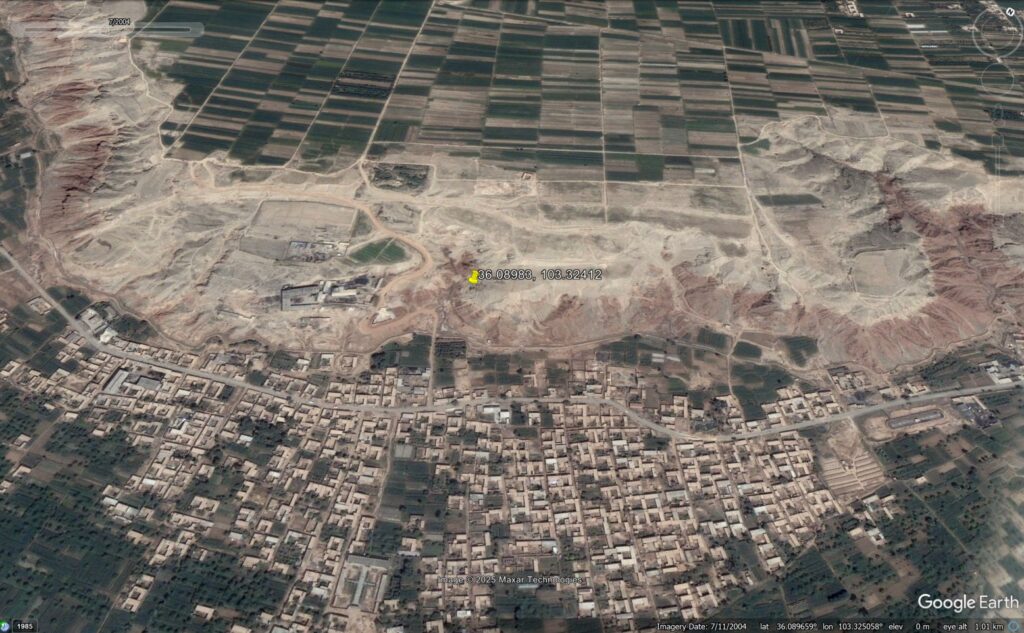
The geology consists of loess overlying mudstones. As the image above shows, the site had previously failed. The houses at the foot of the slope are the homes of people displaced in 1968 during the impoundment of the Liujiaxia Reservoir. Note also the farmland on the terrace behind the landslide. This is an arid area, so this farming requires extensive irrigation.
According to Yang et al. (2026), the failure that can be seen in the image above occurred on 30 January 1995. About 6 million cubic metres of rock and loess were involved, creating a landslide with a width of about 500 metres and a length of about 370 m.
The Huangci landslide failed again on 14 May 2006, this time with a volume of about 4 million cubic metres. The image below, captured in 2013, shows the aftermath:-
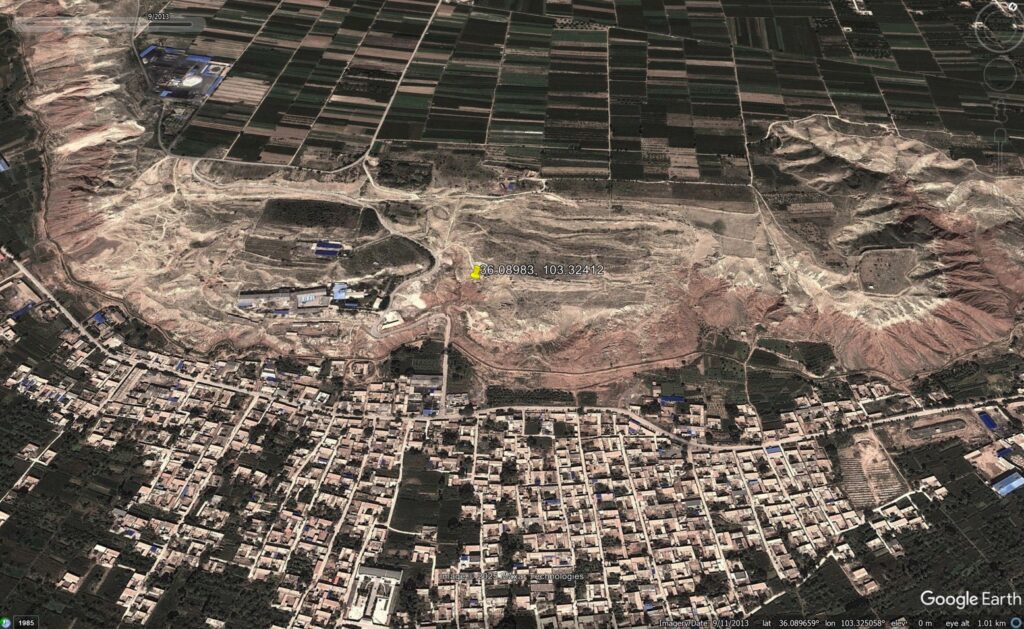
In this failure, 10 houses were destroyed.
The most recent failure of the Huangci landslide occurred on 10 December 2025. This time, a larger mass failed, creating a landslide with a volume of about 6.77 million cubic metres, a length of up to about 740 metres and a width of up to about 420 metres. There is a spectacular video on Youtube showing the aftermath of the failure:-
The still below gives an impression of the scale of the failure:-
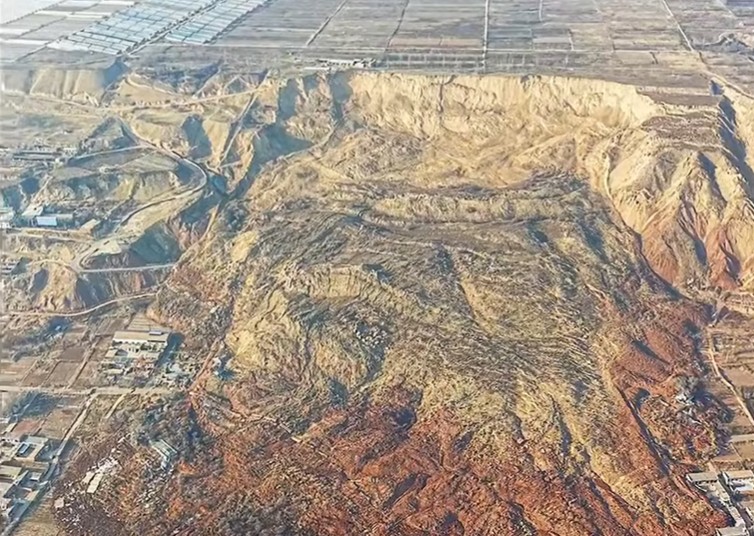
According to Yang et al. (2026), this failure destroyed 39 houses plus a range of infrastructure that includes power transmission systems, irrigation systems, water supply systems and transportation facilities. The site had been successfully evacuated as a result of a community-operated early warning system.
As noted above, this is an unusual time of the year for a landslide of this type. However, Yang et al. (2026) conclude that the underlying driver is irrigation on the terrace upslope from the landslide, driving a rise in the groundwater and consequent progressive deformation of the slope. This led to weakening of the mudstones that were buttressing the failure, eventually triggering collapse.
Reference
Yang, Y. et al. 2026. The reactivated Huangci landslide at the Heifangtai terrace, Gansu Province, China, on December 10, 2025. Landslides. https://doi.org/10.1007/s10346-026-02765-2.