
A new study (Akhila et al. 2025) in the the journal Development in Practice examines the mental health impacts of the 30 July 2024 Wayanad landslides in India.

In this blog, I generally provide a commentary on recent landslide events and a review of subsequent studies of landslides. I regularly discuss the impacts on the local population at the time of the disaster, but in 18 years I have almost never written about the long term effects on those people. This is primarily because of a lack of literature that covers this issue for landslides. This is particularly true of mental health impacts.
However, it is logical to assume that the mental health impacts must be profound. Landslides are deeply traumatic events even setting aside the loss of friends and family. They are violent and unpredictable in their behaviour, and people are often buried alive, which is a fundamental human fear.
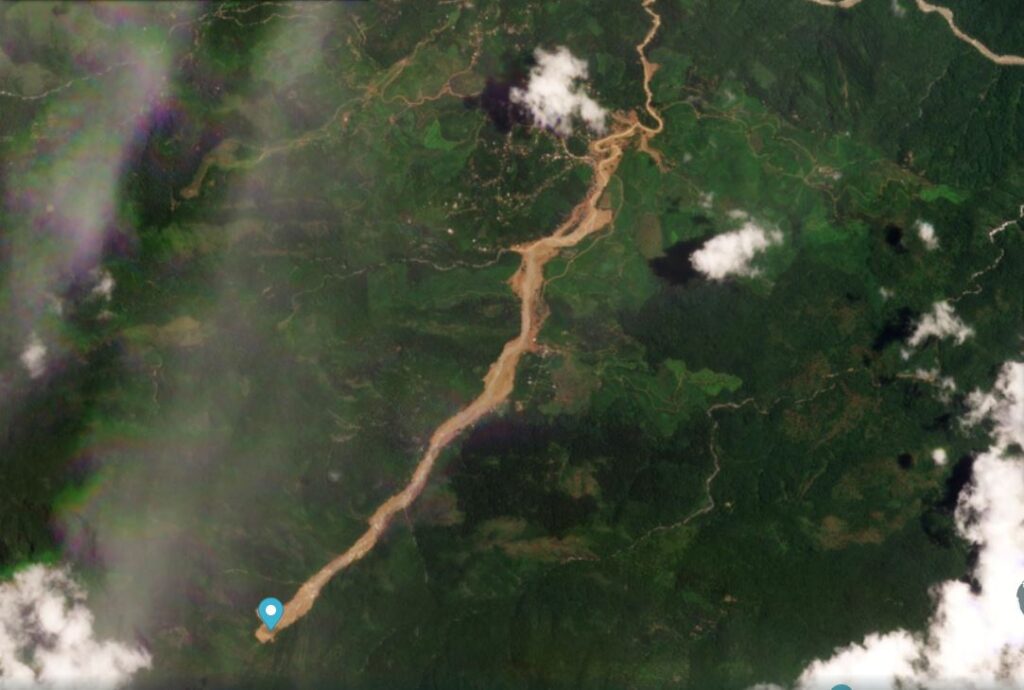
In that context, a faascinating study (Akhila et al. 2025) has been published in the journal Development in Practice that examines the mental health impacts of the 30 July 2024 Wayanad landslides in India, which are believed to have killed 454 people and injured 397 more. Back at the time, I posted this image of the aftermath of these channelised debris flows:-
The first author was present in some of the 53 camps established in the immediate aftermath of the landslides to house and care for the 6,759 people displaced by the landslides. The paper provides a reflection on their experiences.
The short term impacts of the landslide on survivors decumented by Akhila et al. (2025) are perhaps unsurprising but valuable. They describe emotional breakdown:-
“The very grounds they once called home had turned into graveyards of their people. Many survivors now carry the weight of survivor’s guilt, asking why they survived when others didn’t. This leads to feelings of self-blame, helplessness, and in some cases, post-traumatic stress symptoms.”
Survivors lost cherished places and livelihoods, and their “sense of security, identity, and hope was disrupted”. This triggered “heightened anxiety, sleep disturbances, a lingering sense of fear and uncertainty about the future.” The picture that emerges is one of profound collective trauma.
The longer term mental health impacts are also deeply troubling. Akhila et al. (2025) describe how the communities were left in a constant state of fear of a repeat of the event. This was heightened by anxiety about rehabilitation, livelihoods and relocation. The population lost their homes and the fabric of their communities; some inevitably turned to alcohol or substance abuse, leading to high risk behaviours. Financial crises further exacerbated the challenges for many.
Akhila et al. (2025) also highlight the particular mental health impacts for children, older people, those with disabilities and those who were from outside of the area. The ways that landslide disasters have particular impacts on different groups is a really interesting topic.
But the authors also look at the impact on first responders, noting that many of these individuals were themselves survivors, and some lost loved ones. They note that the responders were “forced to work under extreme stress during the disaster relief efforts. Many were deployed without prior debriefing and continue to carry the emotional distress from that period into their daily lives.”
Finally, Akhila et al. (2025) briefly consider the provision of long term mental health support for survivors. They note that there were many gaps in provision of such services, leading to many people failing to receive the support that they needed, but also to some duplication of effort due to poor coordination. Providing such services affectively would stretch any community, but the authors recommend better planning and integration of services.
This is an incredibly valuable piece of work that explores an issue so rarely considered for landslides. The picture described in the paper must be replicated again and again around the world. It would be great to see both more studies of this type and, of course, better provision of mental health support in the aftermath of landslide disasters.
Reference and acknowledgement
Akhlia, V et al. 2025. Mental health aftershocks following the high-intensity landslide in Southern India. Development in Practice, https://doi.org/10.1080/09614524.2025.2551850.
Thanks as ever to the kind people at Planet Labs for providing access to their amazing imagery.