Research & Developments is a blog for brief updates that provide context for the flurry of news that impacts science and scientists today.
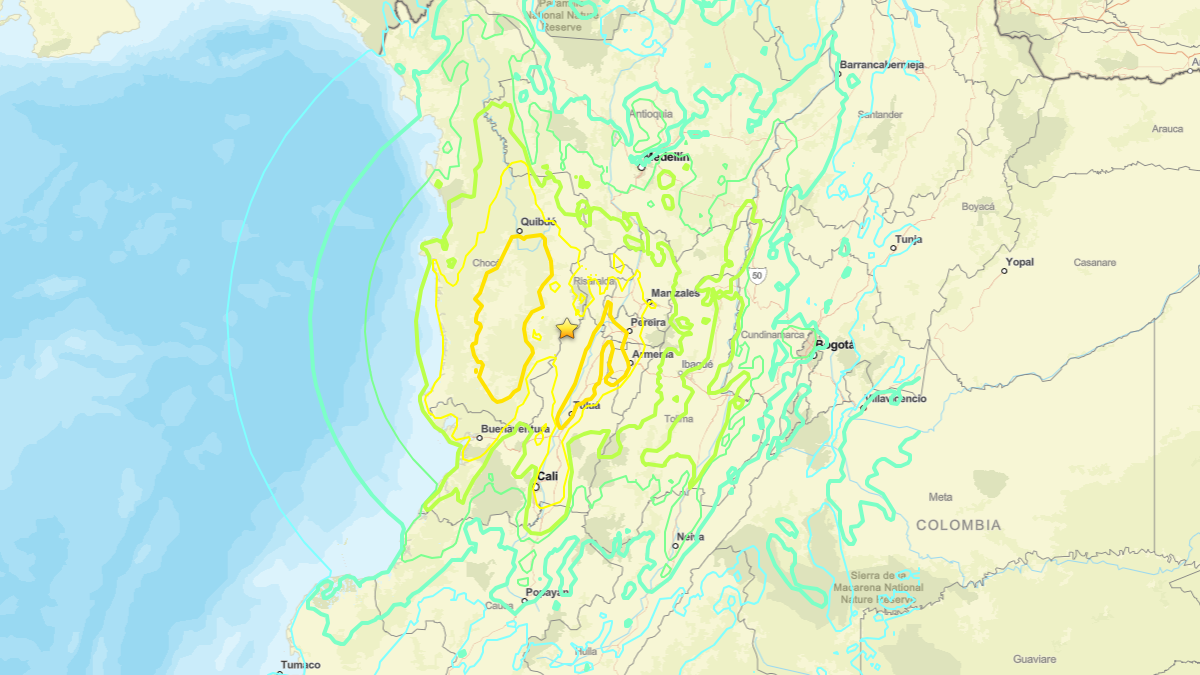
Western Colombia was struck by a magnitude 7.4 earthquake this morning at 7:34 a.m. local time. The epicenter was near San Jose Del Palmar in the region of Chocó, about 280 kilometers (173 miles) west of the capital of Bogota. It was followed by a magnitude 4.8 aftershock at 8:18 a.m. local time and a magnitude 3.8 aftershock at 10:01 a.m. local time.
The earthquake was the result of a strike-slip faulting of the Nazca plate beneath the South American plate, at the intermediate depth of about 110 kilometers (68 miles), the U.S. Geological Survey reported.
Julio Fierro Morales, general director of the Colombian Geological Survey, said in a statement that shaking was also felt in Venezuela, Ecuador, and Panama, and that this was the strongest earthquake recorded in Colombia in the last decade. The Colombian Maritime Authority reported that there is no associated threat of a tsunami.
As of 12:24 p.m. ET, the death toll was at least 47, with 18 deaths in the town of Pereira, three in Manizales, and one in Buenaventura, according to The Guardian. The USGS issued an orange alert, indicating that “significant casualties and damage are likely and the disaster is potentially widespread. Past orange alerts have required a regional or national level response.”
Nubia Carolina Córdoba-Curi, governor of the department of Chocó, reported that the department’s capital city of Quibdó has experienced injuries and severe damage to buildings. Buildings have collapsed in the cities of Cali, Manizales, and Pereira—including Pereira’s passenger airport terminal.
According to the USGS, the region does not typically experience earthquakes exceeding magnitude 7; only two earthquakes of magnitude 7 or larger have occurred within 250 kilometers of this earthquake since 1950.
The quake is the latest along the Pacific Ring of Fire, a tectonic belt surrounding most of the Pacific Ocean where the vast majority of the world’s earthquakes occur. Two days earlier, Alaska, also along the Ring of Fire, experienced a 5.6 magnitude earthquake. In June, thousands died when Venezuela was hit by a magnitude 7.2 foreshock, followed almost immediately by a magnitude 7.5 mainshock.
—Emily Gardner (@emfurd.bsky.social), Deputy Editor
These updates are made possible through information from the scientific community. Do you have a story about science or scientists? Send us a tip at [email protected].