

Editors’ Highlights are summaries of recent papers by AGU’s journal editors.
Source: Community Science
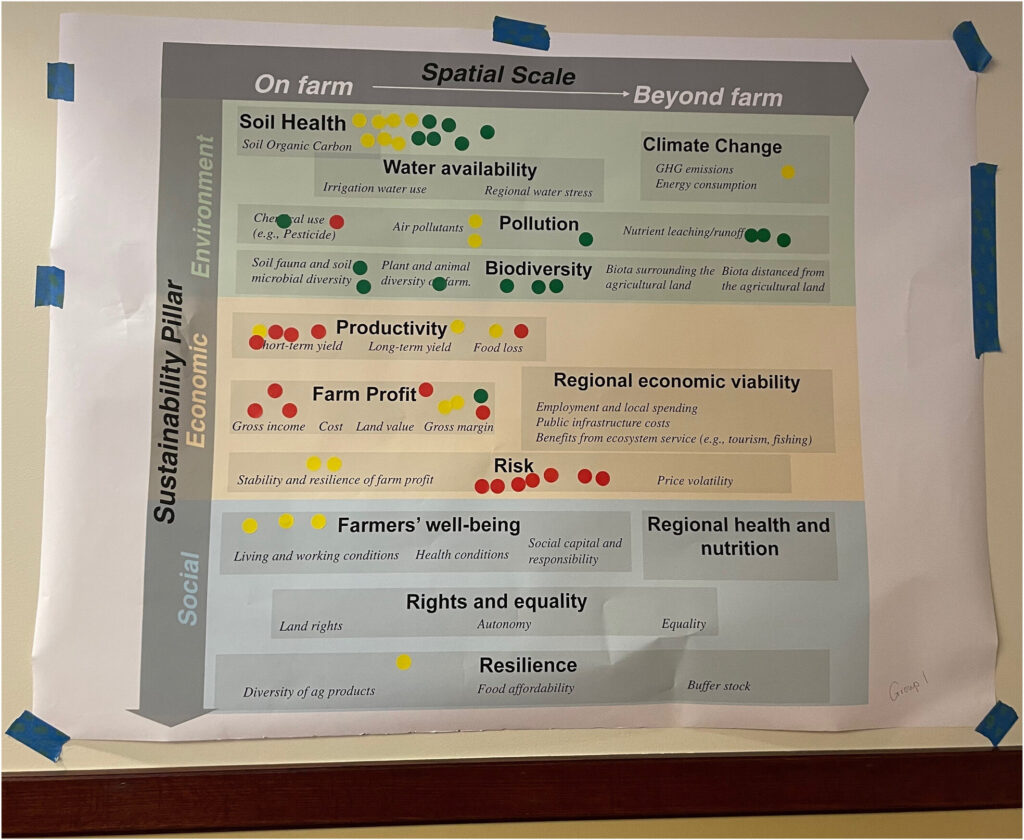
What are the benefits of sustainable agriculture practice, who reaps those benefits, and how do we measure them? Komarek et al. [2026] tackle those questions by integrating national-scale frameworks for assessing sustainable practices in agriculture with on-the-ground knowledge of farmers in the midwestern United States.
Through a combination of surveys and workshops, farmers and scientists worked together to a develop of usable and localized set of indicators for assessing the use of cover crops. “Indicators” are things you can measure to see how something is working; you can measure carbon in the soil to see if cover crops are making soil healthier. The paper describes the resulting indicators, but more importantly it shows that iterative engagement with farmers produces indicators that are easier to measure, give a more complete picture, and are more useful in decision-making that the indicators that come from national-level frameworks alone. It also reveals things that might have been missed otherwise: in this case, farmers recognized that some of the long-term benefits of cover crops accrued to landowners, while much of the short-term cost of cover cropping was born by the farmers who rented that land, illuminating a key challenge for increasing sustainable practices.
Citation: Komarek, A. M., Castellano, M. J., Jackson, K., Lee, A., Zhang, W., & Zhang, X. (2026). A participatory framework to assess agricultural sustainability: Cover cropping as an illustrative example. Community Science, 5, e2025CSJ000138. https://doi.org/10.1029/2025CSJ000138
—Rajul Pandya, Editor, Community Science Exchange