
Editors’ Vox is a blog from AGU’s Publications Department.
Every lightning flash has one defining moment: the return stroke, an intense surge of electric current that rockets upward along the ionized channel at a sizable fraction of the speed of light, unleashing the blinding flash, the crack of thunder, and the burst of radio energy that detection networks use to pinpoint strikes worldwide. Despite decades of study, a full, self-consistent explanation for why this current takes the shape it does — its rapid rise, its slower decay, its weakening and spreading as it climbs — has remained elusive.
In a new article published in Reviews of Geophysics, Caitano da Silva and colleagues at New Mexico Tech show that the Telegrapher’s Equations, a compact framework describing how electrical signals propagate along any conductor, can be adapted into a physically transparent model that derives all of these features from first principles — and reconciles them with decades of field and laboratory measurements. Here, the authors answer a few questions about their work.
In simple terms, what is the “lightning return stroke current”?
When a downward-moving leader from a thundercloud gets close enough to the ground, a channel of ionized air connects cloud to ground. At that instant, a powerful surge of electric current — the return stroke — rushes upward along this newly formed conducting path at a sizable fraction of the speed of light, carrying tens of thousands of amperes. This surge is what produces the visible flash, heats the air explosively to create thunder, and radiates the burst of radio waves that lightning detection networks use to pinpoint strikes. It’s the most energetic and consequential part of a lightning flash, even though it typically lasts only tens of microseconds.
Why are return strokes important to study?
The return stroke current is responsible for most of lightning’s real-world impacts. It causes billions of dollars in damage annually to power transmission lines and communication infrastructure, and it’s a leading ignition source for wildfires. It is also the atmosphere’s main natural source of nitrogen oxides, which influence atmospheric chemistry on regional and global scales. On top of that, the radio pulse the return stroke emits is exactly what national and global lightning-detection networks measure to locate strikes, supporting both hazard mitigation and weather forecasting. Understanding the physics that shapes this current — its peak strength, its speed, and how quickly it weakens — is therefore essential for protecting infrastructure and for interpreting the remote-sensing data scientists rely on.
What are the main types of models scientists use to simulate the return stroke?
Researchers have taken a few different approaches. “Gas-dynamic” models solve the detailed physics of how the current heats and expands the channel of air, which is useful for calculating channel temperature and chemical byproducts, but they need the current as an input rather than predicting it. To calculate the current and resulting electromagnetic fields directly, three families of models exist: “engineering models,” which simply assume a plausible mathematical shape for the current and how it weakens with height; “antenna-theory models,” which apply full numerical electromagnetics; and “distributed-circuit models,” which treat the lightning channel as an electrical transmission line. This last approach, governed by the Telegrapher’s Equations, is the focus of this review.
What are the Telegrapher’s Equations, and what can they tell us about return strokes?
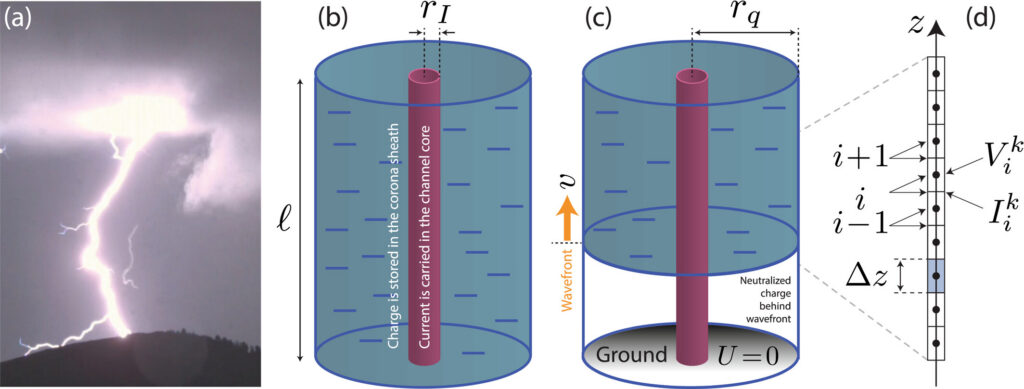
The Telegrapher’s Equations describe how current and voltage evolve along any conductor with distributed resistance, inductance, and capacitance — they are widely used to model how signals travel in power transmission cables. We model the lightning channel as two concentric cylinders: a thin core that carries the current and a wider sheath that stores the associated charge. Solved this way, the equations self-consistently explain the current’s signature shape at ground level — a fast rise, set by how quickly the leader tips connect and thermalize, followed by a slower decay, governed by the channel’s electrical resistance. We also explain why the current wave travels at a fraction of light speed, why it weakens as it climbs, and why the current pulse disperses over distance — all derived from a handful of physical parameters rather than assumed curve shapes.
What are the benefits and limitations of this approach compared to other techniques?
Its biggest strength is speed paired with insight: the model runs orders of magnitude faster than full electromagnetic or gas-dynamic simulations, yet still yields exact analytical solutions in several limiting cases and explains why the empirical “engineering models” long used in industry take the mathematical forms they do. That transparency has made it a teaching tool in its own right — the model anchors how the return stroke is taught in the “Physics of Lightning” graduate course at New Mexico Tech, letting students derive lightning’s key features from first principles rather than take them on faith. Its main limitation is a simplifying assumption baked into the mathematics: it treats the electromagnetic fields as purely transverse to the channel, which breaks down for real, tortuous, branching channels. The model also simplifies the charge-storing corona sheath and requires care at the channel’s upper boundary to avoid artificial wave reflections.
What remaining questions or knowledge gaps need more research?
Two open questions stand out. The first is how to extend this framework — built around a single, straight channel — to capture the full complexity of a real lightning flash: its three-dimensional, branching geometry, and the sequence of multiple return strokes and other subprocesses, such as M-components and continuing currents, that typically follow the first stroke down the same channel.
The second is how to properly incorporate corona sheath dynamics into the Telegrapher’s Equations themselves. The present model treats the sheath’s charge as spreading out instantaneously over a fixed radius, but in reality, the sheath expands and charges on a finite timescale, and self-consistently coupling that behavior to the equations remains unresolved. Solving both problems — geometric realism and sheath physics — would sharpen predictions of lightning’s electromagnetic fields and its hazards to infrastructure, wildfires, and atmospheric chemistry.
—Caitano da Silva ([email protected],  0000-0003-3728-3035), New Mexico Institute of Mining and Technology, United States; Logan Baeza, New Mexico Institute of Mining and Technology, United States; Jacob Wemhoner (0000-0002-8917-3009), New Mexico Institute of Mining and Technology, United States; and Saulo Orizaga (0009-0000-9635-8100), New Mexico Institute of Mining and Technology, United States
Editor’s Note: It is the policy of AGU Publications to invite the authors of articles published in Reviews of Geophysics to write a summary for Eos Editors’ Vox.