
Editors’ Highlights are summaries of recent papers by AGU’s journal editors.
Source: Tectonics
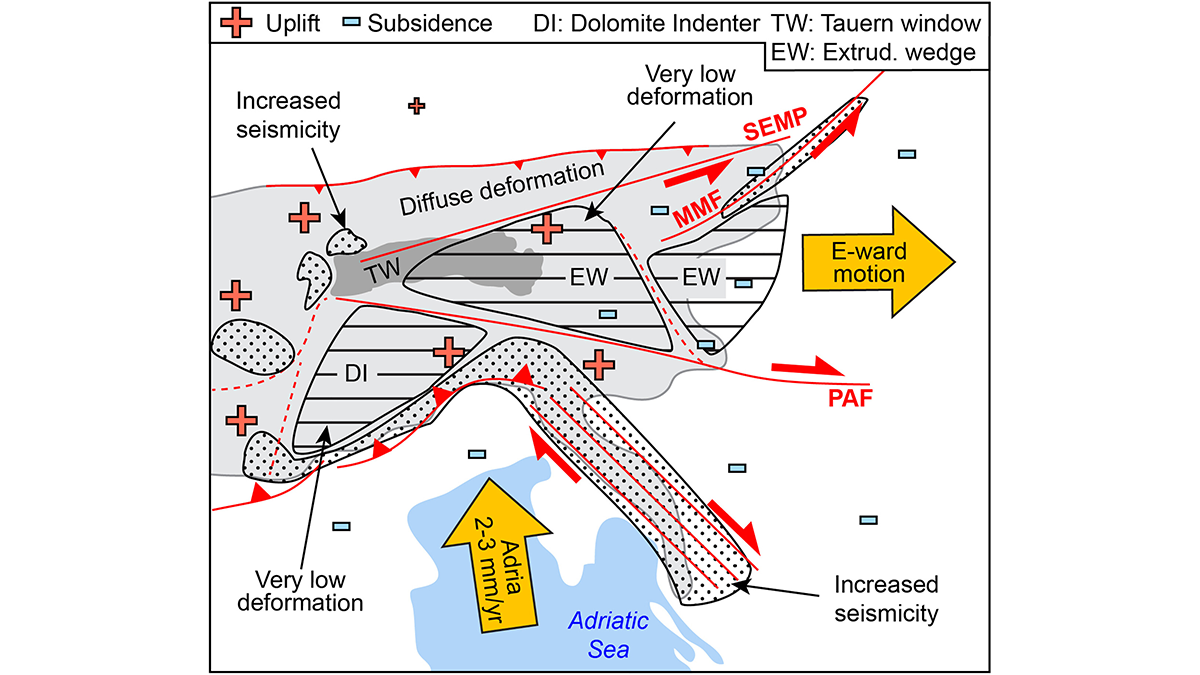
The Eastern and Southern Alps deform slowly compared with many tectonically active regions worldwide, making their ongoing movements especially difficult to detect. Grützner et al. [2026] provide an unusually detailed synthesis of decades of research across nine countries, combining evidence from different datasets, methods, catalogues, and research traditions. By comparing and reconciling these sources, the study creates a comprehensive framework for understanding how active faults and earthquakes relate to climate, the structure of Earth’s outer rocky layer, and deeper processes within the planet.
The results show that present-day deformation is controlled mainly by a strong crustal block beneath the Dolomites pushing into the Alps, movement between relatively rigid blocks of rock, and uplift as the land rebounds following the melting of ice-age glaciers. The slow movement of hot mantle rock deep within Earth appears to play a smaller role than previously proposed. The areas of greatest earthquake hazard are concentrated along the southern edge of the Alps and where the Alps meet the Dinarides. This synthesis will provide an important reference for researchers studying the Alps and other slowly deforming regions, where weak tectonic signals and varied datasets make earthquake-hazard assessment particularly challenging.
Citation: Grützner, C., Petersen, G., Serpelloni, E., Metzger, S., Moernaut, J., Ustaszewski, K., et al. (2026). Active tectonics of the eastern and southern Alps – Crustal response to deep processes? A review. Tectonics, 45, e2025TC009267. https://doi.org/10.1029/2025TC009267
—Lothar Ratschbacher, Associate Editor; and Djordje Grujic, Editor, Tectonics