
Earth acted as a geological sponge for oxygen for more than a billion years before the Great Oxidation Event (GOE) occurred about 2.3 billion years ago, according to new research. Geologists had long suspected that limited amounts of gaseous oxygen were produced by bacteria on Earth before the GOE, a tipping point that transformed the primordial oxygen-free atmosphere forever into the life-sustaining envelope that it is today. But a new study in Nature Geoscience is the first to establish how long ago such oxygen started being absorbed by geological processes in Earth’s mantle.
Early Earth’s mantle contained a certain amount of oxygen, explained geologist Hugo Moreira of the University of Portsmouth in the United Kingdom. But the first whiffs of gaseous oxygen from colonies of photosynthesizing cyanobacteria ultimately added to the oxygen in the mantle and can be tracked through the inclusions in some zircon crystals, he said.
“A little oxygen made a huge difference.”
Initially, the amount of atmospheric oxygen was very small, but “that little oxygen made a huge difference” because oxygen was so rare elsewhere in the environment, Moreira said. These early traces of oxygen in the atmosphere were quickly consumed in chemical reactions through oxidative weathering, or reactions with the outer layers of rocks on the surface. That process, in turn, resulted in more oxygen within Earth’s mantle when the surface rocks were drawn down by early geological processes similar to modern subduction, in which one tectonic plate slides beneath another.
“The discrepancy between how the mantle evolves by itself and how the mantle evolves with the addition of [atmospheric] oxygen is resolvable” through the examination of the inclusions in some zircon crystals, Moreira said.
Studying Sanukitoids
“Zircons are really exciting to scientists, as they are essentially time capsules.”
Moreira is the first author of the new study, which examined zircon crystals from coarse-grained igneous rocks called sanukitoids that are found in cratons—geological regions near the centers of many modern continents that geologists consider their ancient cores. Sanukitoids serve as a geochemical window into the formation of cratons, and they frequently contain zircon crystals with trapped inclusions of apatite, a phosphorus-based mineral. These apatite inclusions can also include traces of sulfur, and the oxidation state of the sulfur indicates the amount of oxygen in the mantle when the apatites formed. Zircons also contain uranium, which radioactively decays at a known rate, meaning testing can determine just when zircon crystals formed, often to within a million years or so. “These minerals are really exciting to scientists, as they are essentially time capsules,” Moreira said.
As a result, the new study establishes both the date of a sanukitoid and its oxidation state at the time it formed. It looks at subarc regions of the mantle—places in the upper mantle that were once beneath active volcanoes—because the researchers theorize they would be the most affected by surface oxidation. But the study’s wider implications are for the entire mantle, stretching down to Earth’s core, because geologists think the rocks created in subarc regions circulate in geological time to much deeper regions.
The Great Oxidation
Billions of years ago, most microbes were anaerobic, producing energy through the consumption of iron and other minerals in shallow waters and around hydrothermal vents.
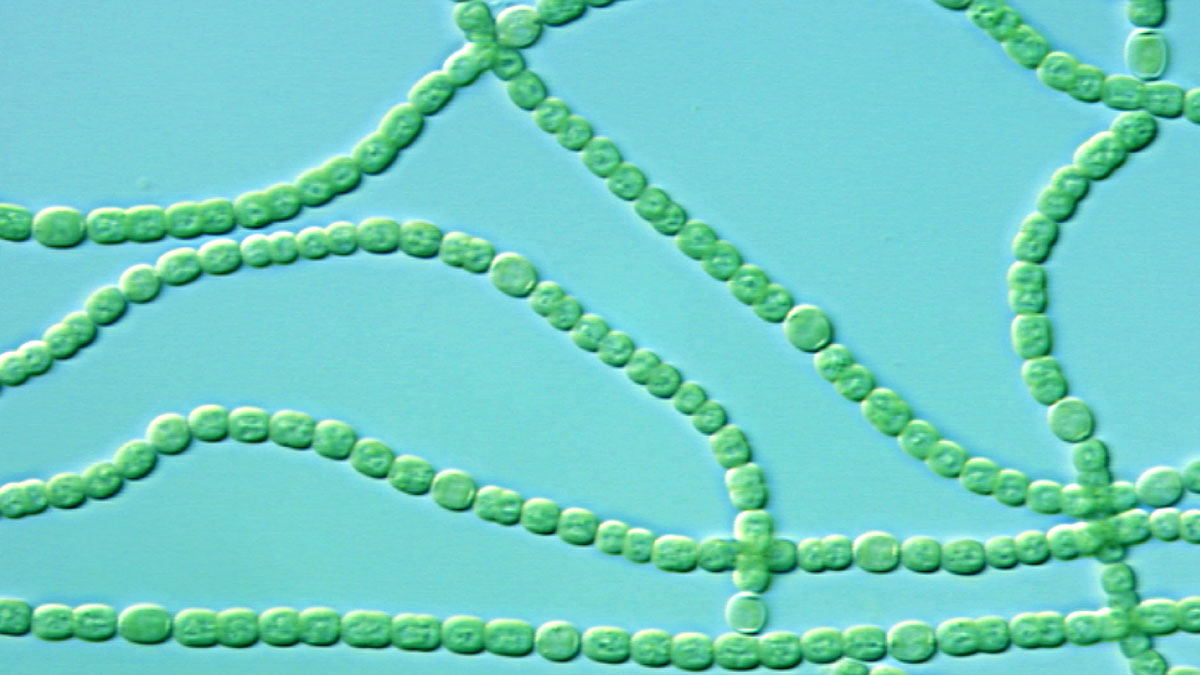
The evolution of photosynthesis by cyanobacteria was a major advance. It liberated life from its reliance on anaerobic processes for energy and allowed cyanobacteria to grow in ever-larger colonies, wherever water and sunlight were present. Eventually—roughly 2.3 billion years ago, according to the new study—the oxygen given off by cyanobacteria as a by-product accumulated in the atmosphere and caused the GOE. One of its first consequences was a mass extinction of anaerobic microbes, which couldn’t tolerate oxygen. But the newly oxygen-rich atmosphere led to complex, oxygen-breathing life.
The new study by Moreira and his colleagues determines that Earth’s mantle was already reacting to the oxygen whiffs in the atmosphere from cyanobacteria as long as 3.4 billion years ago—more than a billion years before the GOE. The researchers noted a significant increase in the activity of oxygen in the mantle between 3.4 billion and 3 billion years ago, indicating that this process had started by that time—much earlier than most scientists thought.
Geologist Richard Palin at the University of Oxford, who wasn’t involved in the study, called the work a “clever approach” to the question of dating the first traces of atmospheric oxygen from cyanobacteria. Palin studies rocks from Earth’s Archaean era that are between 4 billion and 2.5 billion years old and formed before the GOE, during the period covered by the study.
He told Eos his main qualm was that the sample size of sanukitoid rocks used in the study was relatively small—just 14 rock samples from around the world, yielding a total of 72 zircon crystals and 39 apatite inclusions. “The dataset is quite sparse,” he said, while acknowledging that better evidence will be hard to find: “Sanukitoids are rare.…If they were more abundant, you would be able to do a more comprehensive study.”
—Tom Metcalfe (@HHAspasia), Science Writer