

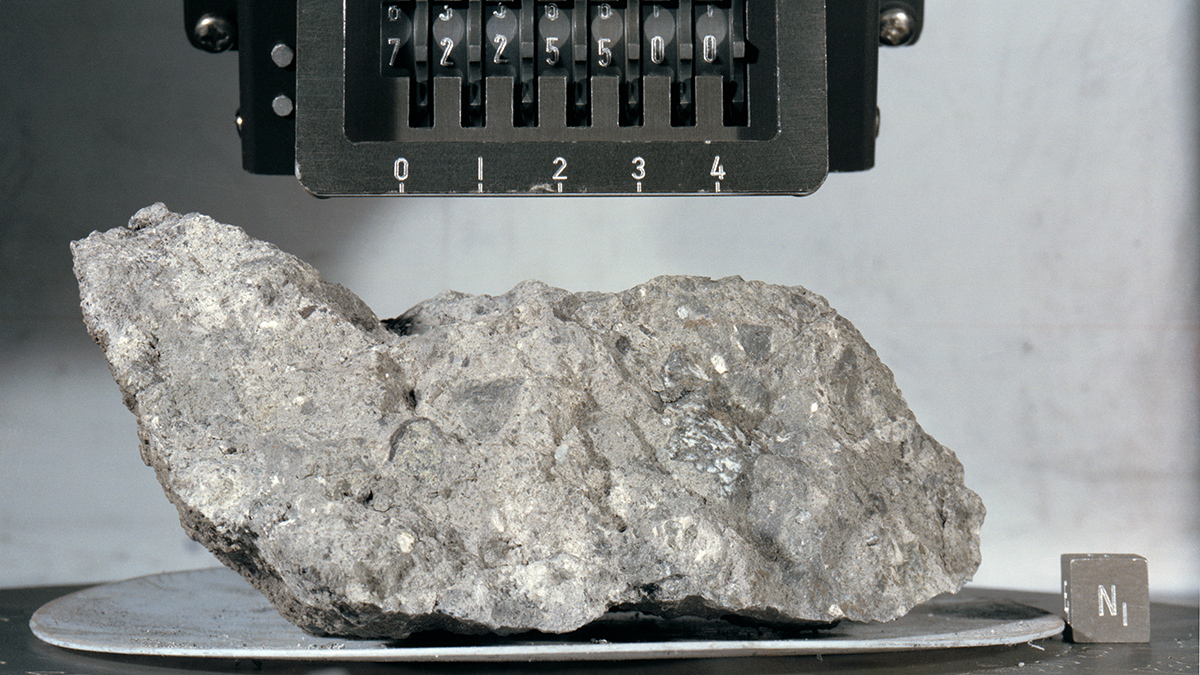
Scientists know that since about 900 million years ago, our Moon has had no magnetic field, and data from lunar soil and observations of lunar crust show that it had either a weak or nonexistent magnetic field even before then. But Moon rocks from NASA’s Apollo missions indicated the opposite, recording strangely strong magnetism during the Moon’s early history between 3.5 billion and 3.9 billion years ago.
The Moon’s inner core is only about one seventh the size (radius) of the Moon itself, meaning that it would be difficult for the Moon to create a dynamo strong enough to explain the magnetism measured in the Apollo samples. (For comparison, Earth’s inner core is about 20% of our planet’s radius.)
“These two conflicting stories just keep fighting each other.”
This discrepancy raised a question for paleomagnetists: Was the Moon’s magnetic field truly weak or truly strong in its early history? “These two conflicting stories,” said Claire Nichols, a paleomagnetist at the University of Oxford, “just keep fighting each other.”
The question inspired Nichols and her team to analyze data from Apollo missions once more. Their results, published in Nature Geoscience, show that both understandings of lunar samples are partly right: The Moon’s early magnetic field was probably mostly weak or nonexistent, punctuated by very short bursts of strong magnetism.
The study is “an important step forward, because it’s a work that recognizes both the evidence for the presence and the absence of a magnetic field on the Moon,” said John Tarduno, a geophysicist at the University of Rochester who was not involved in the new study.
Revisiting Apollo Samples
Many Apollo samples consist of rocks known as mare basalts. Mare basalts are found on the flat plains (lunar maria) that provided suitable landing sites for most of Apollo’s lunar modules, and that’s where astronauts collected most samples.
In the new study, researchers investigated whether a link existed between the intense magnetism of the Apollo samples and their composition. This approach was “really interesting,” explained Sabine Stanley, a planetary scientist at Johns Hopkins University, because it allowed scientists to ask the question of “where did these rocks come from, as opposed to what’s carrying the magnetism.” Stanley was not involved in the new research.
The team found that large amounts of titanium in the Apollo samples correlated with evidence of increased magnetism on the Moon. This result pointed to one likely explanation: The formation of these titanium-rich basalts was somehow linked to the temporary generation of strong magnetic fields.
“I was pretty blown away,” Nichols said. “Suddenly, it all makes sense.” Scientists can now “actually explain” every paleomagnetic observation from the Moon between 3.5 billion and 3.9 billion years ago, she said.
Modeling Magnetism
But what exactly was the relationship between Apollo’s titanium-rich basalts and instances of strong lunar magnetism?
To answer that question, the researchers used existing models that simulated the Moon’s interior.
The models showed the lunar core could feasibly generate strong magnetic fields when titanium-rich material melted at the boundary between the Moon’s core and mantle. This melting would spur high heat transfer (also called heat flux) across the boundary and create a strong dynamo. However, such a process would be possible only if the melting events were very short—less than 5,000 years. Longer melting periods would not be able to generate high enough heat transfers across the core-mantle boundary to create a strong magnetic field, Nichols said.
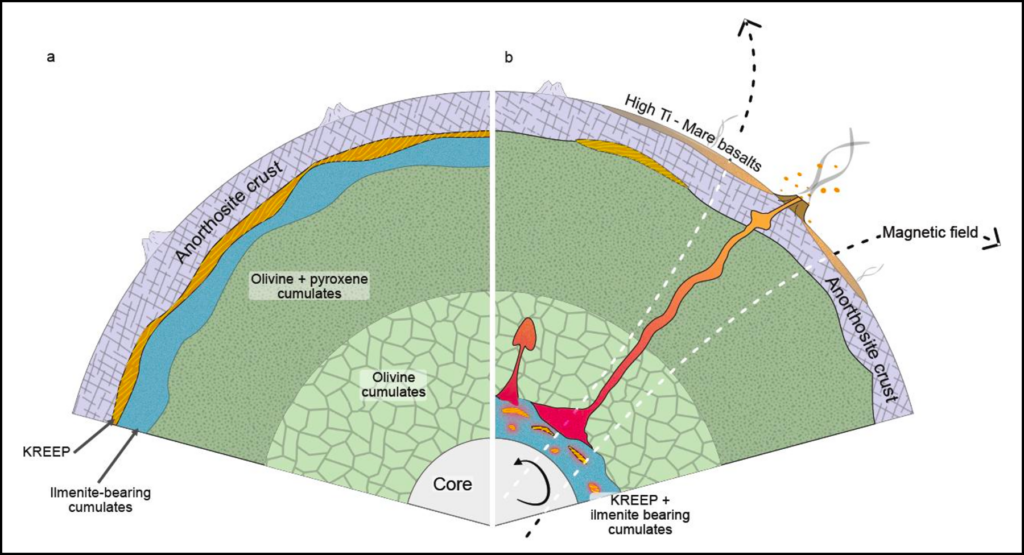
The results indicate that the Apollo samples are likely highly biased, meaning they document very brief periods of strong magnetism in the Moon’s early history, and do not record the hundreds of millions of years of weak or nonexistent lunar magnetism, according to the authors.
The new study is “a really nice systematic analysis to say that there really is a strong correlation [of lunar magnetism] to these high-titanium basalts, and looking for a causal mechanism related to those makes total sense,” Stanley said. However, “there’s a lot of work that needs to be done to see whether or not all the processes and timings that [the authors] are suggesting will actually work,” she added.
Heat flux “is only one criterion for a dynamo,” Tarduno said. “There are other things you have to consider.”
Tarduno, who said he liked the ideas proposed in the paper, agreed. The researchers’ description—of short, discrete melting events that cause strong lunar dynamos—works well to explain the paleomagnetic evidence, he said. But additional factors, such as the magnetic and hydrodynamic properties and the geometry of the Moon’s interior, should be added to more sophisticated models and dynamo simulations to further test whether that explanation is likely. Heat flux “is only one criterion for a dynamo,” he said. “There are other things you have to consider.”
Timing also needs to be better defined, Stanley said. The speed at which the mass of titanium-rich material sank to the Moon’s core, melted, and then rose back to the Moon’s surface would have determined the intensity of the magnetism of Apollo samples, so clarifying the timeline of mare basalt formation is critical.
Experiments on the lunar surface and additional sampling of Moon rocks, perhaps from future Artemis missions, may offer further insight into the origin of the Moon’s early magnetism, Tarduno said.
“It’s going to really depend on what the composition and structure of the Moon’s mantle is, which we need more information on,” Stanley said.
—Grace van Deelen (@gvd.bsky.social), Staff Writer