
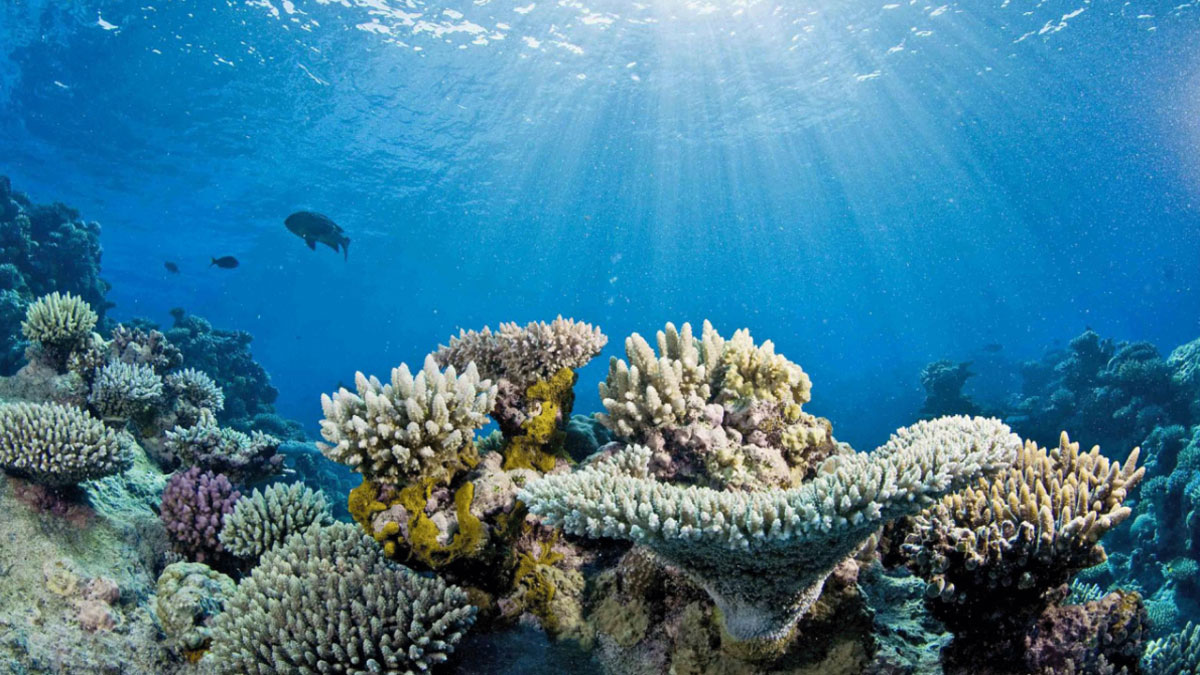
When exposed to environmental stressors like high ocean temperatures and excessive solar radiation, corals bleach and die. Coral reefs collapse, and their benefits—increased biodiversity, protection from coastal erosion, and local economic activity—also disappear.
Some researchers think stratospheric aerosol injection (SAI), one of the most well-studied methods of climate intervention, may help mitigate some of the effects coral bleaching when used in tandem with reductions in greenhouse gas emissions. SAI describes a process in which aerosols such as sulfur dioxide are injected into the stratosphere to reduce incoming solar radiation.
To find out whether SAI could help corals, researchers led by physical oceanographer Gouri Anil of Louisiana State University modeled future heat stress on shallow coral reefs with and without the intervention.
Anil and her fellow researchers found that SAI could help many vulnerable reefs survive through 2060, giving researchers and lawmakers time to develop more lasting solutions to mitigate climate change. Anil and the research team will present their results on 15 December at AGU’s Annual Meeting 2025 in New Orleans.
Cool Atmosphere, Warm Waters

Anil’s team calculated the heat stress that shallow equatorial reefs across the globe would experience under a moderate climate change scenario with surface sea temperature data from the United Nations’ World Conservation Monitoring Centre and the Community Earth System Model–Whole Atmosphere Community Climate Model version 6 (CESM-WACCM6).
The model used in the study is one of the best suited for this type of climate research, according to Alan Robock, a climatologist at Rutgers University who was not involved in the study. Built with data from volcanic eruptions, CESM2-WACCM6 is able to evaluate SAI as a similar release of sulfur dioxide into the atmosphere.
The modeling showed that without any intervention, nearly all the coral reefs studied would experience a fatal amount of heat stress by 2060. Certain coral species and coral reefs in central Polynesia and the tropical east Pacific, which are exposed to the most sunlight, were particularly vulnerable.
When the researchers simulated a scenario that included SAI, however, the sustainability of shallow equatorial reefs through 2060 improved. Every year, the models showed only 10% of the reefs’ area would be at risk of bleaching if SAI was implemented beginning in 2035.
SAI Side Effects
Though SAI may reduce heat stress on coral reefs, researchers said, it could have consequences that require more research to fully understand.
For example, sulfur dioxide can react with water and other substances in the atmosphere to form sulfuric acid aerosols. These aerosols eventually precipitate, Robock said. “It’s going to fall out of the atmosphere to produce acid rain, acid snow.”
“What we’re trying to do is get this information out to people who make these decisions so that they know exactly what could happen.”
Precipitation also means that regular injections of sulfur dioxide into the stratosphere, likely by specialized planes, would be required to maintain SAI’s cooling effect, Robock explained. “You need to put gas continually into the atmosphere—the amount that would be falling out at steady state.”
And while the new model points to SAI contributing to reduced heat stress on coral reefs, it doesn’t consider other factors that could affect their survival, including ocean acidification, according to Anil. The researchers are currently working on models that incorporate variables like this.
“What we’re trying to do is not advocate for climate intervention,” Anil said. “What we’re trying to do is get this information out to people who make these decisions so that they know exactly what could happen.”
—Albert Chern, Science Writer
10 December 2025: This article has been updated to correct the climate intervention method mentioned in the headline.