Source: AGU Advances
The low-latitude highlands region of southwestern China experienced two major climate events in recent years: a severe drought in 2009–2010 and an extreme heat wave in 2019. Though both sprang from similar large-scale atmospheric circulation patterns, the events produced different responses, raising questions about how multiple stressors can push ecosystems toward contrasting outcomes.
Southwestern China’s highlands system offered scientists a chance to study the ways a sensitive ecosystem reacted to both a once-in-a-century drought and an exceptional heat wave. Pan et al. analyzed soil moisture, vegetation productivity, and temperature using remote sensing data and nonlinear structural equation modeling. They discovered a distinct “personality switch” in the way the ecosystem responded to the second event versus the first.
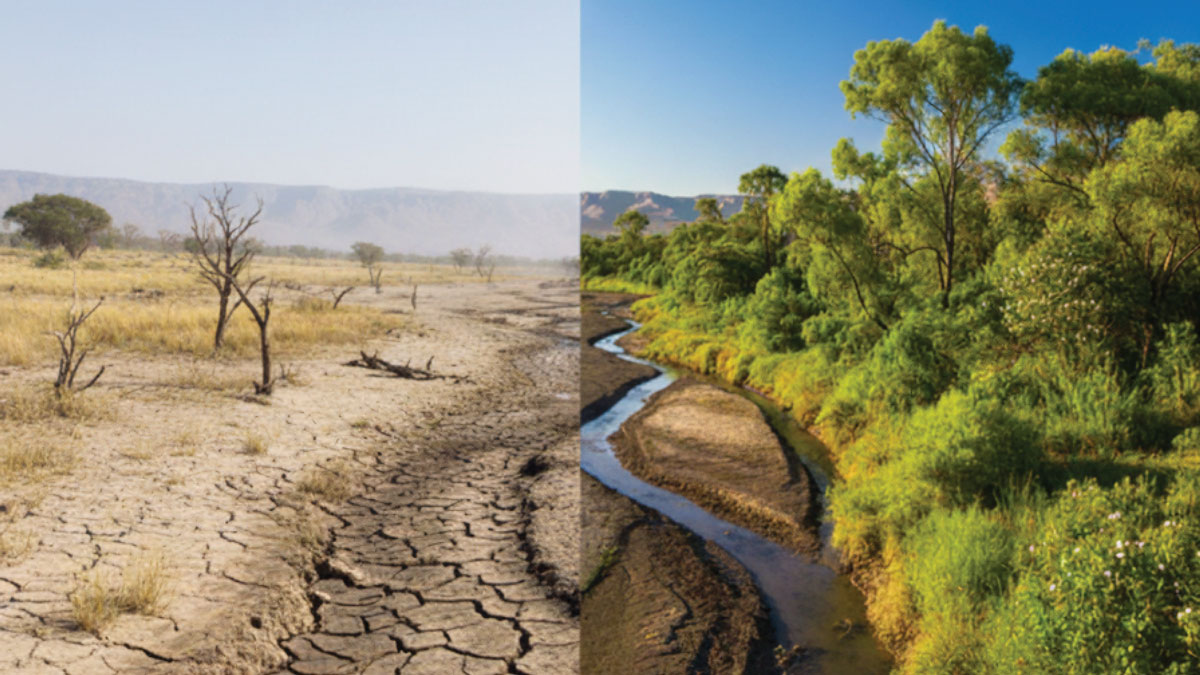
In 2010, when drought left the soil very dry, the ecosystem’s productivity was limited by the amount of available water. During that drought, plant growth slowed as vegetation operated in survival mode and restricted water to its roots. In 2019, when the soil was moistened by previous rains, water was not a limiting factor. Instead, the hot temperatures served as an energy source and caused plant growth to thrive.
Wetter antecedent conditions helped the ecosystem better weather the heat, the research showed. This concept of “hydrological memory” helps explain why the ecosystem reacted so differently to two extreme events. Such a nonlinear effect can be hard to capture in traditional modeling, so these findings have important implications for future modeling and climate change projections, the authors say. Untangling seemingly unpredictable ecosystem behaviors, they continue, could help improve understanding of our planet and its future. (AGU Advances, https://doi.org/10.1029/2025AV001973, 2025)
—Rebecca Owen (@beccapox.bsky.social), Science Writer