
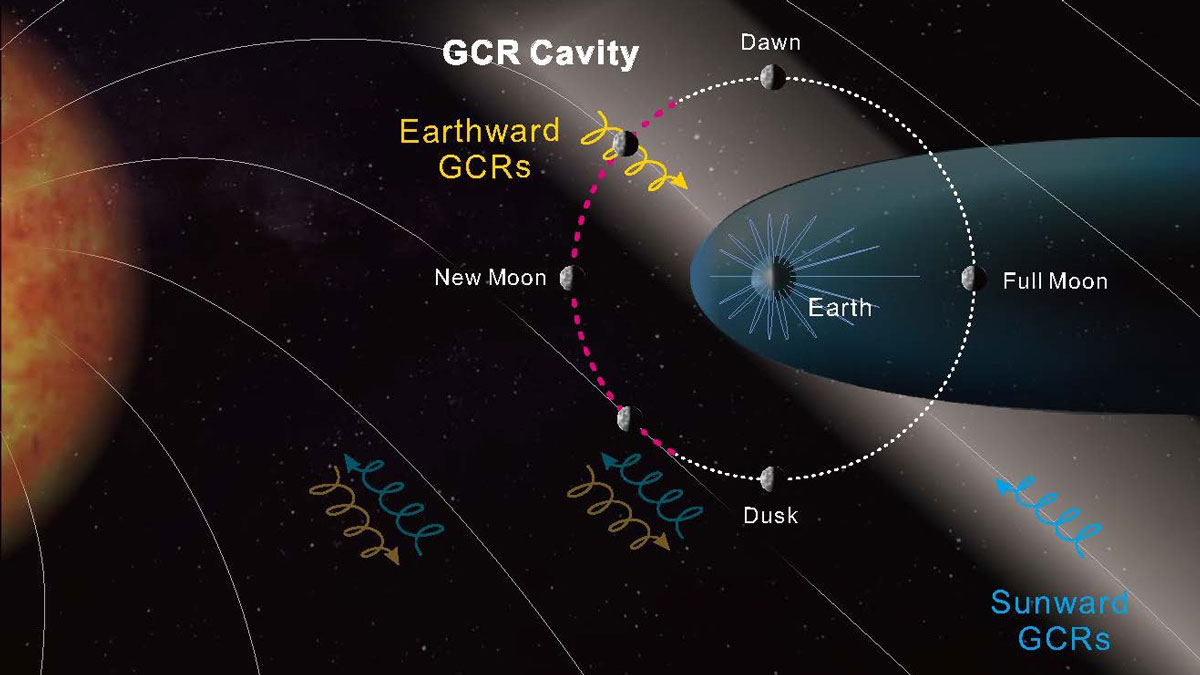
The solar system is bathed in galactic cosmic rays: protons and atomic nuclei traveling, nearly at the speed of light, from all directions. Earth’s magnetic field and atmosphere shield us from most of this harmful radiation, but outside of that shelter, the bombardment is strong enough to prove a threat to astronauts.
But a new analysis of data from the Chang’e-4 lunar lander published in Science Advances revealed an extended cosmic ray shelter stretching from Earth at an unexpected angle at least as far as the Moon, though exactly how far is unclear. When the Moon passes through this shelter in its orbit of Earth, the lunar surface experiences a roughly 20% reduction in the galactic cosmic ray flux.
“We found Earth casts kind of a shadow in the galactic cosmic ray space,” said Robert F. Wimmer-Schweingruber, a space physicist at Kiel University in Germany. “This was unexpected, and to me that was the cool part of this paper.”
The surprise came in part because the shape of Earth’s magnetic field is well understood: It forms a strong protective region around the planet known as the magnetosphere, with a long “tail” shaped by the solar wind of charged particles streaming from the Sun.
If the magnetotail is like a person’s shadow cast behind them by sunshine, this newly discovered bubble would be like if that shadow extended to the front of the person as well.
“You would expect an effect inside the tail or as [the Moon goes] through the tail, but we find an effect of the tail ahead of the tail,” said Wimmer-Schweingruber. He noted that if the magnetotail is like a person’s shadow cast behind them by sunshine, this newly discovered bubble would be like if that shadow extended to the front of the person as well and tilted rather than lying along a line connecting Earth, the Sun, and the Moon.
“The observed region of reduced [galactic cosmic ray] flux on the sunward side of the Moon’s orbit outside the geomagnetic field where it is compressed by the solar wind is unexpected,” Brian Flint Rauch wrote in an email. Rauch, a cosmic ray physicist at Washington University in St. Louis who was not involved in the Chang’e-4 study, added that any reduction in cosmic ray exposure is noteworthy for potential astronauts on the Moon.
A 20% decrease in flux during part of the lunar orbit is unlikely to make a large difference in determining when it’s safest for astronauts go out onto the lunar surface. But it might help guide individual decisions in the moment because while spacesuits won’t protect astronauts from cosmic rays, the metal of a habitat or lander would.
Shelter from the Storm
The China National Space Administration’s Chang’e-4 spacecraft was the first successful mission to the lunar farside, landing in the Von Kármán crater on 3 January 2019. As part of its suite of scientific instruments, the probe carried the Lunar Lander Neutron and Dosimetry experiment (LND) developed by Wimmer-Schweingruber and collaborators at Kiel University in an astonishingly rapid 18 months. This detector was designed in part to gauge conditions for human exploration by measuring the radiation on the Moon’s surface, including cosmic rays.
LND collected data between January 2019 and January 2022. Though Apollo astronauts carried radiation dosimeters, those instruments did not provide detailed information about fluctuations in exposure, making LND the primary source for such information from the lunar surface. For that reason, it provided the best data on galactic cosmic rays, which consist mostly of protons accelerated to nearly the speed of light in the remnants of supernovas.
Measurements show the ambient radiation dose on the lunar surface is more than twice as high as on the ISS and nearly 200 times as high as on Earth.
These protons arrive in the solar system from every direction, often undeflected by the magnetic fields of stars or planets. However, Earth’s magnetosphere is strong enough to repel many galactic cosmic rays in low orbit, where the International Space Station (ISS) resides. Meanwhile, measurements show the ambient radiation dose on the lunar surface is more than twice as high as on the ISS and nearly 200 times as high as on Earth, which is a matter of concern for long-term human presence on the Moon.
All of these reasons are why everyone was surprised when LND data revealed Earth’s magnetic protection extends far beyond the magnetosphere and at an angle to the line connecting Earth and the Sun. Lead author Wensai Shang of Shandong University in Weihai, China, worked out that the angle corresponds to the twisting of the Sun’s magnetic field.
“As the Sun rotates, it pulls the solar wind along the solar magnetic field,” Wimmer-Schweingruber said. “That produces a spiral.” Apparently, an unanticipated interaction between this twist in the solar magnetic field and Earth’s magnetic field produces the cosmic ray shelter revealed by LND.
Wimmer-Schweingruber noted that he was extremely skeptical that such results were possible at first. He warned Shang, a graduate student he worked with, that he might be wasting his time looking for cosmic ray anomalies in the Chang’e-4 data. It was only after Shang provided ironclad analyses ruling out other possibilities that he was swayed.
With the LND instrument shut off, researchers need other sources of data to continue the work. Wimmer-Schweingruber expressed particular interest in understanding how cosmic rays produce secondary radiation—especially neutrons, which are very dangerous to humans—when they impact the lunar soil. In the meantime, the general understanding of the radiation environment provided by Chang’e-4 shows we still have some surprises in store as humans explore the solar system.
—Matthew R. Francis (@BowlerHatScience.org), Science Writer