

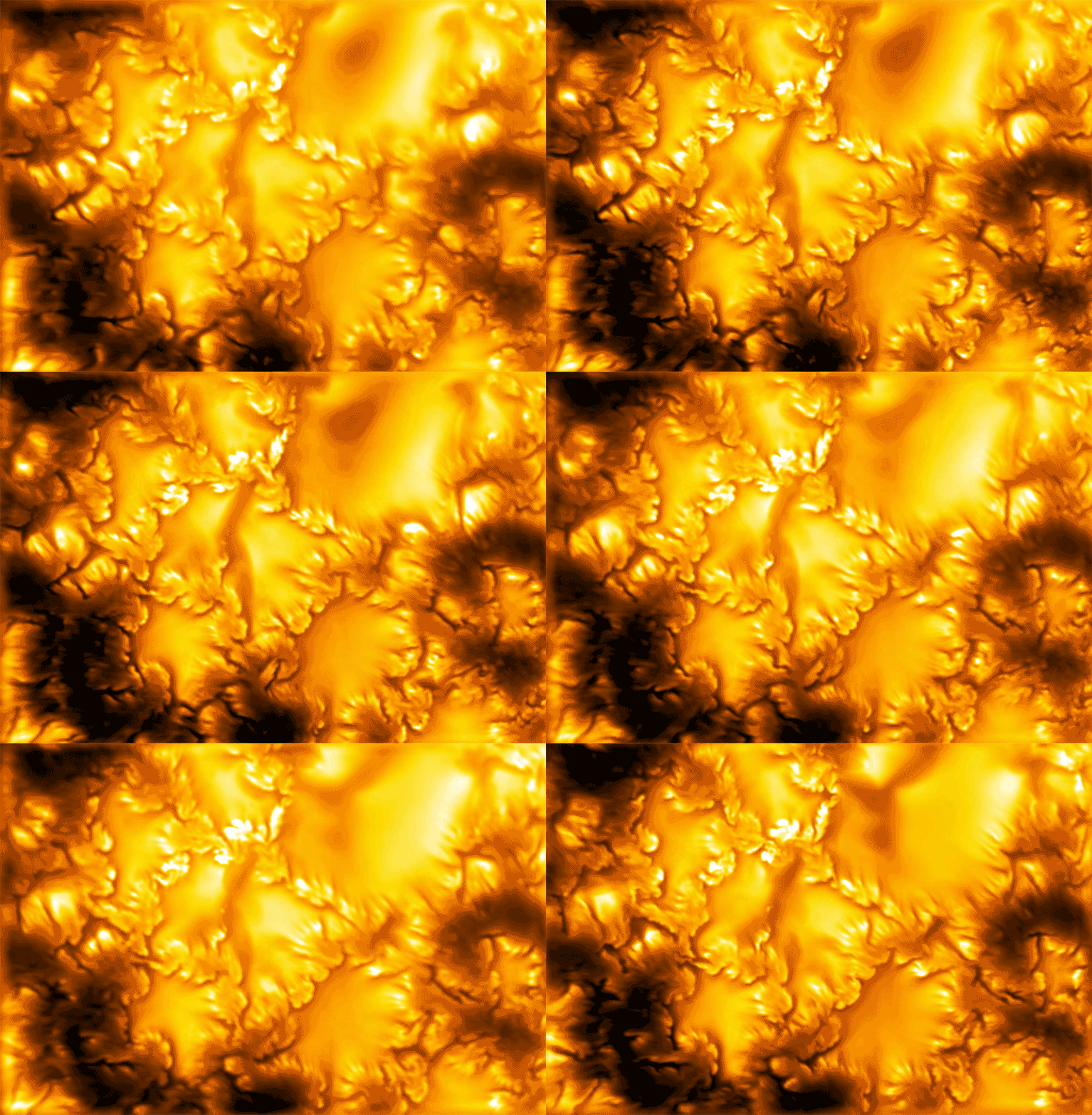
This is the highest-resolution image of the Sun ever taken.
It was captured by the Daniel K. Inouye Solar Telescope (DKIST) in Hawaii, the largest solar telescope in the world, on 14 April 2025.
The image zooms in on a small patch of the Sun’s surface in visible light. The whole image spans 5,800 kilometers (3,604 miles) horizontally and 4,350 kilometers (2,703 miles) vertically, covering a mere 0.0004% of the Sun’s surface. Each pixel is 6 kilometers (3.7 miles) per side.
Take a close look at the grid-like pattern and see if you can spot small swirls among the feathered edges.
Here are two spots with swirling plasma.
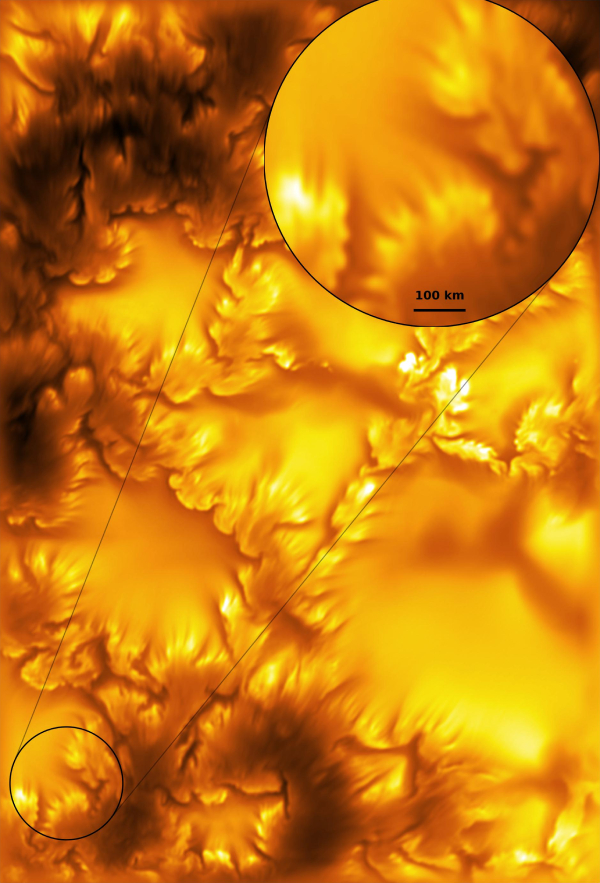
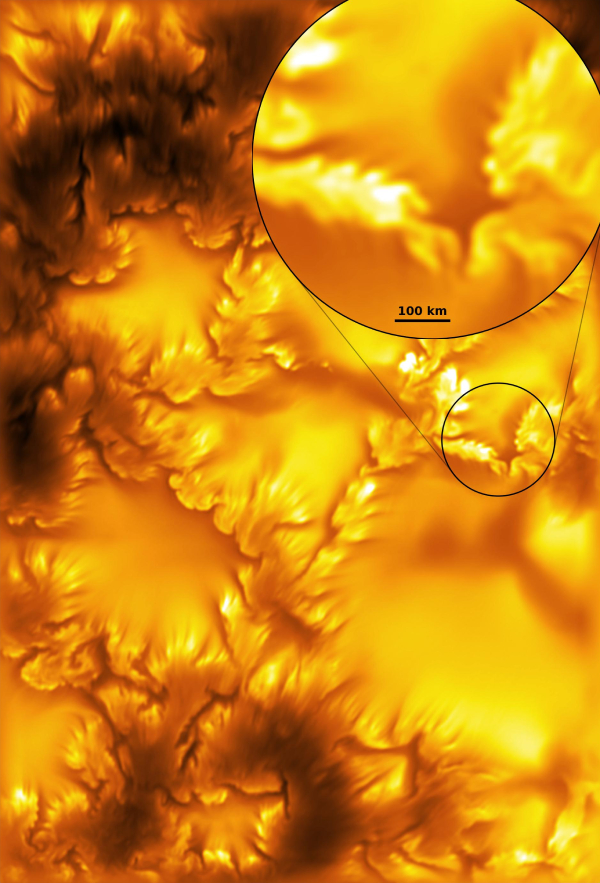
The tiny swirls and vortices are called Kelvin-Helmholtz instabilities, and this is the first observational confirmation that they exist on the Sun. The swirls are manifestations of a physical process that could play a crucial role in how the Sun’s plasma bubbles and bursts.
“Kelvin-Helmholtz instabilities are one of the fundamental instability processes in magnetofluids, fluids, and gases,” said David Kuridze. Kuridze studies plasma in the solar atmosphere at the National Solar Observatory (NSO) in Boulder, Colo., and is colead researcher on the discovery.
“We did not set out to find Kelvin-Helmholtz instabilities,” added colead researcher Friedrich Wöger, who studies flow dynamics of the solar photosphere at NSO. “The experiment was targeted at finding the most efficient way to reach the diffraction limit of the telescope. And the nice thing is, not only did we succeed with that but we also found Kelvin-Helmholtz instabilities.”
When Plasmas Flow By
Kelvin-Helmholtz instabilities (KHI) are caused by the edges of two streams of fluid flowing past each other at different speeds. And “fluid” is quite a broad term, geophysically speaking. Scientists have spotted these swirls and vortices in estuaries and oceans, as well as in Earth’s clouds; the skies of Mars, Jupiter, and Saturn; and interactions between the solar wind and planetary magnetospheres, Kuridze explained.
Astronomers have long suspected that KHI exist on the Sun’s surface. The solar photosphere is a fluidlike plasma, so it would make sense for it to follow the same rules as any other fluid, albeit with the added complication of the Sun’s magnetic field. What’s more, the existence of KHI could explain some of the Sun’s more mysterious phenomena, like braided magnetic field lines, eruptions, and the ultrahot corona.
“Kelvin-Helmholtz instabilities are a very effective mechanism to twist and bend magnetic structures” and generate magnetic energy, Kuridze said.
“One of the big questions is, How much energy can these vortices create and transport up into the outer atmosphere of the Sun, and is it enough to heat it up to millions of degrees kelvin?” Wöger said.
But until recently, actually spotting these instabilities on the Sun’s surface was impossible. Picking out small vortices within the solar plasma requires specialized instruments installed on solar telescopes, and previous generations of solar telescopes were simply not powerful enough to see them. When DKIST came online in 2019, its 4-meter (13-foot) mirror immediately changed the game by allowing astronomers to view the bubbling, boiling solar surface at several wavelengths and at smaller scales than ever before.
“DKIST’s resolving capacity is equivalent to finding a quarter from a distance of 50 kilometers,” said Michail Mathioudakis, a solar astrophysicist at Queen’s University Belfast in the United Kingdom.
Roil and Toil
Kuridze, Wöger, and their team pushed DKIST’s resolving power to the max to zoom in on a small part of the Sun near a sunspot for a few minutes. This slow roiling is what they saw.
Here are those same two zoomed-in spots from before.
“When we looked at these data and the movie, we immediately recognized the signature of Kelvin-Helmholtz instability,” Wöger said.
After they spotted the telltale signs of KHI, the observing team asked their modeling partners to simulate the motions of the Sun’s magnetically influenced fluidlike plasma, or magnetohydrodynamics, at a similarly high resolution. Creating simulations with the level of detail needed to compare with the DKIST observations requires phenomenal computational power and likely wouldn’t have happened without these observations as motivation, Wöger said.
Those simulations, based on fundamental physics and fluid dynamics principles, confirmed that the vortices captured by the DKIST images were likely created by KHI. The DKIST observations show that KHI might be ubiquitous across the Sun’s surface. This discovery was published in Nature in August.
“Models of the solar atmosphere have shown indications of this instability, but the paper has identified this physical process observationally in some of the smallest astrophysical scales,” said Mathioudakis, who was not involved with the research. “What surprised me the most is that this discovery was made with a relatively simple imaging setup and does not involve complex instrumentation, calibration issues, or data inversions. It will therefore stand the test of time.”
Small Swirls, Big Energy
“This is a very notable observation because Kelvin-Helmholtz instability in photospheric shear flows has been predicted theoretically for decades, but the relevant spatial scales were simply too small to resolve directly,” said Claire Foullon, a solar and space physicist at the University of Exeter in the United Kingdom.
“What is more surprising is how DKIST reveals it to be so widespread,” Foullon added. “Rather than being an occasional phenomenon, the observations suggest that this may be a fundamental part of the small-scale dynamics of the magnetized photosphere.” Foullon was not involved with the new discovery.
“There’s always this nice tension between simulation and observation.”
As KHI swirl around and around in the solar photosphere, they can twist up magnetic fields and store up energy. All that energy has to go somewhere, and many solar scientists think it might contribute to heating up the Sun’s corona.
“We are effectively seeing, for the first time, dynamics on the scales at which the magnetic foot-points of the corona are being continually stirred and restructured,” Foullon said.
The degree to which KHI contribute to coronal heating is still unknown, as is whether KHI exist on even smaller physical scales on the Sun. These might remain open questions for a while, Kuridze said, as observers figure out ways to push DKIST to even smaller physical scales and as simulations stretch farther to match.
“There’s always this nice tension between simulation and observation,” Wöger said. “When we see something [in observations], then we’re pushing the numerical simulations. And sometimes in the numerical simulations you see something, and then we’re trying to see whether it actually exists on the Sun.”
—Kimberly M. S. Cartier (@astrokimcartier.bsky.social), Staff Writer