

Striking white stucco buildings with cobalt-colored roofs draw millions of tourists each year to Santorini and other Greek islands. But the idyllic setting of the Aegean Sea harbors a hidden secret in the form of a network of underwater volcanoes capable of explosive eruptions. Researchers have now analyzed sediment cores drilled from the flanks of one of the region’s largest underwater volcanoes to estimate its eruption frequency. Explosive eruptions of Kolumbo Volcano occur every few thousand years, on average, the team found, and activity within the next few decades is unlikely. But the core records also revealed a surprise: a potential linkage between the timing of eruptions of Kolumbo and nearby Santorini Volcano, located just a few kilometers away. These results were published in Geology.
An Invisible Threat
“It’s the main threat to Santorini.”
Kolumbo is a little-known underwater volcano near Santorini, a tourist hot spot. It last erupted explosively in 1650, and that event was associated with a tsunami that killed more than 50 people on Santorini. “It’s the main threat to Santorini,” said Abigail Metcalfe, a volcanologist formerly at Université Clermont Auvergne in France and now at the University of Bristol in the United Kingdom.
But Kolumbo’s perch under the Aegean Sea keeps it largely shrouded from scientists’ prying eyes. “When a volcano erupts on land, you obviously see the deposits around it,” Metcalfe said. “The seafloor is very inaccessible.”
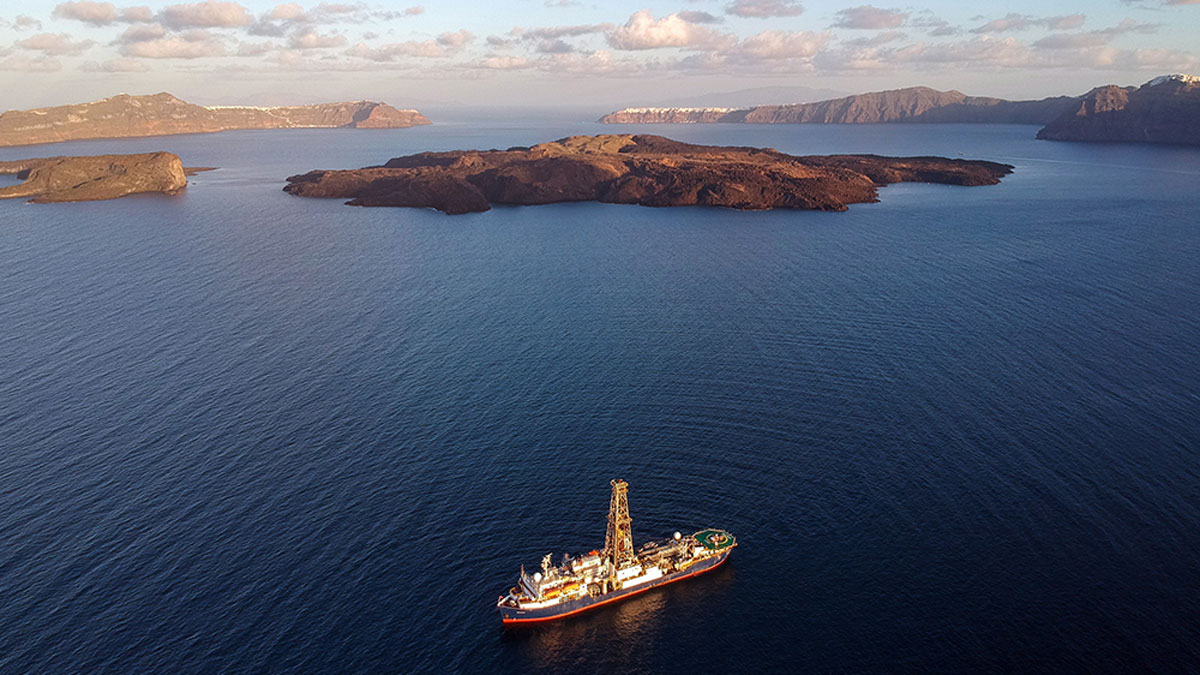
In December 2022, the International Ocean Discovery Program (IODP) embarked on an 8-week cruise to better understand, among other research questions, the eruption history of Kolumbo. Digging into this volcano’s past is important for better understanding its activity in the future, said Metcalfe, who recently led a team in analyzing data from the IODP cruise.
Going Deep to Understand Past Eruptions
Metcalfe and her collaborators focused on sediment cores drilled at two sites on the western flank of Kolumbo beneath roughly 400 meters of water. Over time, the eruptions of undersea volcanoes blanket the seafloor in magmatic material, so such drilling can unearth records of previous eruptions. By pinpointing layers of tephra in the cores, the researchers homed in on earlier eruptions of Kolumbo.
The volcano’s eruption in 1650 was glaringly obvious in the core records; there were literally meters’ worth of volcanic deposits around that time. The team also uncovered 18 previously unknown eruptions stretching back roughly 265,000 years. Each of those eruptions deposited only several centimeters’ worth of tephra, however. “The past eruptions seemed much smaller than the 1650 eruption,” said Metcalfe.
Those records, paired with the 20 volcanic cones visible on the seafloor that comprise the Kolumbo Volcanic Chain, suggest that explosive activity occurs in the region every 6,000 years or so on average. Given that the last eruption—and a big one at that—occurred in 1650, Kolumbo and its brethren volcanoes aren’t likely to spew forth magma anytime soon. Even considering that some historical eruptions occurred closer together in time, the probability that the Kolumbo Volcanic Chain will produce an eruption in the next 30 years hovers around 0.5%–3.0%, the team concluded.
Volcanic Siblings
“When Santorini enters this highly explosive regime, Kolumbo then also becomes active.”
Given the proximity between the Kolumbo Volcanic Chain and Santorini Volcano, Metcalfe and her collaborators decided to compare the eruptive histories. Kolumbo’s activity ramped up about 265,000 years ago, which roughly coincides with the transition of Santorini Volcano from a moderately active volcano to one that let loose wildly explosive eruptions—like the Minoan eruption roughly 3,600 years ago. “When Santorini enters this highly explosive regime, Kolumbo then also becomes active,” said Metcalfe.
Scientists are still puzzling over the physical link that would explain such a correlation between the two volcanoes, however. Each volcano has its own distinct magma chemistry, meaning that it’s unlikely they’re fed by one magma source, Metcalfe said. But the magmatic reservoirs of Kolumbo and Santorini volcanoes are likely coupled, research has shown. Such coupling could be explained by shared tectonic stresses: As magma churns underground, it alternatively loads and unloads different parts of the subsurface, a process that can impart tectonic stress and changes in pressure. “The emptying of one reservoir can pressurize a nearby reservoir,” explained Metcalfe.
It’s an interesting observation that Kolumbo and Santorini volcanoes appear to be linked in some way, said Jens Karstens, a marine geophysicist at the GEOMAR Helmholtz Centre for Ocean Research Kiel in Germany who was not involved in the research. That was also the case in 2024 and 2025 when both volcanoes experienced unrest in the form of deformation and low levels of seismic activity, he added. “We saw last year that both systems are active at the same time.”
That unrest was significant enough to disrupt the local economy, said Karstens, and an eruption would have even farther-reaching impacts. The eruption of Eyjafjallajökull in Iceland in 2010 crippled air travel with its airborne ash, and underwater volcanoes have the additional whammy of producing rafts of pumice, Karstens said. “Pumice is not nice for boats. Ash is very bad for planes.”
—Katherine Kornei (@KatherineKornei), Science Writer
Update, 13 March 2026: This article has been updated to indicate that Abigail Metcalfe was formerly affiliated with Université Clermont Auvergne in France.