

Volcanism is commonly associated with an uptick in atmospheric carbon dioxide (CO2) levels, but that paradigm seems to have been turned on its head during the late Paleozoic. Concentrations of CO2 decreased by about 50% during the emplacement of a large igneous province—a concentration of intense magmatic activity—in what is now southern China, new results show.
That effect was likely due to increased erosion and weathering caused by crustal uplift, researchers reported in Nature Communications. These findings highlight the varied environmental impacts of large igneous provinces, the team suggests.
More Than a Supereruption
“We’re talking about a scale of magmatic activity that dwarfs things like even a Yellowstone supereruption.”
A handful of volcanic eruptions are occurring on Earth at any given moment. But those events, impressive as they may be, still pale in comparison to the volcanic activity associated with large igneous provinces (LIPs). “A large igneous province may involve enough magma to cover the continental United States about half a kilometer or so deep,” said Benjamin Black, an Earth scientist at Rutgers University in Piscataway, N.J., not involved in the research. “We’re talking about a scale of magmatic activity that dwarfs things like even a Yellowstone supereruption.”
Large igneous provinces occur every 20–30 million years, and several have been tied temporally to extinction events in Earth’s past. A causal link between large igneous provinces and extinction events makes sense because volcanism is commonly associated with the release of gases such as CO2; large igneous provinces have also been shown to leak CO2 after their surface eruptions cease. CO2 can substantially alter the natural environment by warming the planet and acidifying the oceans.
LIPs and Biotic Crises
Roughly 260 million years ago, at the end of the Guadalupian epoch, the appearance of a large igneous province coincided with an extinction event. Populations of marine life such as corals and clam-like creatures suffered at the same time that intense magmatic activity spilled across parts of what is today southern China.
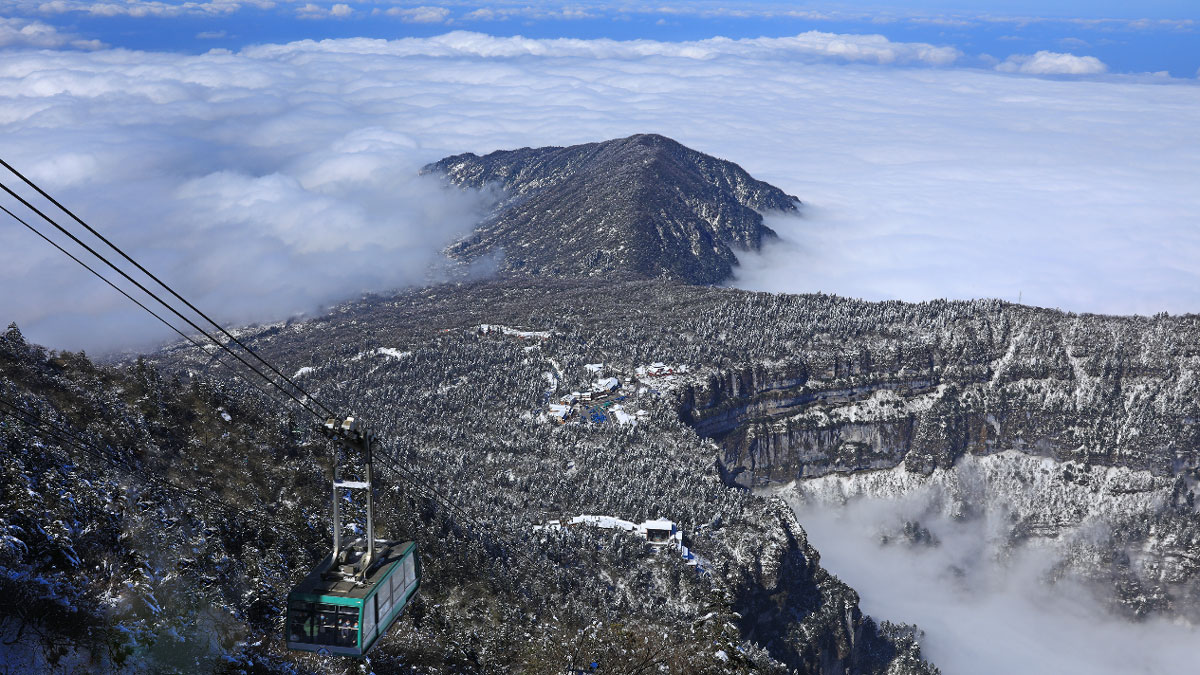
Researchers have long wondered whether that biotic crisis was, indeed, set in motion by the so-called Emeishan large igneous province, named for China’s Mount Emei.
To dig into that idea, geochemist Jiaheng Shen of Peking University in China and her colleagues reconstructed atmospheric CO2 concentrations of 260 million years ago. Finding a significant uptick in CO2 would bolster support for the idea that conditions might have changed so much that life had trouble adapting.
The team analyzed marine sediments unearthed in Sichuan Province (home to Mount Emei), focusing on the fossilized remains of photoautotrophic life-forms such as algae and cyanobacteria, which consumed CO2 when they were alive. Because carbon has several isotopes, these remains are a window into ancient carbon isotope ratios, said Shen. “They locked in the carbon isotope signature of the ocean and atmosphere at that time.”
Organisms are most apt to take up CO2 containing the lightest isotope of carbon—12C—when CO2 is plentiful. Therefore, the ratio of 12C to 13C can be used as a proxy for the atmospheric concentration of the greenhouse gas. Shen and her team inferred that CO2 levels remained roughly stable at around 700 parts per million for around 7 million years through much of the middle Permian. Levels then plummeted over the course of roughly 3 million years to a minimum of around 350 parts per million during the early and main phases of Emeishan large igneous province volcanism, bottoming out for 500,000 or so years near the end of the Guadalupian epoch. It was a big surprise to find that decrease in CO2, said team member Yi Ge Zhang, a geochemist at the Guangzhou Institute of Geochemistry, Chinese Academy of Sciences. “We’re trying to make sense of that.”
Toward the Sky
One explanation, the team proposed, is weathering caused by crustal uplift. The early stages of a large igneous province involve magma literally pushing up on Earth’s crust. That force can cause crustal material to dome upward, “kind of like a mushroom shape,” said Zhang. The team found evidence for such crustal uplift in the form of eroded limestone in a roughly circular feature about 800 kilometers in diameter. “As you move closer toward the center, the limestone systematically thins out,” said Shen. “You see a very distinctive pattern.” In all, the crust uplifted by about 1,000 meters, the team estimated.
Any landform protruding above its neighbors will tend to be preferentially eroded and weathered, processes that can pull CO2 out of Earth’s atmosphere when rocks react with acid rain. Perhaps that’s what happened during the early stages of the Emeishan large igneous province, before volcanism commenced in earnest, Shen and her collaborators concluded.
“Supervolcanoes can do much more than just heat the planet.”
The conventional picture that large igneous provinces and their associated supervolcanoes are always linked to increases in CO2 is therefore clearly simplistic, said Shen. “Supervolcanoes can do much more than just heat the planet.”
These results make sense, said Morgan Schaller, a geochemist at Rensselaer Polytechnic Institute in Troy, N.Y., who was not involved in the research. But just because the team didn’t find any pronounced spikes in CO2 levels doesn’t mean they didn’t occur, said Schaller: The issue might be the time resolution of the data, he said. “Maybe you just don’t see spikes because you don’t have high enough fidelity to see them.”
It’ll also be important to replicate this result with other large igneous provinces, added Paul Wignall, a geologist at the University of Leeds in the United Kingdom also not involved in the research. “If you start getting this result elsewhere, you’d have to start paying attention.”
—Katherine Kornei (@KatherineKornei), Science Writer