
Editors’ Highlights are summaries of recent papers by AGU’s journal editors.
Source: AGU Advances
Ionospheric irregularities—small-scale electron density structures in the ionosphere down to meter spatial scales—can cause refractive and diffractive variations (scintillation) to the amplitude and/or phase of a radio signal, and thereby severely disrupt its transmission. Such scintillation can affect satellite navigation and communication systems such as the Global Navigation Satellite System (GNSS).
Hot flow anomalies (HFAs) are short-lived flows of hot plasma near the Earth’s bow shock—the region of supersonic plasma shock waves upstream of the Earth’s magnetosphere where the fast solar wind slows down and deflects around the Earth.
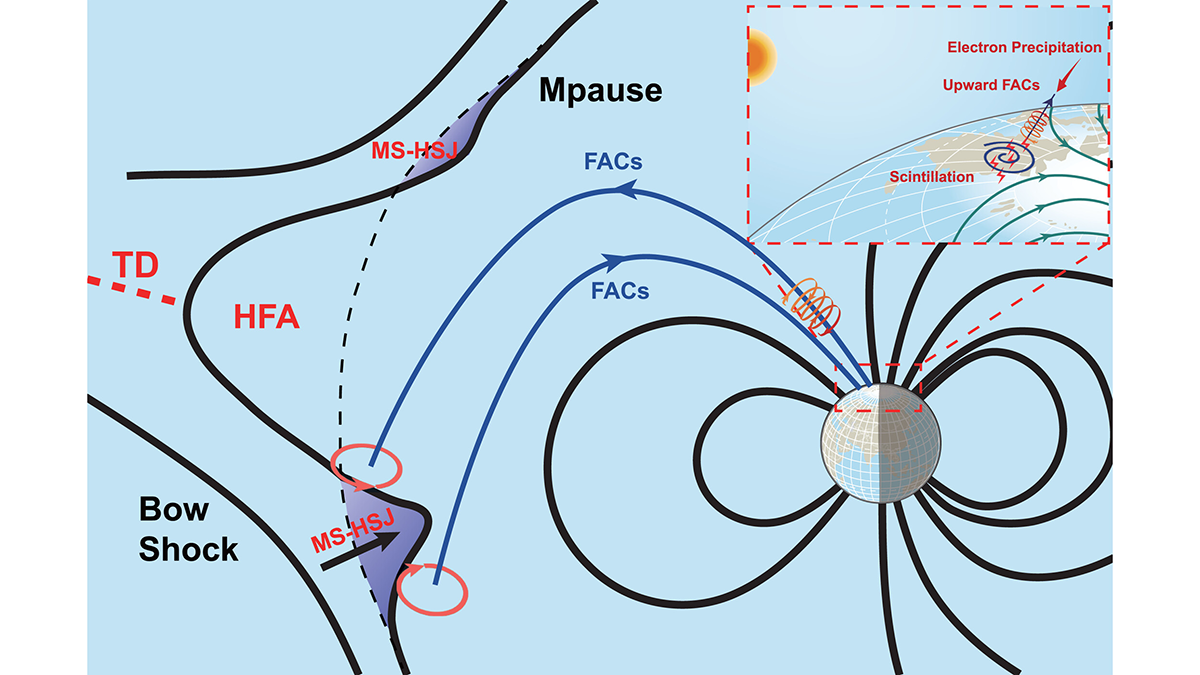
Zhou et al. [2026] successfully connect the dots between the two using measurements of such HFAs on NASA’s Magnetospheric Multiscale (MMS) satellites and simultaneous measurements of energetic charge particles and ionospheric irregularities from other satellites and from ground GNSS receivers. The authors show a definitive case of direct linkage between an HFA near the bow shock and a localized, enhanced phase scintillation in the polar ionosphere more than 60,000 kilometers away.
The HFA and enhanced phase scintillation were associated with a vortex of ion convection and a region of auroral electrons and enhanced electrical current along the magnetic field. The observations suggest that the HFA disturbed the polar ionosphere through a chain of physical processes and created a localized region of ionospheric irregularities, which in turn caused the enhanced phase scintillation and became a source of space weather impact on satellite navigation and communications systems.
Citation: Zhao, J.-C., Zhang, Q.-H., Yang, Z.-W., Zhang, D., Oksavik, K., Wang, B.-Y., et al. (2026). Ionospheric scintillation induced by hot flow anomalies via particle precipitation. AGU Advances, 7, e2026AV002548. https://doi.org/10.1029/2026AV002548
—Andrew Yau, Editor, AGU Advances