
Editors’ Highlights are summaries of recent papers by AGU’s journal editors.
Source: AGU Advances
One of the central questions in subduction-zone earthquake science is why the deep part of a megathrust shifts from earthquake-generating slip to slower, aseismic deformation. Fluid pressure is central to this transition, yet it is often prescribed in models rather than calculated from the processes that release and move water at depth.
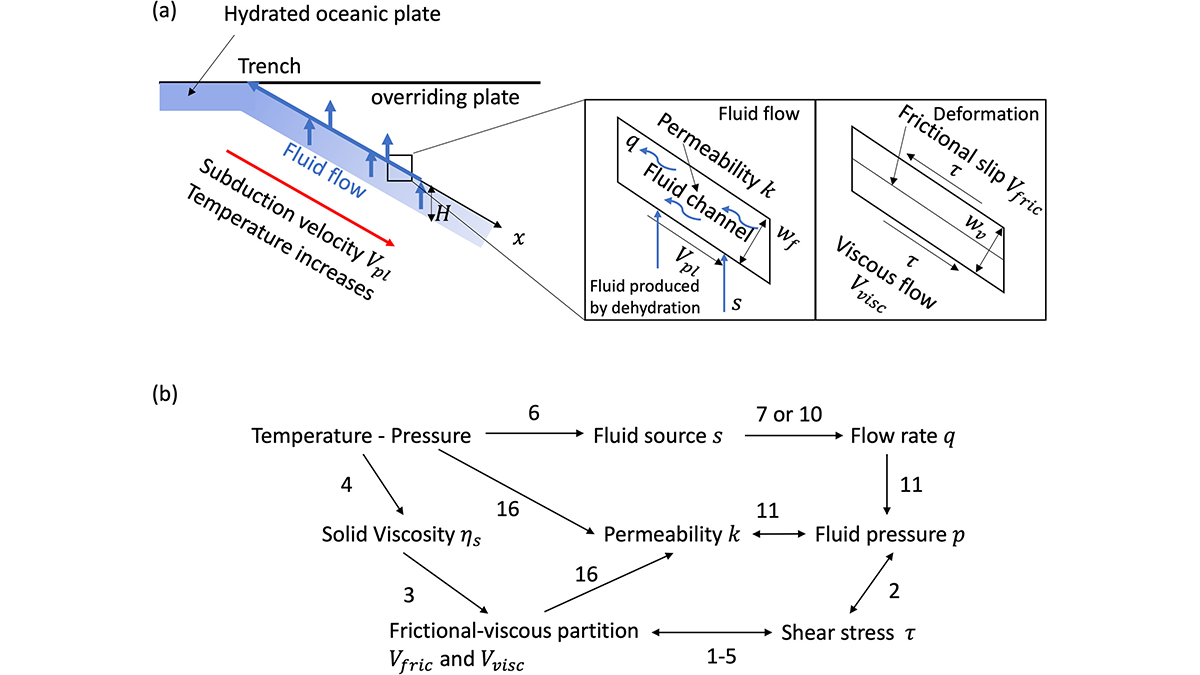
Ozawa et al. [2026] address this gap with a physics-based model for Cascadia that couples metamorphic dehydration, permeability, and frictional-viscous deformation along the plate interface. Their model predicts that effective stress – the clamping pressure on the fault – remains nearly uniform in the earthquake-generating zone and then decreases with depth. This produces a broad zone of mixed frictional and viscous behavior near the depths where slow earthquakes occur. The findings suggest that megathrust slip modes emerge from the coupled evolution of fluid pressure, permeability, and rock deformation. By turning fluid pressure from an assumed process into a calculated outcome, the study offers a framework for testing how dehydration-driven fluids shape the frictional-viscous transition, rupture limits, and the conditions for episodic tremor and slip modes.
Citation: Ozawa, S., Dunham, E. M., & Condit, C. B. (2026). Metamorphic dehydration, fluid pressure, and the frictional-viscous transition along subduction megathrusts: Case study in Cascadia and implications for slow earthquakes. AGU Advances, 7, e2025AV002000. https://doi.org/10.1029/2025AV002000
—Marcos Moreno, Editor, AGU Advances