Source: AGU Advances
Within our solar system, Uranus is a geometric oddball. Its spin axis tilts more than 90° from its orbit, so it essentially rolls on its side through space. In contrast, Earth and other planets tilt only moderately or not at all. What’s more, the ice giant’s magnetic field is strangely offset and tilted another 60°.
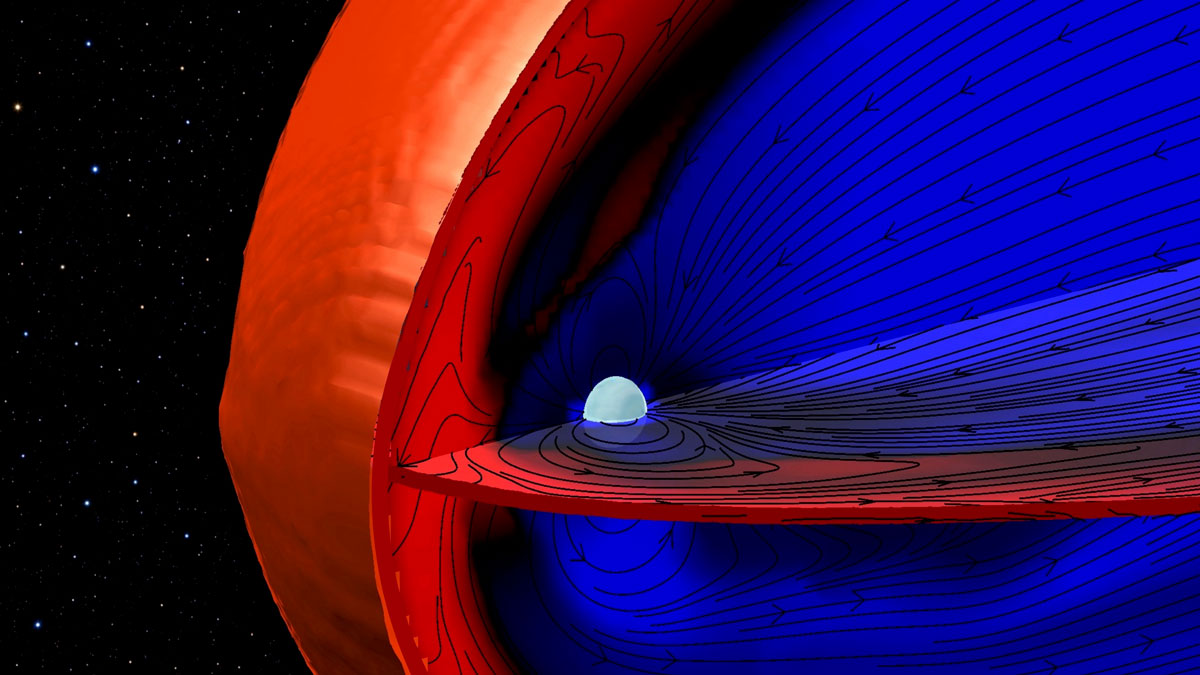
These extreme asymmetries mean that the interaction between Uranus’s magnetic field and the solar wind—charged particles constantly streaming out from the Sun in all directions—is also quirky. At Earth and other planets, the boundary where the solar wind slams into the planetary magnetic field and abruptly slows to form a turbulent shock wave, known as the bow shock, is relatively stable. But at Uranus, the bow shock is highly dynamic, changing shape and size throughout each Uranian day, like the expansion and contraction of breathing lungs.
However, the precise extent and underlying drivers of the Uranian bow shock’s “breathing” have so far been unclear. Now, using advanced computer simulations and data from NASA’s Voyager 2 spacecraft, Cao et al. have quantified the specifics of these daily, repeating changes.
The researchers used a three-dimensional multifluid magnetohydrodynamic model, a tool they recently developed to explore how planets’ magnetospheres interact with the solar wind. For these simulations, they incorporated observations made by Voyager 2 in 1986 when it flew by Uranus. They ran the model under the condition of Uranus’s equinox, the part of its 84-Earth-year orbit during which the Sun is directly over the equator and the bow shock’s expansion and contraction are strongest.
The simulations revealed precisely how the bow shock of Uranus evolves in size and shape over the course of one full day. To isolate the role of planetary rotation, the researchers ran some simulations under conditions of steady, unchanging solar wind. The regular, daily pattern persisted, suggesting that rotation-driven daily reconfiguration of the magnetic field geometry, rather than solar wind changes, is primarily responsible for the breathing.
In contrast, at Earth, solar wind changes are the main driver of variability in the bow shock, with only small daily variations arising from the slight angle between Earth’s spin axis and its magnetic field.
These findings could help inform future space missions to Uranus and could aid in understanding the bow shocks of the numerous ice giant exoplanets detected throughout the galaxy. (AGU Advances, https://doi.org/10.1029/2026AV002307, 2026)
—Sarah Stanley, Science Writer