
Editors’ Highlights are summaries of recent papers by AGU’s journal editors.
Source: Earth and Space Science
Atmospheric conditions over Antarctica affect global climate cycles, and are thus critical for climate assessment. However, studying atmospheric changes in Antarctica is quite challenging as they are driven by a variety of processes at local scale not easily captured by global models. Monitoring seasonal atmospheric pressure changes is one way to keep track of the evolving Antarctic atmosphere.
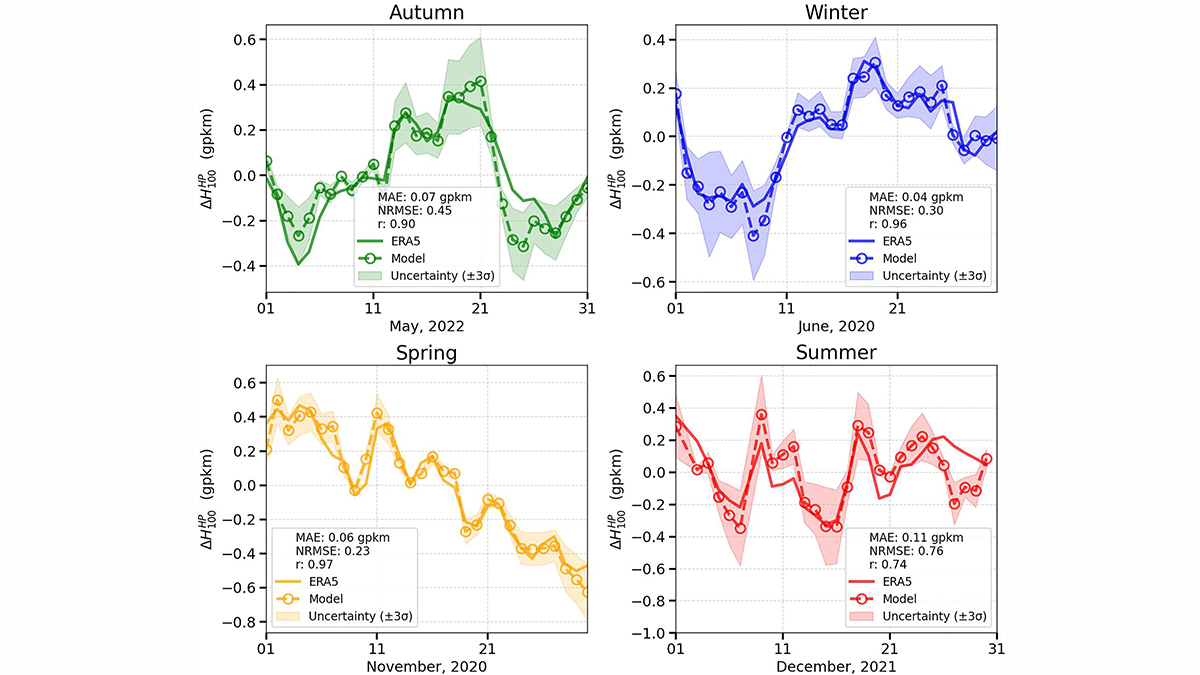
Because changes in stratospheric conditions influence the flux of cosmic rays reaching Earth’s surface, Santos et al. [2025] use measurements from a water-Cherenkov cosmic-ray detector, to monitor variations in the 100-hPa geopotential height (about 15 kilometers) over the Antarctic Peninsula. After conducting a thorough statistical analysis of the data, the authors develop a simple model linking surface pressure and cosmic ray count data, validating it against observed ERA5 100-hPa geopotential height reanalysis data. The model is especially accurate in (southern hemisphere) spring, but it performs well also at other times of the year.
With their model, the authors demonstrate that water-Cherenkov cosmic-ray detectors can be reliably used as proxies for atmospheric pressure changes, thus adding a new, simple, and effective tool to monitor and study lower stratospheric dynamics over Antarctica.
Citation: Santos, N. A., Gómez, N., Dasso, S., Gulisano, A. M., Rubinstein, L., Pereira, M., et al. (2025). Cosmic ray counting variability from water-Cherenkov detectors as a proxy of stratospheric conditions in Antarctica. Earth and Space Science, 12, e2025EA004298. https://doi.org/10.1029/2025EA004298
—Graziella Caprarelli, Editor-in-Chief, Earth and Space Science