
Editors’ Highlights are summaries of recent papers by AGU’s journal editors.
Source: AGU Advances
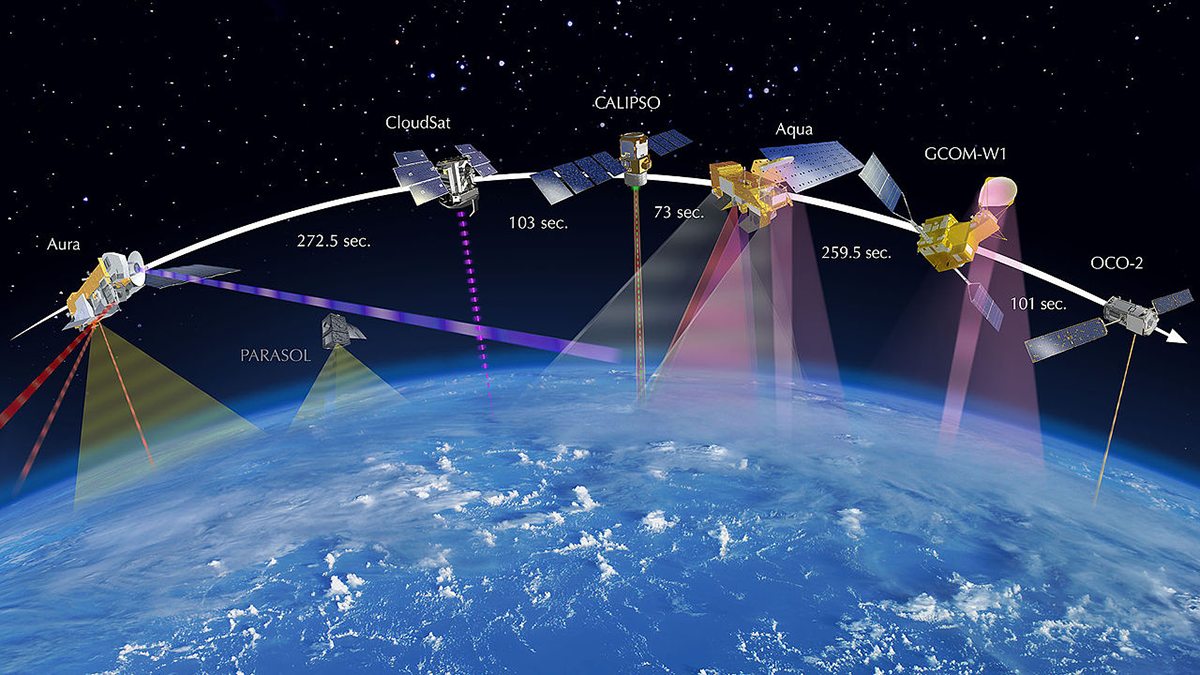
Managing carbon stocks in the land, ocean, and atmosphere under changing climate requires a globally integrated view of carbon cycle processes at local and regional scales. The growing Earth Observation (EO) record is the backbone of this multi-scale system, providing local information with discrete coverage from surface measurements and regional information at global scale from satellites.
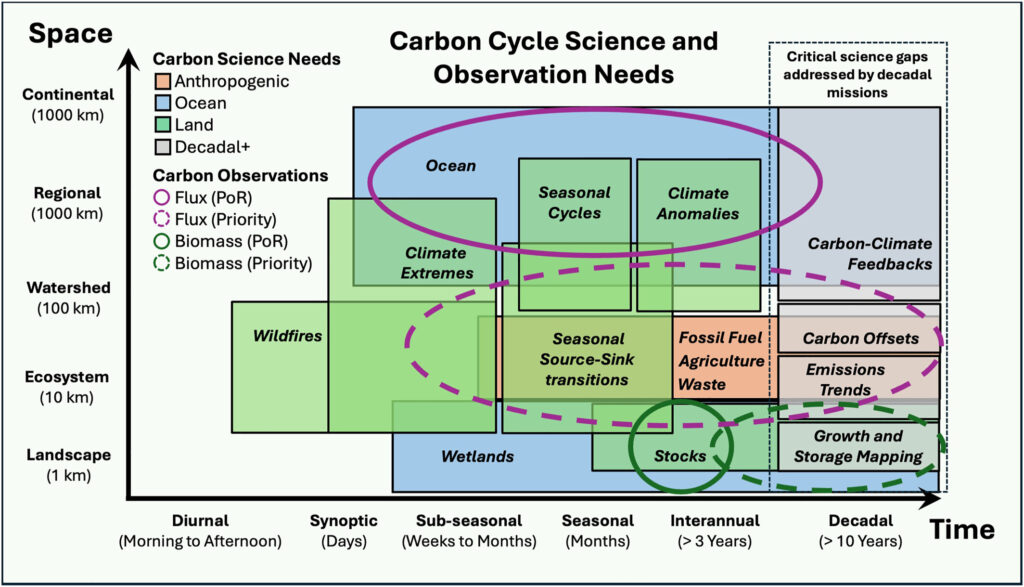
Carbon flux information, anchored by inverse estimates from spaceborne Greenhouse Gas (GHG) concentrations, provides an important top-down view of carbon emissions and sinks, but currently lacks global continuity at assessment and management scales (less than 100 kilometers). Partial-column data can help separate signals in the boundary layer from the overlying atmosphere, providing an opportunity to enhance surface sensitivity and bring flux resolution down from that of column-integrated data (100–500 kilometers).
As described in Parazoo et al. [2025], the carbon cycle community envisions a carbon observation system leveraging GHG partial columns in the lower and upper troposphere to weave together information across scales from surface and satellite EO data, and integration of top-down / bottom-up analyses to link process understanding to global assessment. Such an actionable system that integrates existing and new EO data and inventories using advanced top-down and bottom-up analyses can help address the diverse and shifting needs of carbon management stakeholders.
Citation: Parazoo, N., Carroll, D., Abshire, J. B., Bar-On, Y. M., Birdsey, R. A., Bloom, A. A., et al. (2025). A U.S. scientific community vision for sustained earth observations of greenhouse gases to support local to global action. AGU Advances, 6, e2025AV001914. https://doi.org/10.1029/2025AV001914
—Don Wuebbles, Editor, AGU Advances