
Editors’ Highlights are summaries of recent papers by AGU’s journal editors.
Source: Earth’s Future
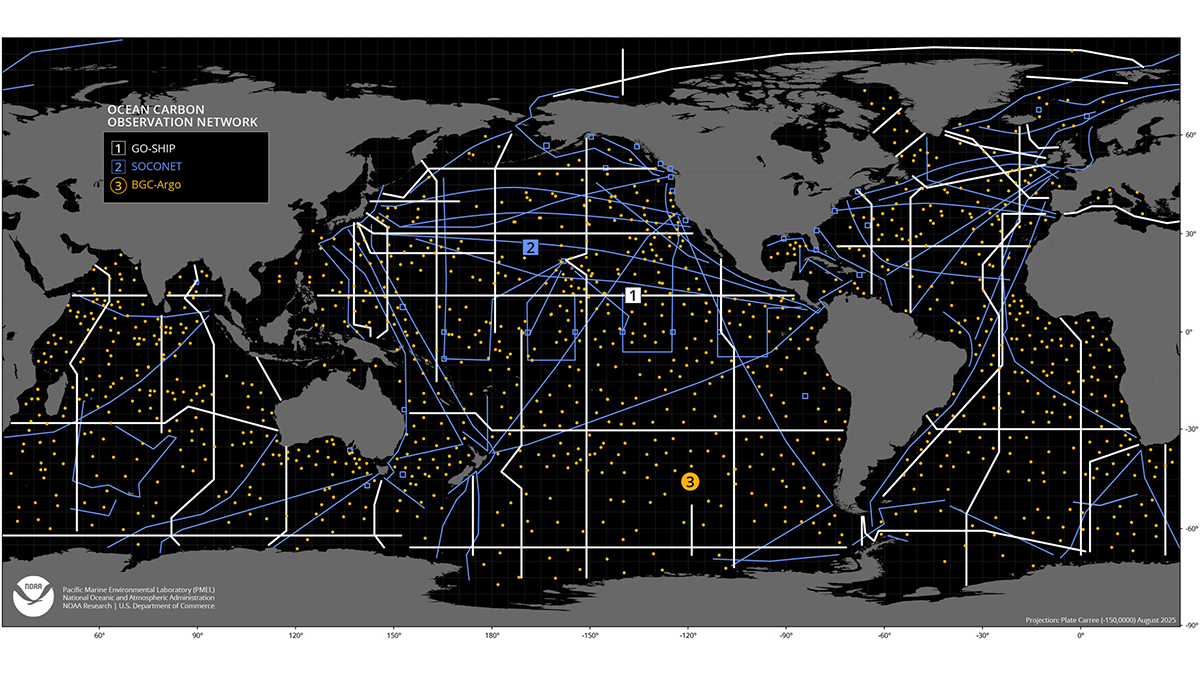
The ocean currently absorbs 25-30% of global carbon dioxide emissions, but this carbon sink is highly, spatially, and temporally variable with uncertainty as to how it will change in the future. Robust estimates of the global ocean carbon sink are critical to constraining remaining carbon budgets and understanding the impact of ocean carbon uptake on marine ecosystems. Three major global observational networks currently perform measurements of surface ocean and depth resolved ocean carbon system measurements using a combination of ship-based and profiling float techniques. Differences in their temporal and spatial coverage, sampling frequency, measurement specifications, and maturity mean that there is considerable opportunity for network co-design to enhance complementarity.
Sutton et al. [2026] offer an assessment of how such a co-designed multi-network observational program might be constructed. Providing actionable recommendations, they argue that maximizing network synergies will improve estimates of natural and anthropogenic ocean carbon fluxes on seasonal-to-decadal timescales and help constrain the impact of climate feedbacks on the ocean carbon sink. In an environment of increasing financial pressure on oceanographic observations, optimization of existing networks is critical to sustaining the scientific and societal value that they provide.
Citation: Sutton, A. J., Bakker, D. C. E., Barbero, L., Bittig, H. C., Carter, B., Claustre, H., et al. (2026). Cross-network synergies fundamental to sustained global ocean carbon observing. Earth’s Future, 14, e2026EF008722. https://doi.org/10.1029/2026EF008722
—Lester Kwiatkowski, Associate Editor, Earth’s Future
