

Editors’ Highlights are summaries of recent papers by AGU’s journal editors.
Source: Journal of Advances in Modeling Earth Systems
Thunderstorms play a central role in tropical weather as they do not only produce local, extreme rainfall, but also interact with their environment. These interactions, from local to large-scale, can strongly influence both the mean climate and its variability. A new generation of kilometer-scale Global Storm-Resolving Models (GSRMs) is expected to represent these multi-scale processes more realistically by explicitly resolving deep convection. Understanding how storms interact with environmental moisture and temperature, and how these interactions shape the climate system’s internal variability, remains a central challenge for GSRMs.
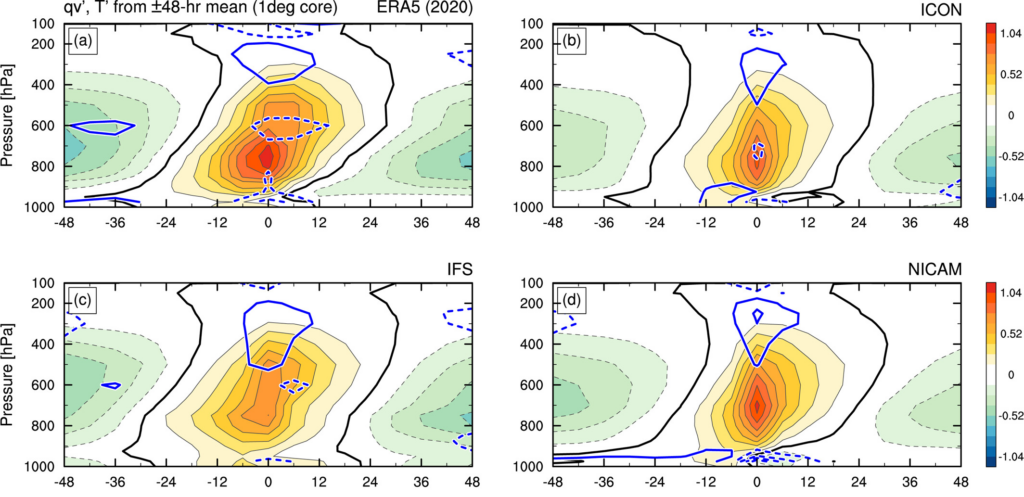
In a new study, Takasuka et al. [2026] analyze multi-year simulations from three GSRMs (ICON, IFS, and NICAM) to examine how these next-generation models represent convective storms and how these representations relate to their different approaches to modeling convection. Although the models capture the timing of peak rainfall over ocean well, they tend to simulate storms that are too numerous and too small. Moreover, the models differ in the lifecycle of convection, particularly in the transition from shallow to deep convection and in the storage of atmospheric moisture, resulting in different large-scale mean state (e.g. precipitation) and variability (e.g. the Madden-Julian oscillation).
The study highlights how mesoscale coupling between convection and the thermodynamic environment shapes larger-scale tropical weather and climate characteristics, while revealing persisting challenges in representing complex storm processes in GSRMs and identifying key areas where a more realistic representation of convective–environment interactions could lead to more reliable simulations.
Citation: Takasuka, D., Becker, T., & Bao, J. (2026). Precipitation characteristics and thermodynamic-convection coupling in global kilometer-scale simulations. Journal of Advances in Modeling Earth Systems, 18, e2025MS005343. https://doi.org/10.1029/2025MS005343
—Jiwen Fan, Editor, JAMES