

Editors’ Vox is a blog from AGU’s Publications Department.
In an era marked by new and accelerating global challenges, we need scientific research to provide guidance and solutions. Anthropogenic changes to the Earth’s climate, ecology, and environment are unprecedented in their speed and scale; scientific observation, prediction, and innovation will be key to finding routes forward. While public trust in science remains high, policy and decision-making can remain disconnected from scientific evidence. Data show that citations of academic papers in policy documents are lagging – and papers in the physical sciences are under-cited.
The American Geophysical Union aims to address challenges like this at all scales, catalyzing discovery and solutions not just within science, but also for society. The research published in AGU journals – already highly cited across scientific disciplines – has also been influential in policy (Figure 1), but we’ve noticed an increasing need for expanding this potential influence and making sure scientists’ voices are heard.
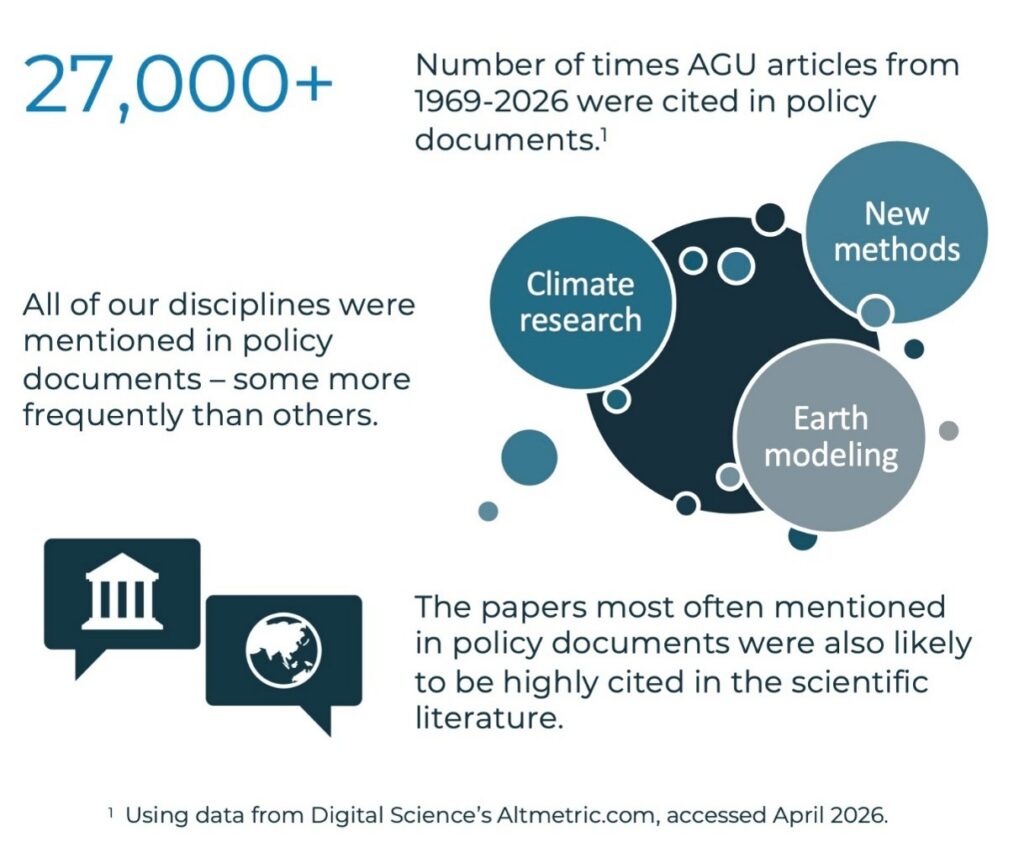
To help bridge the gap between science and policy, we’re launching a new special collection for policy and policy-related work across seven AGU journals. We hope that this special collection will serve as a home for work at the intersection of policy and Earth, space, and environmental science, and support dialogue for an international network of scientific researchers and decision-makers.
AGU Advances, Earth’s Future, GeoHealth, Global Biogeochemical Cycles, JGR: Biogeosciences, Paleoceanography and Paleoclimatology, and Space Weather are all welcoming submissions within this new special collection, including commentaries discussing emerging policy that directly impacts Earth, space, and environmental science researchers, research articles highlighting new findings with immediate or future consequences for science and society, and assessments and other evaluative work with a direct connection to our disciplines. The call for papers also includes more specific guidance for submitters to each journal.
Global challenges require global solutions, and this special collection is intended to address policy-related issues at a global scale, especially given developing regions’ disparities in access to scientific and policy-related research. However, rapid shifts in the political landscape in the United States have also brought to light the need to preserve evidence-based research and the scientific data that supports research for informed decision making.
AGU is committed to fighting for science and has launched several special initiatives in support of this, including the Impactful Datasets in Earth, Space, and Environmental Sciences special collection and, with the American Meteorological Association (AMS), the U.S. Climate Collection. Our AGU Science Policy program continues to advocate for science and for our members within the U.S., both nationally and locally.
We look forward to receiving contributions to the new Policy and Policy-Related Research Special Collection. We also recognize that the conversation doesn’t end here. AGU is committed to supporting science and society through our programming and publications and we look forward to collaborating further with our members.
—Kristina Vrouwenvelder ([email protected],  0000-0002-5862-2502); and Emille Beller ([email protected], 0009-0009-7274-0706), American Geophysical Union, United States