
Editors’ Vox is a blog from AGU’s Publications Department.
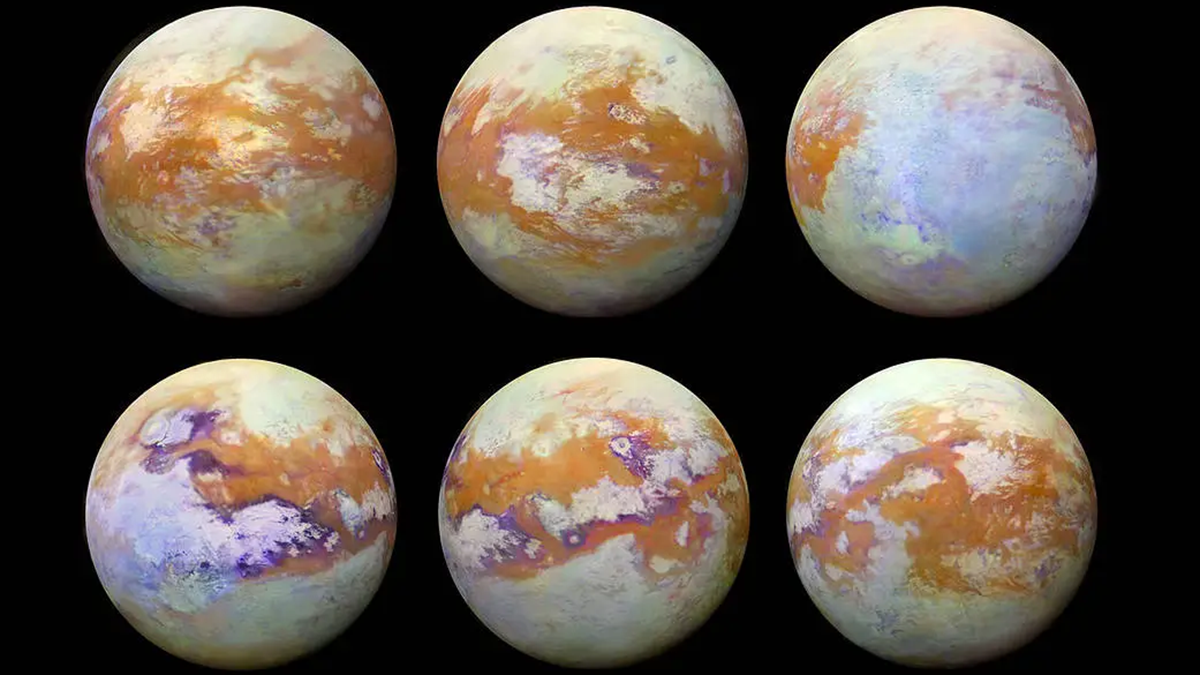
While Saturn has 274 confirmed moons in its orbit, its largest moon, Titan, is of particular interest to researchers due to its similarities to Earth. A new article in Reviews of Geophysics explores the geophysical parallels between Earth and Titan, and how scientists could use field work on Earth to learn more about both worlds. Here, we asked the lead author to give an overview of Titan, the use of field analogs, and future directions for research.
What sets Titan apart from other moons in our solar system?
[Titan] is the only moon in our solar system with a significant atmosphere.
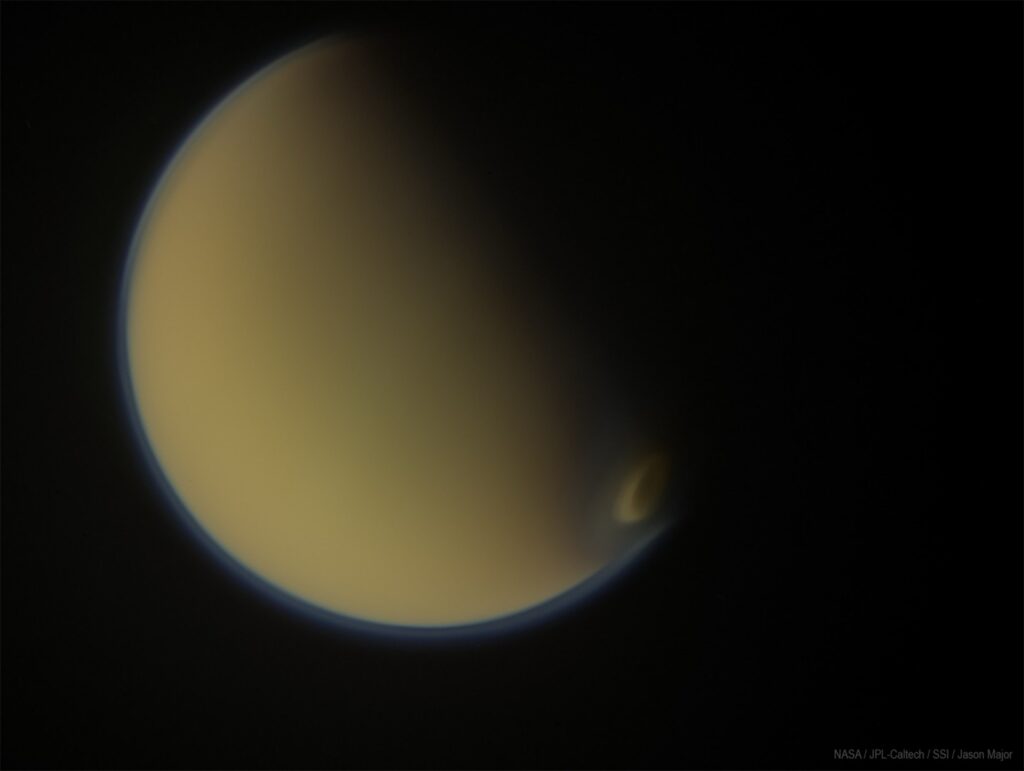
Titan is really unique. It’s the only moon in our solar system with a significant atmosphere, and we still don’t know for sure why that is, although there are theories of course, such as outgassing and even impacts. That alone makes it an enigma. In addition, its atmosphere hosts a ‘hydrological’ cycle with rivers, seas, evaporation, cloud formation and rainfall, but based on methane rather than water as on Earth. Finally, if all that isn’t enough, it has really fascinating chemistry that may be creating the building blocks for exotic forms of life. So, there’s a lot of different kinds of science questions covering many fields to study and solve.
How do scientists study the different characteristics of Titan?
We can study Titan directly through spacecraft visits, such as the Voyager and Cassini-Huygens missions. The Voyager missions were one-time flybys making remote measurements, while Cassini orbited Saturn and made many close flybys of Titan, and dropped off the Huygens probe that landed on the surface in 2005. Both Cassini and Huygens sampled the atmosphere directly at different altitudes. All of these missions collected great data, but of course we always have more questions, and so the Dragonfly rotorcraft arriving in 2034 to explore the surface should help to answer some of those. The other main techniques we use are astronomy, lab studies and modeling, all of which play important roles in helping to understand the spacecraft data.
What are field analogs and why are they useful?
Field analog studies are surveys of locations on Earth that hold some similarities to places on other worlds.
Field analog studies are surveys of locations on Earth that hold some similarities – although imperfect – to places on other worlds in the solar system that are more difficult for us to access directly. An example would be the many studies of locations in Antarctica as Mars analogs, since these can be extremely cold and dry, and give us clues about what kinds of life might also be surviving on Mars. There are also studies of craters as lunar analogs, and sea ice for Europa analogs, and others. However, Titan analog studies have historically been a little under-used, with some notable exceptions especially for dunes and craters in recent years.
What are the main Titan-Earth analogs described in your review article?
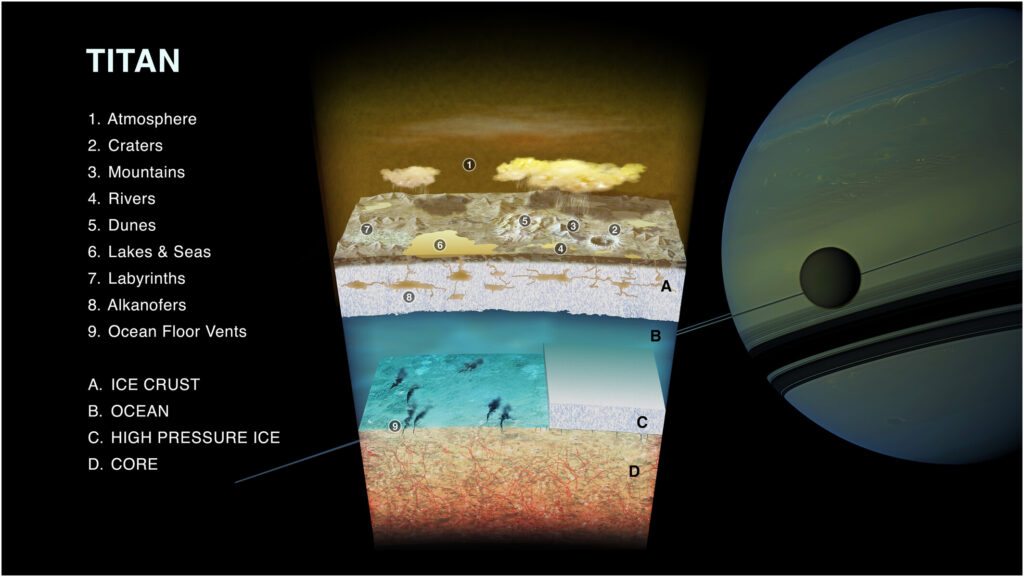
We sought to really widen the range of Titan analogs under consideration. These include terrains identified more recently on Titan such as labyrinths and karst. We also noted the well-known aeolian features – dunes, and yardangs, which are wind-carved ridges – and impact craters, of course. We expanded the scope to also include the atmosphere, which has similar polar stratospheric clouds and chemistry to Earth, and hard-charging, rainy weather fronts like the ‘derecho’ storms systems experienced in North America. Rain leads naturally to Titan’s other famous surface features: dry and wet river valleys, lakes and seas, and sub-surface hydrocarbon reservoirs, which have plenty of terrestrial counterparts. Then there are tectonic features such as mountains. Finally, there is thought to be an interior water ocean like Europa or Enceladus, for which we might find analogs on Earth such as Lakes Vostok and Whillans in Antarctica that have seen drilling projects to detect isolated strains of life.
What are some of the limitations of using terrestrial sites as Titan analogs?
There are definitely limitations with the use of terrestrial analogs. Titan’s surface is at 93K, or -180C, much colder than on Earth, so there is no possibility of liquid water on the surface except for after very transient impact events. That means all liquids we see – from rain to rivers to seas – are all methane, which has very different properties and especially solubility to water. However, Titan’s ‘bedrock’ is mostly water ice, so erosion of methane on water ice on Titan is going to be quite different from water on rock as on Earth. Even the dunes are different, being made mostly of solid organic materials rather than weathered sand and rock as on Earth. However, we think that these differences are exciting as well as challenges, since we can learn more about geophysical processes at large from studying two quite different example cases.
What are the remaining questions or knowledge gaps where additional research efforts are needed?
Analog field work is currently an underexploited way of learning about Titan.
In our paper we propose that analog field work is currently an underexploited way of learning about Titan. Field data could help to not only improve our understanding of the current mission data, but also to help us design experiments and test equipment that could one day fly to Titan. A good example is extremophiles: we are still uncovering whole branches of the tree of life on Earth, and locations such as tar pits and sub-glacial lakes could be really fertile environs for finding lifeforms that might also be able to survive on, or in, Titan.
But alongside field work the more traditional disciplines of astronomy, computer modeling, and lab work are all needed together to tackle important open questions, such as “What is the origin of Titan’s atmosphere?” and “How far along the road to life has Titan’s chemistry progressed?” So, there’s no shortage of exciting Titan research topics for the future.
—Conor Nixon ([email protected];  0000-0001-9540-9121), NASA Goddard Space Flight Center, United States
Editor’s Note: It is the policy of AGU Publications to invite the authors of articles published in Reviews of Geophysics to write a summary for Eos Editors’ Vox.