
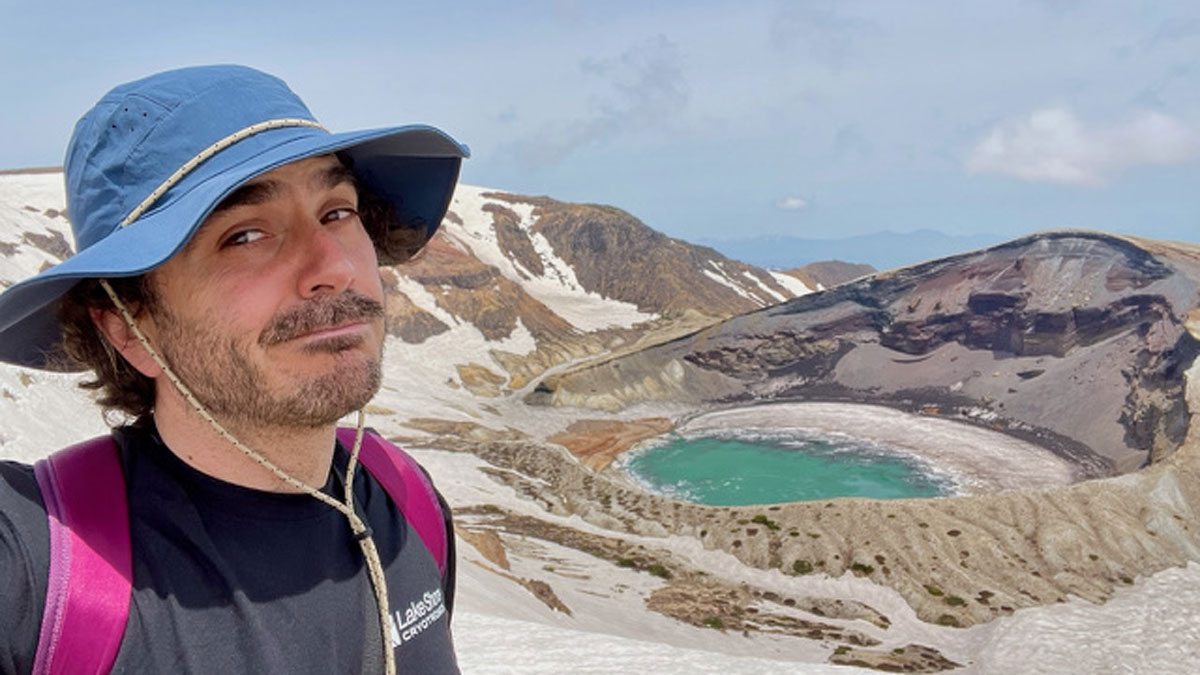

It was the dinosaurs that set Daniel Pastor-Galán on his journey to tectonics. As a Jurassic Park–obsessed youth, he says watching the on-screen paleontologists solidified his desire to become a scientist. Hollywood storytelling collided with reality when he was an undergraduate at the University of Salamanca in Spain: There, he instead found himself inspired by the stuff the dinosaurs were buried in.
“We know more about what happens out of the Earth than what is happening inside the Earth,” said Pastor-Galán, now a tectonicist and geodynamicist with the National Research Council of Spain.
That fascination with the mechanics of the deep Earth carried Pastor-Galán to a Ph.D. in tectonics and a postdoctoral position at Utrecht University in the Netherlands conducting paleomagnetism research. One focus for him was gathering clues from Paleozoic era rocks about the formation and evolution of the supercontinent Pangea, work he continued at a second postdoctoral position in Japan, which put him closer to remnants of the erstwhile supercontinent’s outer reaches.
Pastor-Galán moved back to Spain in 2021 but maintains a position at Tohoku University in Japan, where he travels for several weeks each year. His research today attempts to untangle various factors that complicate tectonic reconstructions, such as plate deformation and continental subduction, using field geology, paleomagnetism, geochronology, and geochemistry. Just as he was drawn to the mysteries of the deep Earth, Pastor-Galán said events far back in Earth’s history also appeal to him—there are many more questions to ask, he said, and therefore more to explore. In addition to his research, he serves as an associate editor of AGU’s Journal of Geophysical Research: Solid Earth.
What is one book, movie, or piece of media about your field you would recommend to young scientists?
Red Mars by Kim Stanley Robinson.
This novel, the first in the science fiction author’s Mars Trilogy, follows a pioneering contingent of scientists and settlers as they work to establish a Martian colony. Its depictions of disagreements between scientific contingents settling the planet are “exactly what I expect from scientists,” Pastor-Galán said.
A conservatory-trained musician (where he focused on clarinet and voice), Pastor-Galán has found ways to infuse his love of music (rock music primarily, like any good geologist) into his scientific career. Hidden amid the acknowledgments of some of his papers are tributes to rock heroes like Tom Petty (“you dropped me in free fallin’ and now I’m learning to fly,” in a paper about late Paleozoic oroclines in Iberia) and Chris Cornell of Soundgarden (“you broke your rusty cage, now the cold Earth is your bed,” in a paper about forearc sediment provenance).
In both geology and music, “it’s all about finding that rhythm,” Pastor-Galán said.
Pastor-Galán says his advice to anyone similarly inspired to pursue a career in research by big-screen scientists is to first make sure they enjoy the research. Though the practice of science can involve many hurdles, the work of pursuing fundamental questions about our world is the rewarding part, Pastor-Galán said.
—Nathaniel Scharping (@nathanielscharp), Science Writer
This profile is part of a special series in our August 2026 issue on science careers.