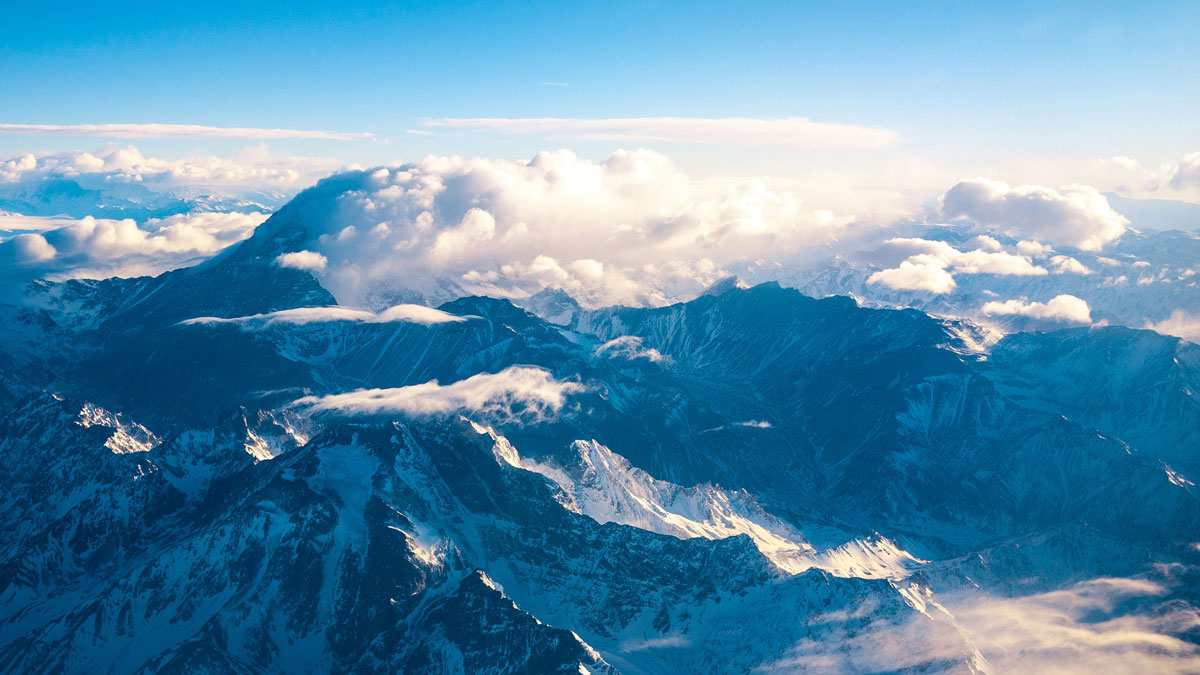
Source: AGU Advances
Most studies of how clouds are responding to climate change focus on clouds over the oceans, rather than over mountains. Those that do focus on mountain clouds tend to explore cloud microphysics rather than long-term trends in cloud phase. But understanding cloud behavior over regions such as the Tibetan Plateau, which supplies water to hundreds of millions of people, is critical—especially as diminishing snowpack and altered precipitation patterns threaten this critical water source.
Zhang et al. fill this knowledge gap by studying long-term changes in cloud phases in the world’s mountainous regions. Using satellite observations and climate data from 2003 to 2022, they analyzed cloud fraction, cloud top temperature, and cloud height over the Tibetan Plateau, the European Alps, the Andes, the Appalachians, and the Rockies, and their adjacent lowlands.
In response to global warming, clouds can change in their vertical structure and phase, including liquid, ice, and transitional supercooled phases.
The researchers found that clouds over most of the mountainous regions had increases in warm-liquid and ice cloud phases, with suppressed vertical development and fewer clouds in the supercooled phase. Ice cloud tops over mountains also rose and cooled 2–4 times more quickly than clouds over adjacent lowlands.
However, where supercooled clouds did form, they exhibited a different response to a warmer climate depending on where they were located. Over lowlands and lower-elevation mountains, supercooled cloud tops warm and then descend, a pattern that indicates suppressed development of vertical cloud structure. But over the highest-elevation mountains—the Tibetan Plateau and the Andes—supercooled clouds were able to further cool and ascend.
In the Tibetan Plateau, that change could be related to stronger warming at lower altitudes that destabilizes the region’s vertical thermal profile, letting clouds develop higher into colder air. In the Andes, colder and higher clouds were associated with more moisture content in the atmosphere.
Together the findings suggest that high-elevation clouds are responding both differently and more strongly to warming than clouds over other regions.
More research is needed into how icy high-elevation cloud changes over the Tibetan Plateau and the Andes could affect the way clouds trap radiative energy (including heat) in Earth’s atmosphere or reflect it back into space, the authors note. Such research could help improve regional radiative energy budgets. (AGU Advances, https://doi.org/10.1029/2026AV002380, 2026)
—Rebecca Dzombak, Science Writer