Source: Journal of Geophysical Research: Planets
Reconstructing impact events on Earth and other planetary bodies, including the Moon, is crucial for understanding how the solar system evolved and how planets develop.
Ancient grains of minerals such as zircon can hold physical and chemical clues about the timing and energy levels of past impacts. But long-lived grains can go through a lot, geologically speaking, making it challenging for scientists to use the minerals to reconstruct past impacts.
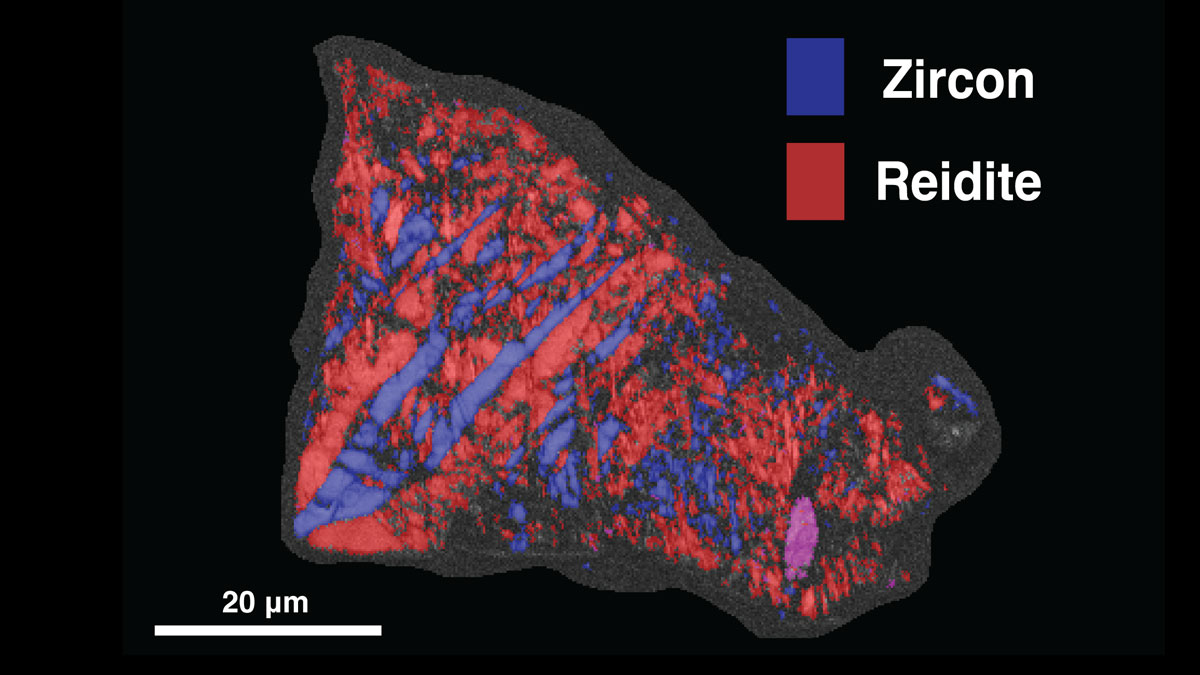
Building on recent research that upended some assumptions about how mineral microstructures change in response to different shock-related pressures, Cone et al. conducted shock wave experiments and postshock thermal annealing experiments on zircon, apatite, and whitlockite to delve into how the minerals’ physical properties, geochemistry, and uranium-lead-derived ages change in response to different shock pressures. To the authors’ knowledge, theirs is the first such attempt to shock all three minerals in the same experiment, which creates consistency in the pressure experiences among the mineral grains.
The researchers concluded that single-shock experiments may be too simplistic to reproduce the complexities that a real-world mineral grain goes through, such as multiple shock events or repeated cycles of heating and cooling.
One of their key findings is that subjecting a mineral to the same shock pressures does not always change the mineral’s microstructure in a consistent way, with evidence for variety between grains. Even within one grain, different zones can produce different structural responses to the same pressure. Inspecting micro- or even nanoscale zones before using the grains to reconstruct impact ages becomes important, especially when the events may be closely spaced in time, the authors found.
Additionally, the absence of what is considered a shock pressure’s diagnostic microstructure does not, on its own, mean the mineral did not experience that pressure, the authors caution. (Journal of Geophysical Research: Planets, https://doi.org/10.1029/2026JE009701, 2026)
—Rebecca Dzombak, Science Writer