• About
  • Special Reports
  • Topics
    • Climate
    • Earth Science
    • Oceans
    • Space & Planets
    • Health & Ecosystems
    • Culture & Policy
    • Education & Careers
    • Opinions
  • Projects
    • Postcards From the Field
    • ENGAGE
    • Editors’ Highlights
    • Editors’ Vox
    • Eos en Español
    • Eos 简体中文版
    • Print Archive: 2015–2025
  • Policy Tracker
  • Blogs
    • Research & Developments
    • The Landslide Blog
  • Newsletter
  • Submit to Eos
  • AGU.org
  • Career Center
  • Join AGU
  • Give to AGU
  • About
  • Special Reports
  • Topics
    • Climate
    • Earth Science
    • Oceans
    • Space & Planets
    • Health & Ecosystems
    • Culture & Policy
    • Education & Careers
    • Opinions
  • Projects
    • Postcards From the Field
    • ENGAGE
    • Editors’ Highlights
    • Editors’ Vox
    • Eos en Español
    • Eos 简体中文版
    • Print Archive: 2015–2025
  • Policy Tracker
  • Blogs
    • Research & Developments
    • The Landslide Blog
  • Newsletter
  • Submit to Eos
Skip to content
  • AGU.org
  • Career Center
  • Join AGU
  • Give to AGU
Eos

Eos

Science News by AGU

Support Eos
Sign Up for Newsletter
  • About
  • Special Reports
  • Topics
    • Climate
    • Earth Science
    • Oceans
    • Space & Planets
    • Health & Ecosystems
    • Culture & Policy
    • Education & Careers
    • Opinions
  • Projects
    • Postcards From the Field
    • ENGAGE
    • Editors’ Highlights
    • Editors’ Vox
    • Eos en Español
    • Eos 简体中文版
    • Print Archive: 2015–2025
  • Policy Tracker
  • Blogs
    • Research & Developments
    • The Landslide Blog
  • Newsletter
  • Submit to Eos

biogeosciences

Posted inEditors' Highlights

Improved Simulation of Gross Primary Productivity

by P. A. Dirmeyer 10 November 201717 March 2023

A new model better explains seasonal variations in biomass.

A satellite image of an atmospheric river on 20 February 2017, which helped the American west emerge from a 5-year drought.
Posted inFeatures

How Will Climate Change Affect the United States in Decades to Come?

by D. Wuebbles, D. W. Fahey and K. A. Hibbard 3 November 201730 March 2023

A new U.S. government report shows that climate is changing and that human activities will lead to many more changes. These changes will affect sea levels, drought frequency, severe precipitation, and more.

Landsat 5 Thematic Mapper image of the northwestern corner of North Lake Eyre, Australia, after floods in March 2011.
Posted inScience Updates

Observing Life near the Ocean’s Surface with Satellites

by V. Stuart 30 October 20178 November 2022

Third International Ocean Colour Science (IOCS) Meeting; Lisbon, Portugal, 15–19 May 2017

Posted inAGU News

Czimczik Receives 2017 Sulzman Award for Excellence in Education and Mentoring

by AGU 20 October 201718 April 2023

Claudia Czimczik will receive the 2017 Sulzman Award for Excellence in Education and Mentoring at the 2017 American Geophysical Union Fall Meeting, to be held 11–15 December in New Orleans, La. The award is given to “one mid-career female scientist…for significant contributions as a role model and mentor for the next generation of biogeoscientists.”

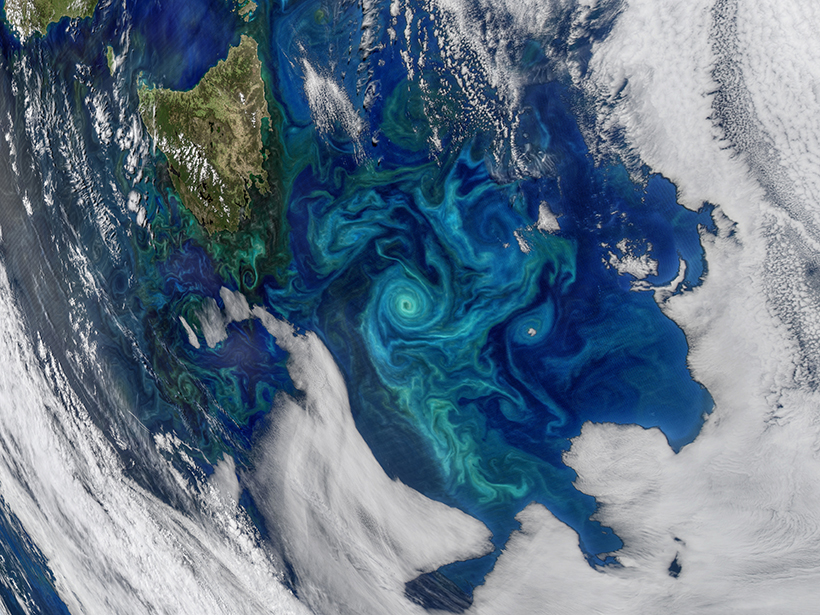
Scientists analyze the role of ocean eddies in phytoplankton populations
Posted inResearch Spotlights

World’s Biggest Oxygen Producers Living in Swirling Ocean Waters

by S. Witman 13 September 201729 September 2021

Oceanographers probe the impact of deep swirling vortices on phytoplankton.

The Harris River, on Prince of Wales Island in Alaska’s panhandle, winds through temperate rain forest to the sea.
Posted inScience Updates

Quantifying Coastal Rain Forest Carbon Transport

by A. Bidlack, B. Buma and D. Butman 19 July 201730 March 2023

Aquatic Carbon Biogeochemistry of the Pacific Coastal Temperate Rainforest Region Workshop; Seattle, Washington, 7–10 February 2017

A “dead cart” depicted in an antique engraving.
Posted inNews

Plague Bug May Have Lurked in Medieval England Between Outbreaks

Bas den Hond, Science Writer by Bas den Hond 8 May 201723 March 2023

A new analysis of climate records in England and Europe’s Low Countries suggests that the disease-causing bacterium persisted in rodents between recurrences in people.

Marine scientists deploy a video plankton recorder in the high-latitude North Atlantic in April 2012.
Posted inScience Updates

Optical Sensors Can Shed Light on Particle Dynamics in the Ocean

by S. L. C. Giering 2 May 201727 September 2022

First TOMCAT Workshop; Southampton, UK, 12–14 September 2016

Twitchell Island, in Sacramento County, Calif., is a wetland flux site in the FLUXNET network.
Posted inScience Updates

A New Data Set to Keep a Sharper Eye on Land-Air Exchanges

by G. Z. Pastorello, D. Papale, H. Chu, C. Trotta, D. A. Agarwal, E. Canfora, Dennis Baldocchi and M. S. Torn 17 April 201710 March 2023

FLUXNET2015, the latest update of the longest global record of ecosystem carbon, water, and energy fluxes, features improved data quality, new data products, and more open data sharing policies.

Phenocam webcam image from Sevilleta National Wildlife Refuge, N.M.
Posted inScience Updates

Integrating Multiscale Seasonal Data for Resource Management

by Andrew D. Richardson, J. F. Weltzin and J. T. Morisette 23 January 20171 March 2023

Workshop on Phenology at Scales from Individual Plants to Satellite Pixels; Cambridge, Massachusetts, 21–23 June 2016

Posts pagination

Newer posts 1 … 17 18 19 20 21 Older posts
Over a dark blue-green square appear the words Special Report: The State of the Science 1 Year On.

Features from AGU Publications

Research Spotlights

Sea Turtles, Shrinking Beaches, and Rising Seas

16 March 202616 March 2026
Editors' Highlights

The Multi-Faceted Water Footprint of Data Centers

18 March 202618 March 2026
Editors' Vox

How Frozen Ground Controls Water in a Warming World

17 March 202617 March 2026
Eos logo at left; AGU logo at right

About Eos
ENGAGE
Awards
Contact

Advertise
Submit
Career Center
Sitemap

© 2026 American Geophysical Union. All rights reserved Powered by Newspack