• About
  • Special Reports
  • Topics
    • Climate
    • Earth Science
    • Oceans
    • Space & Planets
    • Health & Ecosystems
    • Culture & Policy
    • Education & Careers
    • Opinions
  • Projects
    • Postcards From the Field
    • ENGAGE
    • Editors’ Highlights
    • Editors’ Vox
    • Eos en Español
    • Eos 简体中文版
    • Print Archive: 2015–2025
  • Policy Tracker
  • Blogs
    • Research & Developments
    • The Landslide Blog
  • Newsletter
  • Submit to Eos
  • AGU.org
  • Career Center
  • Join AGU
  • Give to AGU
  • About
  • Special Reports
  • Topics
    • Climate
    • Earth Science
    • Oceans
    • Space & Planets
    • Health & Ecosystems
    • Culture & Policy
    • Education & Careers
    • Opinions
  • Projects
    • Postcards From the Field
    • ENGAGE
    • Editors’ Highlights
    • Editors’ Vox
    • Eos en Español
    • Eos 简体中文版
    • Print Archive: 2015–2025
  • Policy Tracker
  • Blogs
    • Research & Developments
    • The Landslide Blog
  • Newsletter
  • Submit to Eos
Skip to content
  • AGU.org
  • Career Center
  • Join AGU
  • Give to AGU
Eos

Eos

Science News by AGU

Support Eos
Sign Up for Newsletter
  • About
  • Special Reports
  • Topics
    • Climate
    • Earth Science
    • Oceans
    • Space & Planets
    • Health & Ecosystems
    • Culture & Policy
    • Education & Careers
    • Opinions
  • Projects
    • Postcards From the Field
    • ENGAGE
    • Editors’ Highlights
    • Editors’ Vox
    • Eos en Español
    • Eos 简体中文版
    • Print Archive: 2015–2025
  • Policy Tracker
  • Blogs
    • Research & Developments
    • The Landslide Blog
  • Newsletter
  • Submit to Eos

carbon cycle

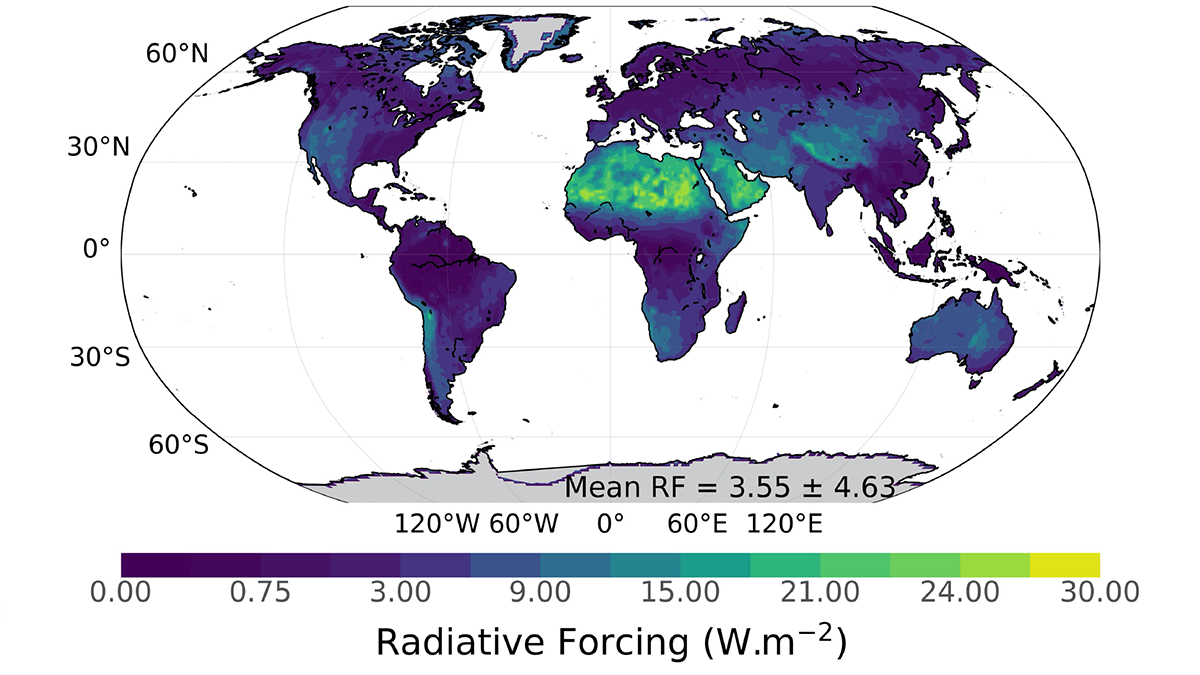
World map with radiative forcing data.
Posted inEditors' Highlights

Sensing the Color of Soil for Climate Modeling

Eric Davidson, president-elect of AGU by Eric Davidson 20 July 202328 August 2023

The color of soil reflecting the Sun’s rays affects the Earth’s climate and water cycle. Using satellite data that senses many wavelengths improves soil reflectivity estimates, especially in deserts.

A photo of a small mushroom in a wooded area surrounded by tiny mushroom sprouts
Posted inNews

Soil Fungi May Be a Carbon Pool

by Caroline Hasler 17 July 202324 July 2023

New research suggests that mycorrhizal fungi take in 13 billion tons of carbon dioxide annually, playing a prominent role in Earth’s carbon cycle.

Diagram from the paper
Posted inEditors' Highlights

Tracking Human CO2 Emissions from Medium-Sized Cities

by Bo Zheng 28 June 202327 June 2023

Atmospheric inverse models, combined with observations, successfully tracked modest CO2 emission reductions in Salt Lake City during the first COVID-19 lockdown in 2020.

Images of measurements taken from a coccolithophore.
Posted inEditors' Highlights

Applying Algal Geometry to Past and Future Environments

by Marguerite A. Xenopoulos 11 May 202310 May 2023

Math can be fun when reconstructing the ocean’s past and forecasting the future with algal geometry.

白色的烟雾从灰绿色的水中升起,背景是高耸的黑色岩石。
Posted inResearch Spotlights

火山排放的碳比吸收的多吗?

by Saima May Sidik 11 May 202318 May 2023

火山喷发结束后很长一段时间内缓慢的碳排放可能会在地质时间尺度上影响碳循环。

An aerial view of a river flowing in Crescent Lake in Lake Clark National Park
Posted inResearch Spotlights

The Greenhouse Gas Burden of Inland Waters

Aaron Sidder, freelance science writer by Aaron Sidder 8 May 20238 May 2023

A global collaboration inventoried greenhouse gas emissions from rivers, lakes, and streams.

Un instrumento científico desciende al océano desde un buque de investigación.
Posted inENGAGE, News

La presión del océano profundo tiene un aplastante impacto en el ciclo del carbono

by Elise Cutts 4 May 20234 May 2023

La presión extrema que existe en el mar profundo reduce el apetito de los microorganismos por carbono orgánico. Este hallazgo podría tener implicaciones importantes en la geoingeniería y el balance de carbono global.

Diagram of the carbon cycling in Subglacial Lake Mercer.
Posted inEditors' Highlights

Clues from a Subglacial Lake for Holocene Grounding Line Change

by Susan Trumbore 2 May 20231 May 2023

Organic carbon sampled in the lake contained radiocarbon, indicating connection to the ocean in the mid-Holocene, when the grounding line was up to 260 kilometers inland of its current position.

Satellite view of a swirling green bloom of phytoplankton set in the dark blue ocean.
Posted inScience Updates

Carbon In, Carbon Out: Balancing the Ocean’s Books

by Ryan Vandermeulen 27 April 202325 January 2024

Scientists have developed a consensus guide of standard protocols for how best to measure oceanic primary productivity, a key component in Earth’s carbon cycle.

White fumes lift from green-gray waters with black rocks towering in the background.
Posted inResearch Spotlights

Do Volcanoes Add More Carbon Than They Take Away?

by Saima May Sidik 26 April 202311 May 2023

Slow carbon seep long after eruptions have ceased could shape the carbon cycle on geological timescales.

Posts pagination

Newer posts 1 … 6 7 8 9 10 … 35 Older posts
Over a dark blue-green square appear the words Special Report: The State of the Science 1 Year On.

Features from AGU Publications

Research Spotlights

What Makes Mars’s Magnetotail Flap?

20 April 202620 April 2026
Editors' Highlights

How Space Plasma Can Bend the Laser of Gravitational Wave Detectors

24 April 202623 April 2026
Editors' Vox

Can Any Single Satellite Keep Up with the World’s Floods?

20 April 202620 April 2026
Eos logo at left; AGU logo at right

About Eos
ENGAGE
Awards
Contact

Advertise
Submit
Career Center
Sitemap

© 2026 American Geophysical Union. All rights reserved Powered by Newspack