

Expansive construction in fragile mountain environments is often pursued without adequate consideration of heightened hazards and local concerns, putting people and infrastructure at greater risk.
culture & policy
Posted inResearch & Developments
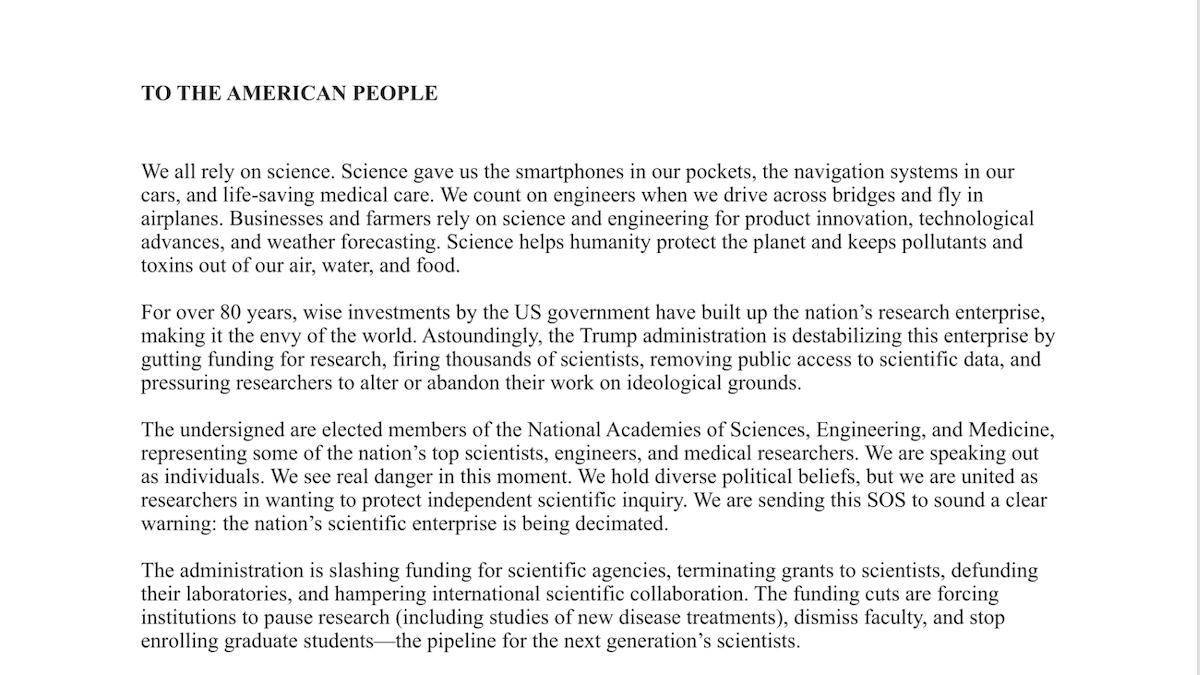
1,900 Scientists Warn of “Real Danger” in Open Letter

In an open letter to the American people, more than 1,900 scientists sent an “SOS” that the Trump administration’s actions have “decimated” the nation’s scientific enterprise and censored scientific work. “We see real danger in this moment,” the scientists wrote.

Posted inResearch & Developments
Climate Scientists Unite to Nominate U.S. Experts for IPCC Report

A new academic alliance provides a pathway for U.S. climate scientists to participate in a critical international climate report.

Posted inResearch & Developments
Majority of Polled Scientists Considering Leaving United States, Signaling “Brain Drain”
After an onslaught of funding cuts, firings, and cancelled programs as a result of Trump administration actions, scientists in the United States are feeling targeted. That’s according to the results of a poll of 1,200 U.S. scientists, published by Nature.

Posted inFeatures
Cómo pueden los vulcanólogos mejorar la resiliencia urbana al cambio climático
Las estrategias pensadas para ciudades enteras para hacer frente al cambio climático pueden beneficiarse de los conocimientos de los vulcanólogos, que llevan mucho tiempo adaptando la información y la comunicación sobre riesgos a las comunidades locales.
Posted inResearch & Developments
NIH Cancels Climate and Health Research Grants
The Trump administration’s intentions toward addressing climate change are clear: Federal agencies purged mentions of the climate crisis from their websites and slashed funding for mitigation tools such as the Future Risk Index. Now, those intentions are extending to health research: The National Institutes of Health (NIH) has begun to cancel funding for investigations into the health effects of climate change, and will not financially support new research on the subject, according to ProPublica and Nature.

Posted inResearch & Developments
NASA Abandons Pledge to Put Women, Astronauts of Color on the Moon
NASA has dropped its commitment to land the first woman, the first person of color, and the first non-American astronaut on the Moon through the Artemis program.

Posted inResearch & Developments
French Scientist, En Route to Conference, Denied U.S. Entry for Trump-Critical Messages
On 9 March, a French researcher traveling to a science conference near Houston, Texas, was denied entry to the United States and expelled back to France.

Posted inEditors' Vox
Announcing the AGU Publications DEIA Reviewer Board
With the launch of a new DEIA Reviewer Board, AGU Publications reaffirms our commitment to publishing content on equity and inclusion in the geosciences.

Posted inResearch & Developments
Trump Administration Plans to Fire More Than 1,000 EPA Scientists
The Trump Administration plans to fire more than 1,000 scientists in the EPA’s research arm. The layoffs are part of a “reduction in force” that comes after the agency already fired hundreds of probationary workers. (A federal judge has since ordered that these employees be reinstated, and though the administration has complied, most of the workers have been placed on administrative leave.)