Source: Journal of Geophysical Research: Earth Surface
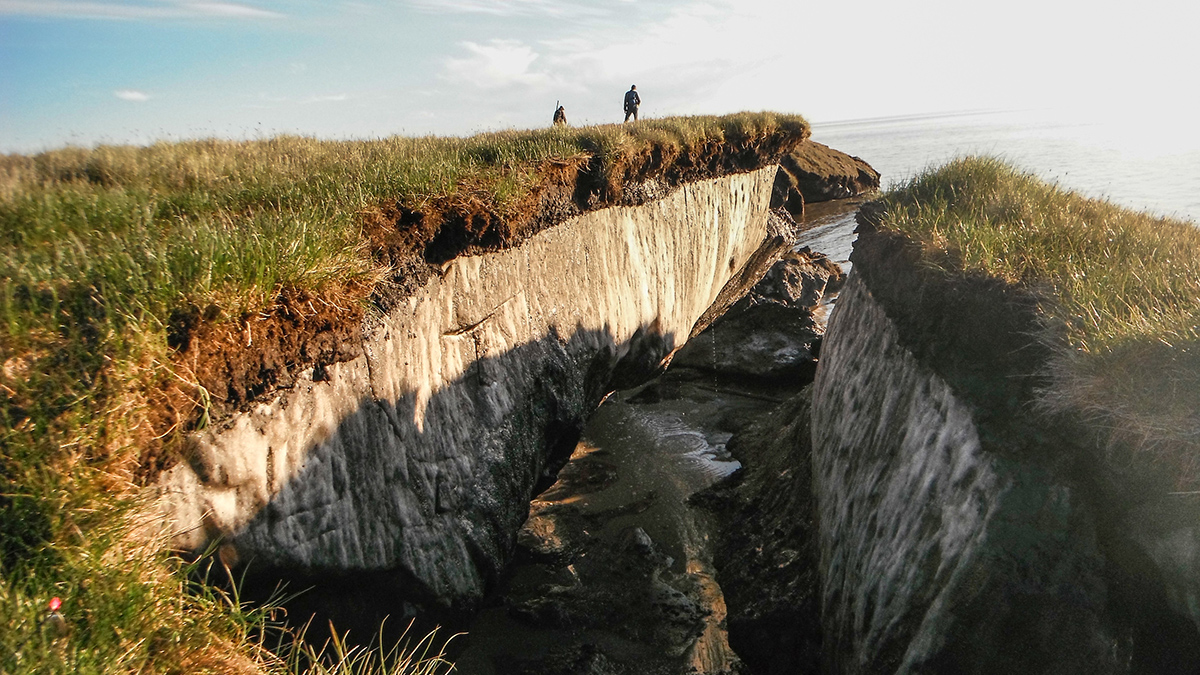
Arctic coastlines are falling into the sea. Wave action, rising sea levels, and thawing permafrost are all contributing to the massive erosion that has forced whole towns to move farther from the water’s edge.
To understand how these forces combine to bring down cliffs, Omonigbehin et al. created a microcosm of an Arctic coastline in a lab. First, the researchers mimicked soil containing permafrost by mixing water and sand in ratios designed to maximize the density of the sand, then compacting the mixture with a hydraulic press and freezing it. The researchers pummeled these blocks of faux permafrost with water in a cooled wave flume, a long and narrow tank in which waves are generated so researchers can observe their effects. In this study, the scientists varied the wave height and frequency to see how the permafrost would respond.
The method reproduced observed patterns of erosion that hollow out the bases of coastal bluffs. Wave height had the strongest influence on the rate of erosion, with the highest-wave conditions causing twice as much erosion as low-wave conditions. Wave frequency, on the other hand, strongly influenced the height of the notch carved out by the waves.
When the researchers increased the ice content in the soil by adding more water prior to freezing, they found that the higher ice content decreased the initial erosion rate (because the ice took longer to thaw). This finding suggests that coastlines with higher ice content that currently appear stable may not see high erosion rates in the immediate term but could erode abruptly if the current global warming rate is sustained—a finding that’s consistent with the theory that climate change will trigger tipping points. However, the researchers caution that more research is needed to confirm this finding. (Journal of Geophysical Research: Earth Surface, https://doi.org/10.1029/2025JF008528, 2025)
—Saima May Sidik (@saimamay.bsky.social), Science Writer