• About
  • Special Reports
  • Topics
    • Climate
    • Earth Science
    • Oceans
    • Space & Planets
    • Health & Ecosystems
    • Culture & Policy
    • Education & Careers
    • Opinions
  • Projects
    • Postcards From the Field
    • ENGAGE
    • Editors’ Highlights
    • Editors’ Vox
    • Eos en Español
    • Eos 简体中文版
    • Print Archive: 2015–2025
  • Policy Tracker
  • Blogs
    • Research & Developments
    • The Landslide Blog
  • Newsletter
  • Submit to Eos
  • AGU.org
  • Career Center
  • Join AGU
  • Give to AGU
  • About
  • Special Reports
  • Topics
    • Climate
    • Earth Science
    • Oceans
    • Space & Planets
    • Health & Ecosystems
    • Culture & Policy
    • Education & Careers
    • Opinions
  • Projects
    • Postcards From the Field
    • ENGAGE
    • Editors’ Highlights
    • Editors’ Vox
    • Eos en Español
    • Eos 简体中文版
    • Print Archive: 2015–2025
  • Policy Tracker
  • Blogs
    • Research & Developments
    • The Landslide Blog
  • Newsletter
  • Submit to Eos
Skip to content
  • AGU.org
  • Career Center
  • Join AGU
  • Give to AGU
Eos

Eos

Science News by AGU

Support Eos
Sign Up for Newsletter
  • About
  • Special Reports
  • Topics
    • Climate
    • Earth Science
    • Oceans
    • Space & Planets
    • Health & Ecosystems
    • Culture & Policy
    • Education & Careers
    • Opinions
  • Projects
    • Postcards From the Field
    • ENGAGE
    • Editors’ Highlights
    • Editors’ Vox
    • Eos en Español
    • Eos 简体中文版
    • Print Archive: 2015–2025
  • Policy Tracker
  • Blogs
    • Research & Developments
    • The Landslide Blog
  • Newsletter
  • Submit to Eos

fieldwork

Researchers predict the movement of sediment in very steep streams.
Posted inResearch Spotlights

Boulders Limit Transport of Sand and Gravel in Steep Rivers

Alexandra Branscombe by A. Branscombe 6 January 20176 March 2023

Mountain rivers and streams actively reshape landscapes by eroding material from uplands and depositing it in lowlands. Scientists can now predict this transport in very steep streams.

Hovercraft-based Arctic sea ice drift research station in February
Posted inScience Updates

Scientists Spend Arctic Winter Adrift on Sea Ice

by Y. Kristoffersen, A. Tholfsen, J. K. Hall and R. Stein 11 October 20169 August 2022

A hovercraft-based ice drift station gives researchers access to previously inaccessible regions of the changing Arctic sea ice cover off the coast of Greenland.

A scientist takes a smoke sample from a smoldering peat fire in Kalimantan, Indonesia.
Posted inNews

The 2015 Indonesian Fires: Less Carbon Release Than Was Thought

by R. Heisman 9 June 201627 March 2023

Preliminary results from field measurements of smoldering Kalimantan peatlands suggest that the fires emitted 8% less carbon dioxide and 55% less methane than were previously estimated from lab tests.

View of typical Santiaguito explosion as seen from the summit of Santa Maria.
Posted inScience Updates

Visiting the Volcano

by J. B. Johnson, B. Andrews and R. Escobar-Wolf 2 May 20165 June 2023

Workshops on Volcanoes; Santiaguito, Guatemala, 4–12 January 2016

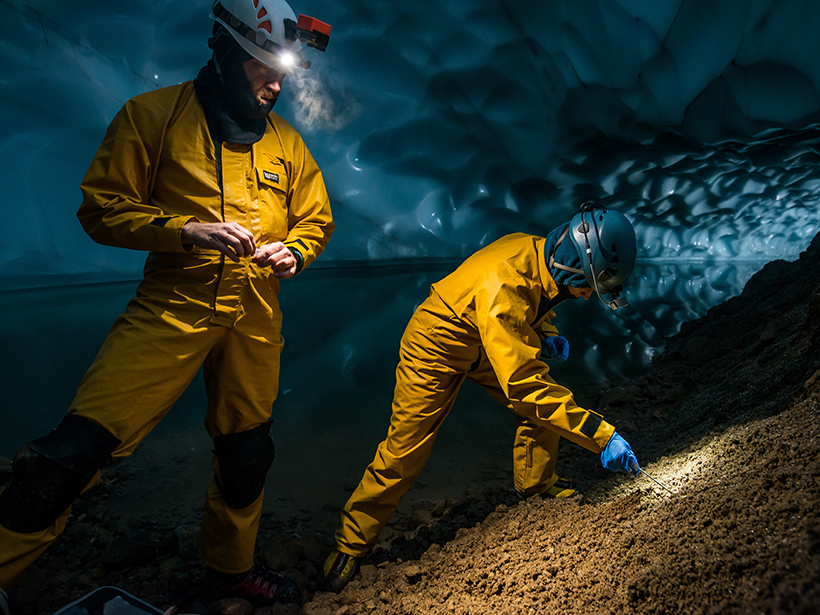
Kiya Riverman peers at ice crystals growing from the ceiling of an ice cave in the Larsbreen glacier in Svalbard, Norway.
Posted inNews

Into the Belly of a Glacier

JoAnna Wendel, freelance science writer and illustrator by JoAnna Wendel 14 April 20166 February 2024

Ice caving started as a weekend hobby but has now blossomed into a portion of graduate student Kiya Riverman's Ph.D. research.

Posted inEditors' Vox

What Are Scientists Doing off the Oregon Coast in Winter?

by M. Goni 22 March 201630 August 2022

Social media and the value of communicating field experiences to the public

Posted inResearch Spotlights

Recent Studies Crack Open New Views of Glacial Crevasses

Sarah Stanley, Science Writer by Sarah Stanley 16 March 201614 October 2022

Scientists review 60 years of direct and remote observations of crevasses and the models used to simulate them.

Posted inOpinions

Embracing Open Data in Field-Driven Sciences

by R. Fowler 10 March 20169 December 2022

Allowing data to be reused and research results to be replicated fosters innovation, high-quality research, and public trust in science.

Posted inScience Updates

Arctic Research on Thin Ice: Consequences of Arctic Sea Ice Loss

by M. A. Granskog, P. Assmy, S. Gerland, G. Spreen, H. Steen and Lars H. Smedsrud 26 January 201616 September 2022

Scientists embarked on a 6-month expedition in the Arctic Ocean to study the thinning sea ice cover, improve our understanding of sea ice loss effects, and help predict future changes.

Posted inScience Updates

Field Data Management: Integrating Cyberscience and Geoscience

by M. Mookerjee, D. Vieira, M. A. Chan, Y. Gil, T. L. Pavlis, F. S. Spear and B. Tikoff 13 October 201516 February 2023

The smartphone and tablet revolution has changed how geologists work in the field, but now the community must come up with standards to tame the flood of data.

Posts pagination

Newer posts 1 … 15 16 17 18 19 Older posts
Over a dark blue-green square appear the words Special Report: The State of the Science 1 Year On.

Features from AGU Publications

Research Spotlights

How Internal Waves Transport Energy Thousands of Miles Across the Ocean

26 March 202626 March 2026
Editors' Highlights

A Next-Generation Telescope for Space Weather Research

30 March 202626 March 2026
Editors' Vox

The Future of Earth’s Future

24 March 202624 March 2026
Eos logo at left; AGU logo at right

About Eos
ENGAGE
Awards
Contact

Advertise
Submit
Career Center
Sitemap

© 2026 American Geophysical Union. All rights reserved Powered by Newspack