• About
  • Special Reports
  • Topics
    • Climate
    • Earth Science
    • Oceans
    • Space & Planets
    • Health & Ecosystems
    • Culture & Policy
    • Education & Careers
    • Opinions
  • Projects
    • Postcards From the Field
    • ENGAGE
    • Editors’ Highlights
    • Editors’ Vox
    • Eos en Español
    • Eos 简体中文版
    • Print Archive: 2015–2025
  • Policy Tracker
  • Blogs
    • Research & Developments
    • The Landslide Blog
  • Newsletter
  • Submit to Eos
  • AGU.org
  • Career Center
  • Join AGU
  • Give to AGU
  • About
  • Special Reports
  • Topics
    • Climate
    • Earth Science
    • Oceans
    • Space & Planets
    • Health & Ecosystems
    • Culture & Policy
    • Education & Careers
    • Opinions
  • Projects
    • Postcards From the Field
    • ENGAGE
    • Editors’ Highlights
    • Editors’ Vox
    • Eos en Español
    • Eos 简体中文版
    • Print Archive: 2015–2025
  • Policy Tracker
  • Blogs
    • Research & Developments
    • The Landslide Blog
  • Newsletter
  • Submit to Eos
Skip to content
  • AGU.org
  • Career Center
  • Join AGU
  • Give to AGU
Eos

Eos

Science News by AGU

Support Eos
Sign Up for Newsletter
  • About
  • Special Reports
  • Topics
    • Climate
    • Earth Science
    • Oceans
    • Space & Planets
    • Health & Ecosystems
    • Culture & Policy
    • Education & Careers
    • Opinions
  • Projects
    • Postcards From the Field
    • ENGAGE
    • Editors’ Highlights
    • Editors’ Vox
    • Eos en Español
    • Eos 简体中文版
    • Print Archive: 2015–2025
  • Policy Tracker
  • Blogs
    • Research & Developments
    • The Landslide Blog
  • Newsletter
  • Submit to Eos

greenhouse gases

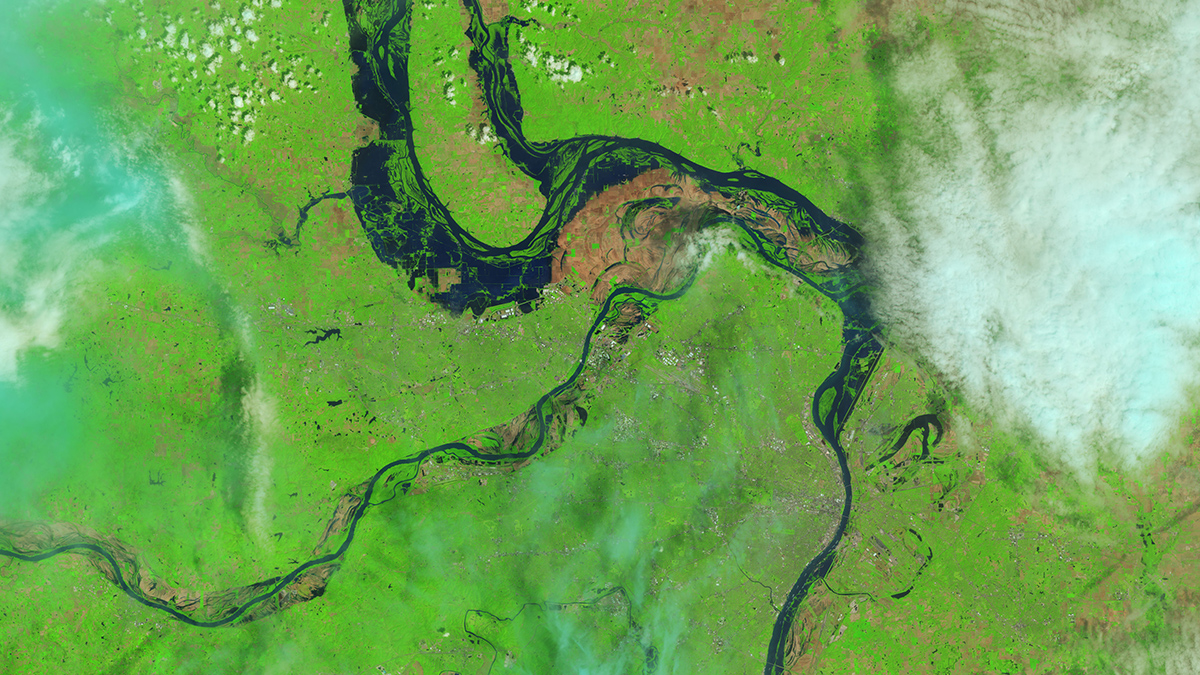
Satellite image of the Mississippi River surrounded by a green landscape
Posted inNews

Rivers Are Warming Up and Losing Oxygen

by Elise Cutts 3 November 20233 November 2023

Researchers used deep learning to fill in the gaps of “patchy” water quality data, revealing decades-long trends toward warmer and less oxygenated rivers that could have worrisome consequences.

Two world maps with colors representing the experiments.
Posted inEditors' Highlights

Warming Reduces Relative Humidity Through Soil Moisture 

by Guiling Wang 10 October 202310 October 2023

Relative humidity over land decreases in a warmer climate as a result of interactive soil moisture response.
Two graphs from the paper.
Posted inEditors' Highlights

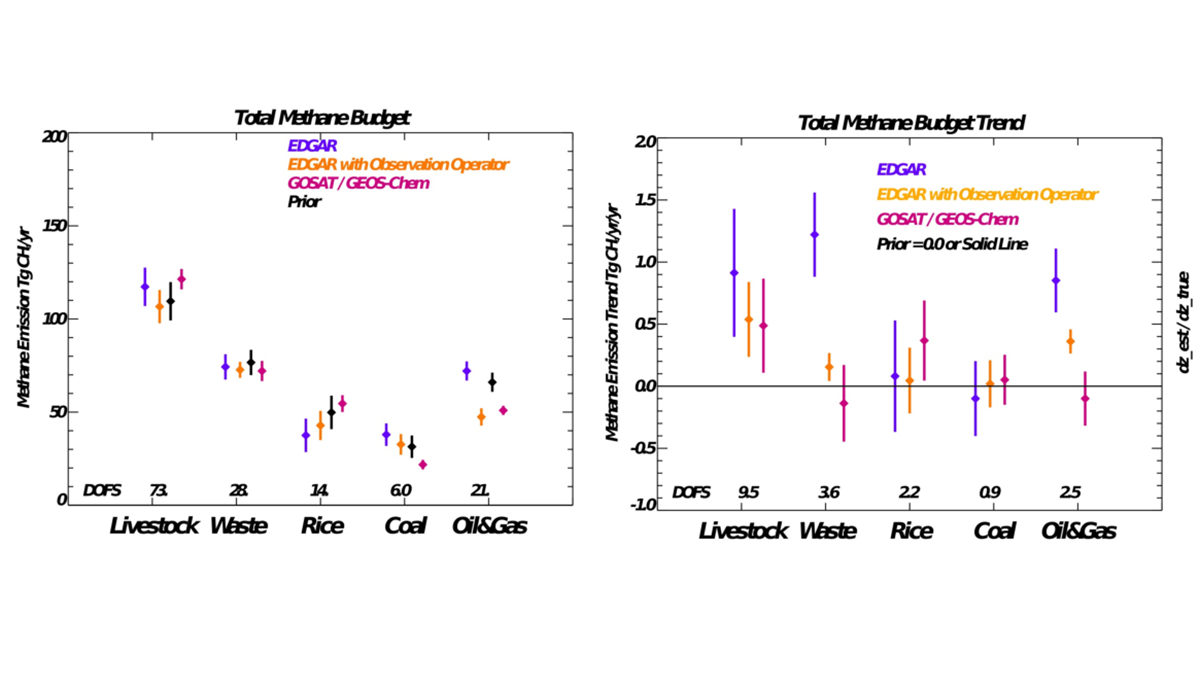
Using Bayesian Estimation to Improve Methane Inventories

by Donald Wuebbles 21 August 202315 August 2023

A Bayesian, optimal estimation evaluation of state-of-the-art methane inventory with satellite-based emissions from 2009 to 2018 finds substantial differences for livestock, rice, and coal emissions.

Diagram from the paper
Posted inEditors' Highlights

Tracking Human CO2 Emissions from Medium-Sized Cities

by Bo Zheng 28 June 202327 June 2023

Atmospheric inverse models, combined with observations, successfully tracked modest CO2 emission reductions in Salt Lake City during the first COVID-19 lockdown in 2020.

Global map with colors indicating different types of aerosols.
Posted inEditors' Vox

Reducing Aerosol Climate-Forcing Uncertainty: A Three-Way Street

by Ralph A. Kahn 13 June 202312 June 2023

To reduce persistent aerosol-climate-forcing uncertainty, new in situ aerosol and cloud measurement programs are needed, plus much better integration of satellite and suborbital measurements with models.

A large plume of dark smoke rises from a forest. Orange flames are visible among the trees.
Posted inNews

As Wildfires Grow, So Could Methane Emissions

by Derek Smith 13 June 202313 June 2023

Wildfires that wreaked havoc on California in 2020 filled the atmosphere with a potent greenhouse gas.

Map of western Europe with colors indicating land surface temperature.
Posted inEditors' Vox

Heat Waves: A Growing Threat to Society and the Environment

by David Barriopedro, Ricardo García–Herrera, Carlos Ordóñez, Diego G. Miralles and Sancho Salcedo–Sanz 18 May 20237 June 2023

With heat waves expected to worsen in the 21st century it is essential to take stock of our current understanding, knowledge gaps, and to set research priorities.

Un close-up de tres vacas, dos café con blanco con una enmedio negro con balnco. Al fondo se ve un pastizal verde.
Posted inNews

Para el 2100 la producción de alimentos podría contribuir con 1°C al calentamiento global

by Meghie Rodrigues 9 May 20239 May 2023

Un nuevo estudio separa las emisiones de gases de efecto invernadero provenientes de la agricultura, mostrando cómo lo que comemos calienta el planeta.

An aerial view of a river flowing in Crescent Lake in Lake Clark National Park
Posted inResearch Spotlights

The Greenhouse Gas Burden of Inland Waters

Aaron Sidder, freelance science writer by Aaron Sidder 8 May 20238 May 2023

A global collaboration inventoried greenhouse gas emissions from rivers, lakes, and streams.

A close-up photo of three cows—two with brown-and-white hide and one with black-and-white hide
Posted inNews

Food Production Could Add 1°C of Global Warming by 2100

by Meghie Rodrigues 25 April 20239 May 2023

A new study teases apart greenhouse gas emissions from agriculture, showing how the food we eat heats up the world.

Posts pagination

Newer posts 1 … 4 5 6 7 8 … 12 Older posts
Over a dark blue-green square appear the words Special Report: The State of the Science 1 Year On.

Features from AGU Publications

Research Spotlights

Making a Map to Make a Difference

11 February 202611 February 2026
Editors' Highlights

A New Way to Measure Quartz Strength at High Pressure

13 February 202612 February 2026
Editors' Vox

A Double-Edged Sword: The Global Oxychlorine Cycle on Mars

10 February 202610 February 2026
Eos logo at left; AGU logo at right

About Eos
ENGAGE
Awards
Contact

Advertise
Submit
Career Center
Sitemap

© 2026 American Geophysical Union. All rights reserved Powered by Newspack