• About
  • Sections
  • Topics
    • Climate
    • Earth Science
    • Oceans
    • Space & Planets
    • Health & Ecosystems
    • Culture & Policy
    • Education & Careers
    • Opinions
  • Projects
    • Postcards From the Field
    • ENGAGE
    • Editors’ Highlights
    • Editors’ Vox
    • Eos en Español
    • Eos 简体中文版
    • Print Archive: 2015–2025
  • Science Policy Tracker
  • Blogs
    • Research & Developments
    • The Landslide Blog
  • Newsletter
  • Submit to Eos
  • AGU.org
  • Career Center
  • Join AGU
  • Give to AGU
  • About
  • Sections
  • Topics
    • Climate
    • Earth Science
    • Oceans
    • Space & Planets
    • Health & Ecosystems
    • Culture & Policy
    • Education & Careers
    • Opinions
  • Projects
    • Postcards From the Field
    • ENGAGE
    • Editors’ Highlights
    • Editors’ Vox
    • Eos en Español
    • Eos 简体中文版
    • Print Archive: 2015–2025
  • Science Policy Tracker
  • Blogs
    • Research & Developments
    • The Landslide Blog
  • Newsletter
  • Submit to Eos
Skip to content
  • AGU.org
  • Career Center
  • Join AGU
  • Give to AGU
Eos

Eos

Science News by AGU

Support Eos
Sign Up for Newsletter
  • About
  • Sections
  • Topics
    • Climate
    • Earth Science
    • Oceans
    • Space & Planets
    • Health & Ecosystems
    • Culture & Policy
    • Education & Careers
    • Opinions
  • Projects
    • Postcards From the Field
    • ENGAGE
    • Editors’ Highlights
    • Editors’ Vox
    • Eos en Español
    • Eos 简体中文版
    • Print Archive: 2015–2025
  • Science Policy Tracker
  • Blogs
    • Research & Developments
    • The Landslide Blog
  • Newsletter
  • Submit to Eos

spacecraft

Posted inNews

Dawn Spacecraft Enters into Orbit Around Dwarf Planet Ceres

by Randy Showstack 9 March 201517 February 2023

A 16-month investigation of the dwarf planet Ceres could reveal a lot about the most massive body in the asteroid belt and could advance our understanding of the formation of terrestrial planets.

Posted inFeatures

Human and Robotic Missions: To the Moon Again and Beyond

by D. A. Kring 20 February 201518 November 2021

Robotic probes could help us collect samples from the Moon, potentially revealing the origins of our solar system.

Posted inFeatures

How Robotic Probes Helped Humans Explore the Moon—And May Again

by D. A. Kring 19 February 201526 January 2022

Robotic probes—including Ranger VIII, launched 50 years ago this week—paved the way for humankind’s giant leap to the Moon. This history may help guide future plans for lunar exploration.

Posted inAGU News

Andrew Grant Receives 2014 David Perlman Award for Excellence in Science Journalism—News

by AGU 4 February 201519 May 2023

Andrew Grant, physics reporter for Science News, received the 2014 David Perlman Award for Excellence in Science Journalism—News at the AGU Fall Meeting Honors Ceremony, held on 17 December 2014 in San Francisco, Calif. The Perlman Award is for work published under deadline pressure of 1 week or less.

Posted inAGU News

Learn about the MAVEN Mission to Mars at the 2014 Public Lecture

by K. Gadeken and Faith Ishii 25 November 201430 May 2023

The 2014 AGU Public Lecture will feature a panel of expert scientists who will speak about the Mars Atmosphere and Volatile Evolution (MAVEN) mission.

Posted inResearch Spotlights

Manganese Deposits on Mars Suggest a Highly Oxidized Past

by J. Rosen 18 November 201426 January 2023

Data from the Curiosity rover suggest that the surface of Mars has experienced more strongly oxidizing conditions than previously thought.

Posted inNews

Failed Rocket Payload Included Research Experiments

by Randy Showstack 4 November 201416 March 2023

Orbital Sciences’ Antares rocket and Cygnus cargo spacecraft, which failed on 28 October, included a number of student research projects along with other science experiments.

Posted inNews

Pluto-Bound Spacecraft Crosses Orbit of Neptune

by Randy Showstack 9 September 201417 February 2023

NASA’s New Horizons spacecraft, which is en route to explore Pluto and its planetary system in 2015, crossed the orbit of Neptune on 25 August.

Posted inFeatures

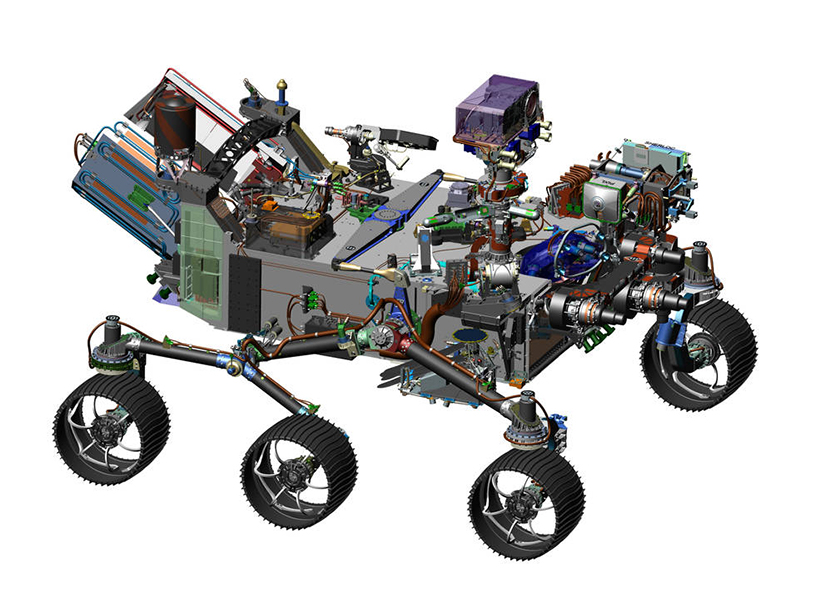
Future Mars Rovers: The Next Places to Direct Our Curiosity

by B. J. Thomson and F. El-Baz 2 September 201424 April 2024

Where will the next Mars rovers will land? Think of the selection process as the science fair to end all science fairs, where participating scientists get first looks at the newest Mars data.

Posts pagination

Newer posts 1 … 15 16 17
A view of a bridge, with the New Orleans skyline visible in the distance between the bridge and the water. A purple tint, a teal curved line representing a river, and the text “#AGU25 coverage from Eos” overlie the photo.

Features from AGU Publications

Research Spotlights

Denitrification Looks Different in Rivers Versus Streams

16 January 202616 January 2026
Editors' Highlights

ALMA’s New View of the Solar System

16 January 202616 January 2026
Editors' Vox

Bridging the Gap: Transforming Reliable Climate Data into Climate Policy

16 January 202616 January 2026
Eos logo at left; AGU logo at right

About Eos
ENGAGE
Awards
Contact

Advertise
Submit
Career Center
Sitemap

© 2026 American Geophysical Union. All rights reserved Powered by Newspack