• About
  • Sections
  • Topics
    • Climate
    • Earth Science
    • Oceans
    • Space & Planets
    • Health & Ecosystems
    • Culture & Policy
    • Education & Careers
    • Opinions
  • Projects
    • Postcards From the Field
    • ENGAGE
    • Editors’ Highlights
    • Editors’ Vox
    • Eos en Español
    • Eos 简体中文版
    • Print Archive: 2015–2025
  • Science Policy Tracker
  • Blogs
    • Research & Developments
    • The Landslide Blog
  • Newsletter
  • Submit to Eos
  • AGU.org
  • Career Center
  • Join AGU
  • Give to AGU
  • About
  • Sections
  • Topics
    • Climate
    • Earth Science
    • Oceans
    • Space & Planets
    • Health & Ecosystems
    • Culture & Policy
    • Education & Careers
    • Opinions
  • Projects
    • Postcards From the Field
    • ENGAGE
    • Editors’ Highlights
    • Editors’ Vox
    • Eos en Español
    • Eos 简体中文版
    • Print Archive: 2015–2025
  • Science Policy Tracker
  • Blogs
    • Research & Developments
    • The Landslide Blog
  • Newsletter
  • Submit to Eos
Skip to content
  • AGU.org
  • Career Center
  • Join AGU
  • Give to AGU
Eos

Eos

Science News by AGU

Support Eos
Sign Up for Newsletter
  • About
  • Sections
  • Topics
    • Climate
    • Earth Science
    • Oceans
    • Space & Planets
    • Health & Ecosystems
    • Culture & Policy
    • Education & Careers
    • Opinions
  • Projects
    • Postcards From the Field
    • ENGAGE
    • Editors’ Highlights
    • Editors’ Vox
    • Eos en Español
    • Eos 简体中文版
    • Print Archive: 2015–2025
  • Science Policy Tracker
  • Blogs
    • Research & Developments
    • The Landslide Blog
  • Newsletter
  • Submit to Eos

the Sun

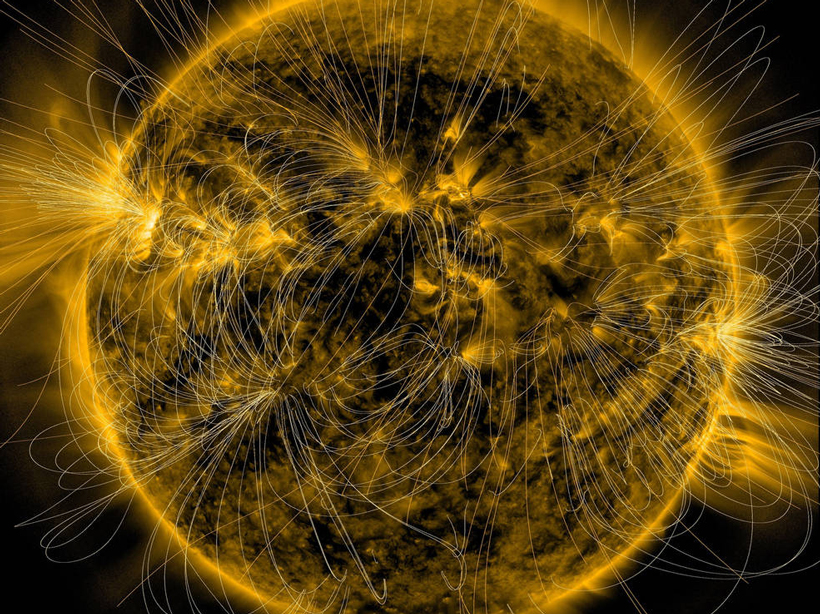
The Sun’s magnetic field lines, shown here using a model, can further twist and loop after they encounter near-Earth space.
Posted inResearch Spotlights

Explaining Unexpected Twists in the Sun's Magnetic Field

by Mark Zastrow 4 April 201718 July 2023

New research shows how the Sun's magnetic field can shift when it approaches Earth, which can throw off space weather forecasts.

Researchers identify the role of plasma waves where the magnetic fields of Earth and the Sun interact.
Posted inResearch Spotlights

Plasma Waves Pinpointed at the Site of Magnetic Reconnection

by Mark Zastrow 17 February 201718 July 2023

When the Earth's and the Sun's magnetic fields meet, they realign in explosive and mysterious reconnections. Data suggest that plasma waves called kinetic Alfvén waves play a key role.
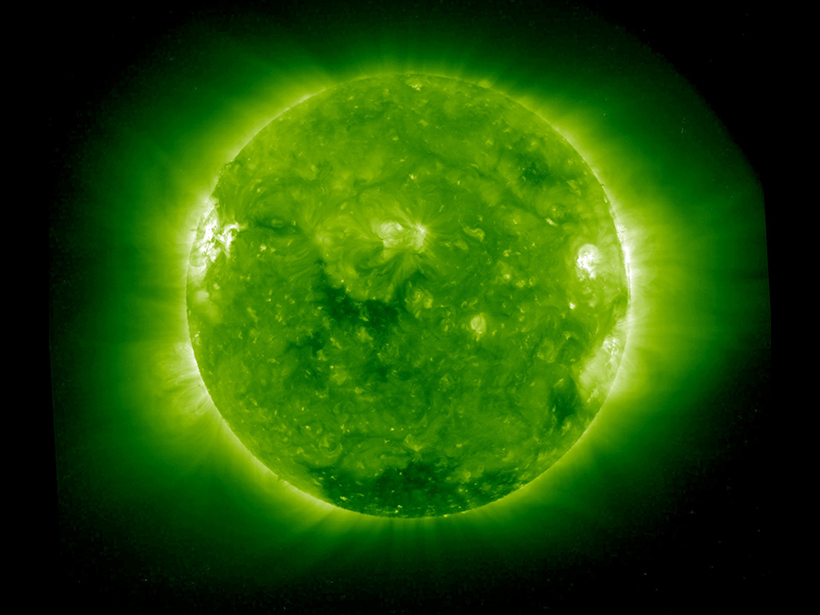
Up-close view of the Sun.
Posted inNews

Scientists Get First Glimpse of Solar Wind as It Forms

JoAnna Wendel, freelance science writer and illustrator by JoAnna Wendel 9 September 201613 October 2022

Using computer-processed images from Sun-watching satellites, scientists observed solar wind emerging from the Sun's corona.
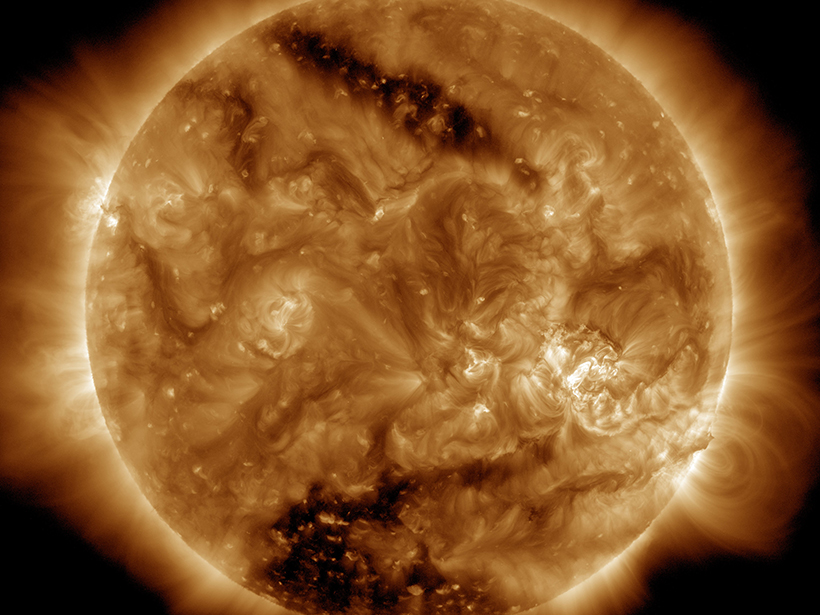
magnetic-reconnection-fuels-slow-solar-winds
Posted inResearch Spotlights

Spotting the Source of Slow Solar Wind

Kate Wheeling, freelance science writer by Kate Wheeling 24 August 201618 July 2023

A new study suggests that magnetic reconnection may fuel slow solar winds, which top out at speeds below 500 kilometers per second.

Posted inEditors' Vox

First Results from NASA’s Magnetospheric Multiscale Mission

by Andrew Yau 18 August 201618 July 2023

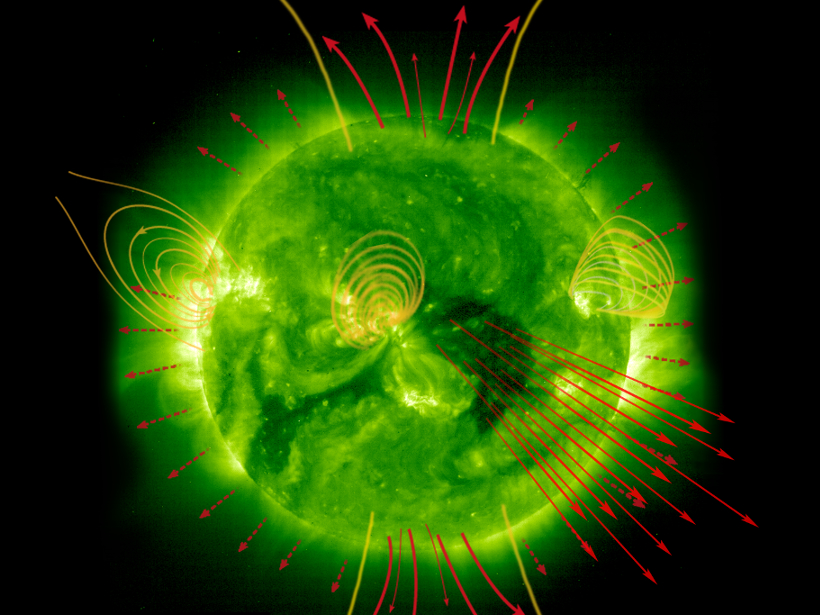
Understanding magnetic reconnection is important in the context of Sun-Earth Connection, because of the resulting exchange of mass and energy, and the large amount of energy involved.
Posted inEditors' Vox

Chasing Down the Slow Solar Wind

by L. E. Kepko 20 June 201618 July 2023

The Sun's plasma blasts Earth’s magnetosphere at more than a million miles per hour. The fastest pours from holes in the corona, but until recently the source of the "slow" solar wind was a mystery.

Posted inNews

James Wynne Dungey (1923–2015)

by D. Southwood 2 February 201610 November 2022

Dungey, whose research laid the foundation for how the Sun's magnetic field connects to Earth's magnetic field, died on 9 May 2015. He was 92.

Posted inResearch Spotlights

Satellites Test Theory of Magnetic Reconnection

by Mark Zastrow 2 February 201618 July 2023

A quartet of satellites flying through Earth's magnetic field measures its interaction with the Sun's and puts a theory about their reconnection to the test.

Posted inResearch Spotlights

Sun's Magnetic Field Impacts Earth's Thunderstorms

Sarah Stanley, Science Writer by Sarah Stanley 29 January 201620 December 2021

Lightning strikes are more frequent when Earth encounters a polarity switch in the solar magnetic field.

Posted inNews

Physics Nobel Winners Also Solved Solar Mystery

JoAnna Wendel, freelance science writer and illustrator by JoAnna Wendel 7 October 201523 January 2023

Although they won the prize for showing neutrinos have mass, the two Nobel-winning physicists also solved a long-standing mystery of solar neutrinos.

Posts pagination

Newer posts 1 … 6 7 8 9 Older posts
A view of a bridge, with the New Orleans skyline visible in the distance between the bridge and the water. A purple tint, a teal curved line representing a river, and the text “#AGU25 coverage from Eos” overlie the photo.

Features from AGU Publications

Research Spotlights

Denitrification Looks Different in Rivers Versus Streams

16 January 202616 January 2026
Editors' Highlights

ALMA’s New View of the Solar System

16 January 202616 January 2026
Editors' Vox

Bridging the Gap: Transforming Reliable Climate Data into Climate Policy

16 January 202616 January 2026
Eos logo at left; AGU logo at right

About Eos
ENGAGE
Awards
Contact

Advertise
Submit
Career Center
Sitemap

© 2026 American Geophysical Union. All rights reserved Powered by Newspack