• About
  • Special Reports
  • Topics
    • Climate
    • Earth Science
    • Oceans
    • Space & Planets
    • Health & Ecosystems
    • Culture & Policy
    • Education & Careers
    • Opinions
  • Projects
    • Postcards From the Field
    • ENGAGE
    • Editors’ Highlights
    • Editors’ Vox
    • Eos en Español
    • Eos 简体中文版
    • Print Archive: 2015–2025
  • Policy Tracker
  • Blogs
    • Research & Developments
    • The Landslide Blog
  • Newsletter
  • Submit to Eos
  • AGU.org
  • Career Center
  • Join AGU
  • Give to AGU
  • About
  • Special Reports
  • Topics
    • Climate
    • Earth Science
    • Oceans
    • Space & Planets
    • Health & Ecosystems
    • Culture & Policy
    • Education & Careers
    • Opinions
  • Projects
    • Postcards From the Field
    • ENGAGE
    • Editors’ Highlights
    • Editors’ Vox
    • Eos en Español
    • Eos 简体中文版
    • Print Archive: 2015–2025
  • Policy Tracker
  • Blogs
    • Research & Developments
    • The Landslide Blog
  • Newsletter
  • Submit to Eos
Skip to content
  • AGU.org
  • Career Center
  • Join AGU
  • Give to AGU
Eos

Eos

Science News by AGU

Support Eos
Sign Up for Newsletter
  • About
  • Special Reports
  • Topics
    • Climate
    • Earth Science
    • Oceans
    • Space & Planets
    • Health & Ecosystems
    • Culture & Policy
    • Education & Careers
    • Opinions
  • Projects
    • Postcards From the Field
    • ENGAGE
    • Editors’ Highlights
    • Editors’ Vox
    • Eos en Español
    • Eos 简体中文版
    • Print Archive: 2015–2025
  • Policy Tracker
  • Blogs
    • Research & Developments
    • The Landslide Blog
  • Newsletter
  • Submit to Eos

the Sun

Posted inResearch Spotlights

New Ionosphere Model Incorporates Solar Angles

by Mark Zastrow 4 June 201516 November 2021

The decades-old theory of the layers of the Earth's ionosphere, which dates to 1931, has just received an update that takes into account the angle of the Sun.

Posted inResearch Spotlights

What Causes Sunspot Pairs?

JoAnna Wendel, freelance science writer and illustrator by JoAnna Wendel 5 May 201518 January 2023

Analysis of magnetic fields on the Sun's surface offers a new clue on why sunspots appear.
Posted inResearch Spotlights

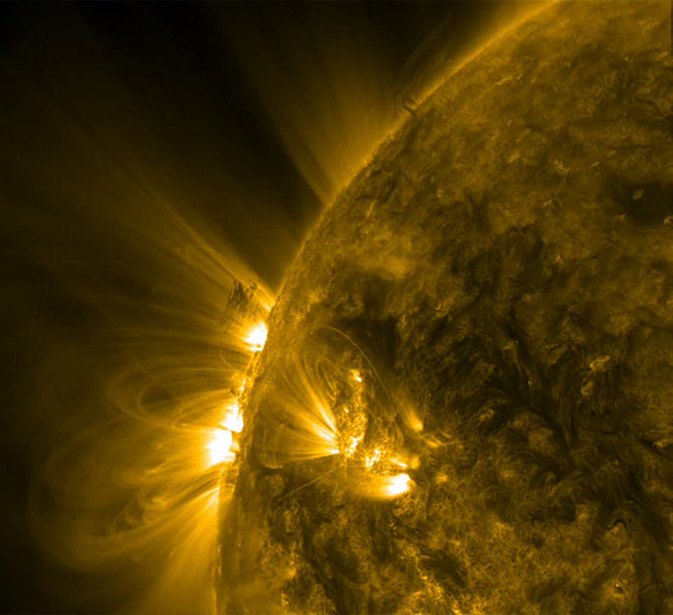
Can Scientists Boost Solar Modeling Despite a Lack of Data?

by C. Schultz 5 February 201515 March 2022

Researchers show that a data processing technique could salvage useful information from raw solar observations, opening the door to improved understanding of the solar dynamo.

Posted inScience Updates

The Impact of Coronagraphs

by O. C. St. Cyr, B. Fleck, J. M. Davila and Faith Ishii 14 October 201427 January 2022

Observations of the Sun’s extended atmosphere with coronagraphs have become indispensable to both basic and applied research.
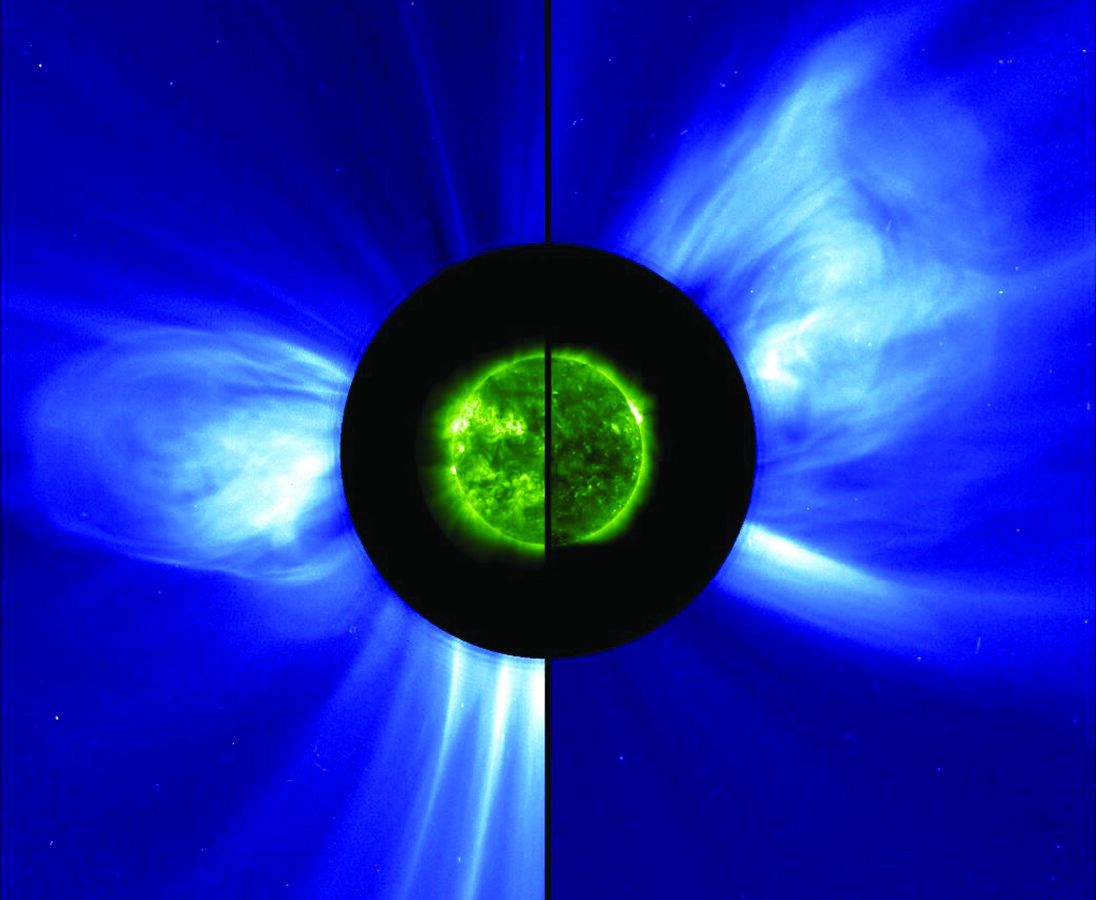
Posted inResearch Spotlights

Low Heliosphere Pressure Drives Wide CMEs in Weak Solar Cycles

JoAnna Wendel, freelance science writer and illustrator by JoAnna Wendel 29 July 201410 September 2025

Why are coronal mass ejections from the current solar cycle wider than others? Researchers investigate.

Posts pagination

Newer posts 1 … 7 8 9
Over a dark blue-green square appear the words Special Report: The State of the Science 1 Year On.

Features from AGU Publications

Research Spotlights

Drought Drove the Amazon’s 2023 Switch to a Carbon Source

25 February 202625 February 2026
Editors' Highlights

Satellite View of the California Wildfires of January 2025

27 February 202626 February 2026
Editors' Vox

A Double-Edged Sword: The Global Oxychlorine Cycle on Mars

10 February 202610 February 2026
Eos logo at left; AGU logo at right

About Eos
ENGAGE
Awards
Contact

Advertise
Submit
Career Center
Sitemap

© 2026 American Geophysical Union. All rights reserved Powered by Newspack